Viti Levu – land trip

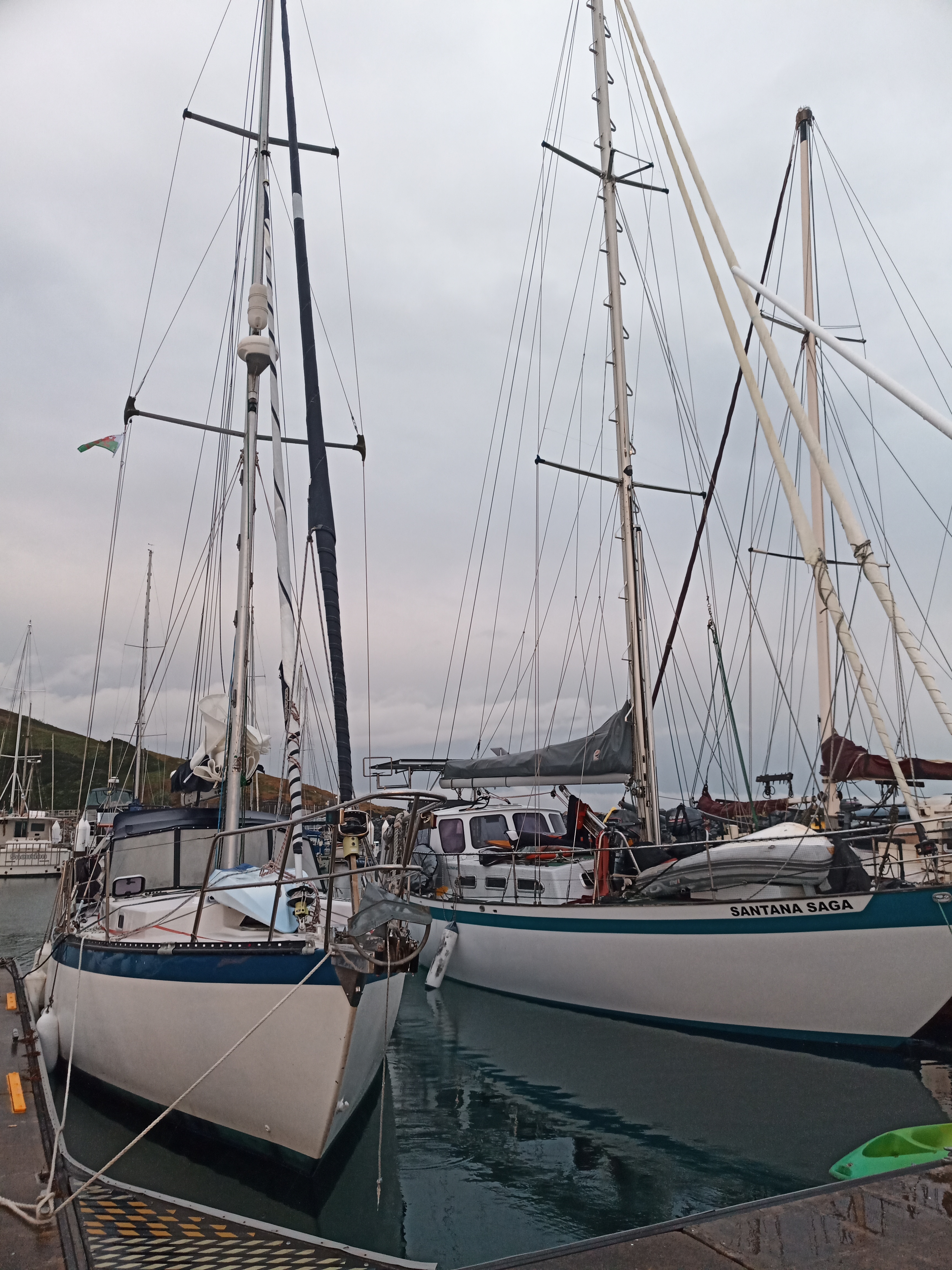
We’ve arrived! We picked up a mooring outside Vuda marina, where a couple of officials came out to check our boat papers before we were allowed in to the quarantine dock in the marina itself. There we were met by two ladies who handled immigration, customs and biosecurity. They took our remaining fresh fruit, our defrosted meat (the freezer couldn’t handle the heat of being next to the hot engine for 4 days), our honey, and stamped our passports. We’re in!

The marina staff gave us frangipani flower garlands and sung a wonderful welcome song. Time for a celebratory beer!

We rented a car for a few days so we could explore the main island of Viti Levu before heading out sailing again.

Day 1
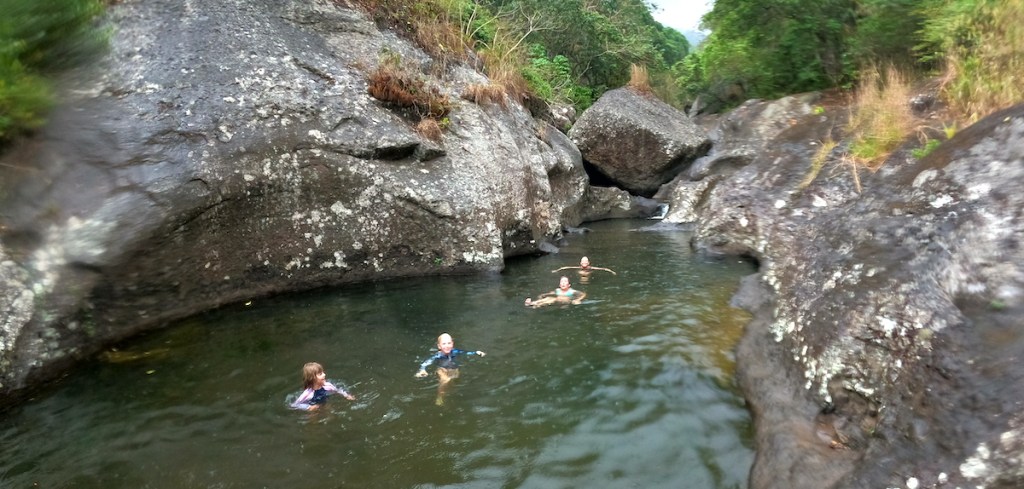
Headed up into the hills with Adelle and Sierra to find some waterfalls. An exciting off road trip in a not-offroad car, into the clouds. Hundreds of flame trees around with bright orange flowers. Smell of burning and smoke; lots of fires burning around the countryside, keeping the brush down; this is what we could smell as we approached from offshore.
Day 2 – Sunday 12th Sept
First stop, Garden of the Sleeping Giant … an orchid nursery and tropical gardens where we wandered around for an hour or so, soaking up the sounds, shapes and colours of the Fijian bush.

Next up, the main town of Nadi (pronounced Nandi) where we stopped in at the impressive Hindu temple. The colours, impressive paintings, shrines of Ganesh, Shiva and general uniqueness seemed to make a strong impression on Tilly. We spent some time over the next few days looking up more about hinduism – great learning! Lunch at Nadi was a yummy curry. Lots of Indian influence here, but being a Sunday most of the shops were shut.

We continued around the south – the Coral Coast – to Sigatoka, staying at a small budget resort for the night. It happened to be “entertainment night”, with dancers and fire poi. An interesting change from boat travel, seeing how “normal” tourists see Fiji. We all joined in and got up on stage for some dancing. There was a pool at the resort which Tilly loved, and she made friends with another girl who was visiting from Australia. We also met a local family enjoying a weekend away from home; he worked on a dive boat and she was a masseuse for a resort.

Day 3
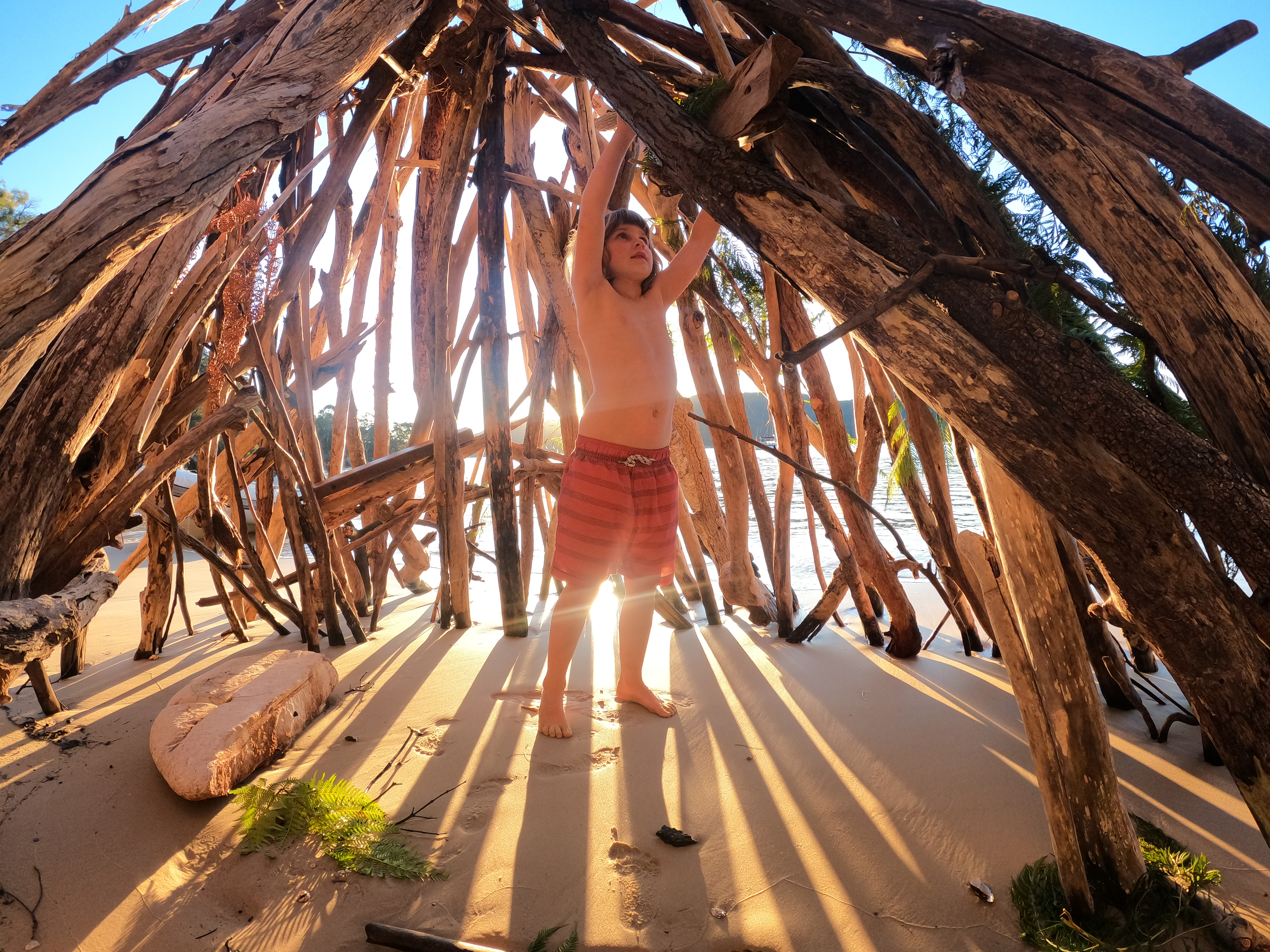
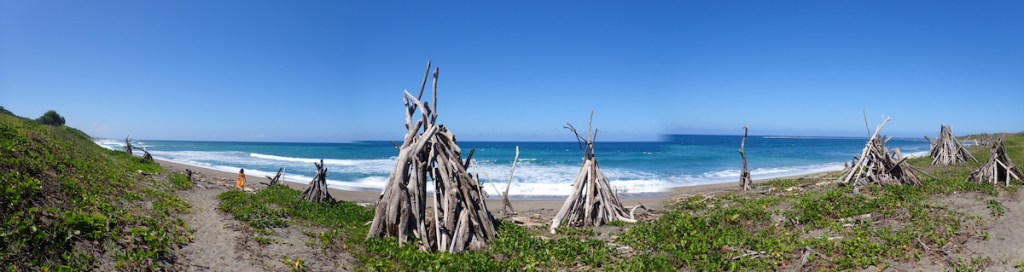
Onwards east along the coast to the Sigatoka Sand Dunes – even though it was first thing in the morning, it was too hot for us to take Tilly on the full dune walk (she was pretty tired from the previous day playing and swimming) but we managed a small loop through the woods and along the beach, where over the years people had built lots of driftwood tipis.
Then onwards to Suva, a few hours drive through countryside that got more and more lush as we headed east and south to the windward side of the island. Tilly had a good sleep in the car.

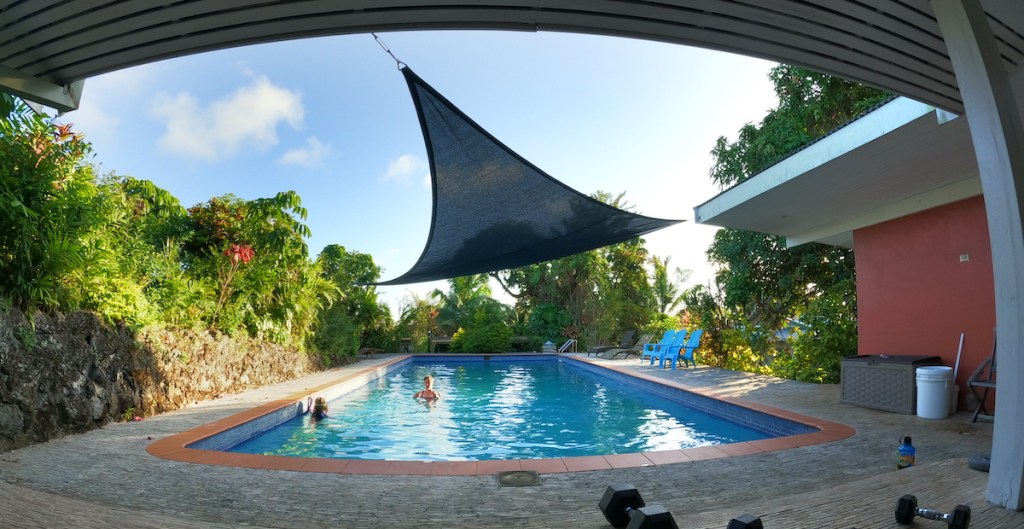
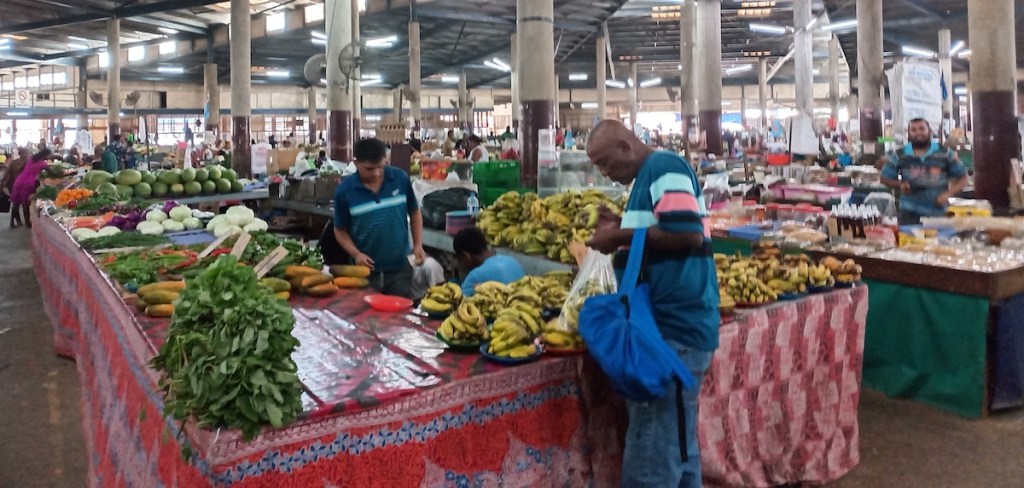
Suva (the capital of Fiji) is a decent sized town, with lots of traffic and noise. We had a good wander about. Picked up some fabric for a bag we wanted to get made [for Tilly’s birthday lego], which we dropped off at a tailor lady in the back of the huge fruit and veg market. Then headed back to the old colonial hotel on the hill where we were staying, for a swim in the “oldest pool in Fiji” – supposedly 100 years old.
Day 4
Back to Vuda! A long 4/5 hour drive back along the coast to the marina, stopping to pick up provisions for our next few weeks sailing around the islands, and a coffee at a handicrafts centre. We happened to bump into the Fijian family we’d met at the resort, and their little boy wanted to give Tilly a turtle necklace as a “welcome to Fiji” gift.

They say that the people of Fiji are some of the most welcoming anywhere in the world, and it’s probably true. There’s no pretence or ulterior motive; just huge smiles and a happy “Bula!” wherever you go. Even in the main towns, it doesn’t seem busy or overpopulated, and almost no sign of true poverty.

It was an interesting few days; exploring nature, towns and getting a feel for the “inland” parts of the island. Roadside villages by mangroves, with houses on stilts. Sugar cane plantations. The biggest produce market I’ve ever seen. Hundreds of kids in Suva at school closing time, climbing onto open-sided buses for their ride back home.

Day 5
We were back on Songline in Vuda marina for the night…. then a quick trip to Lautoka town where there’s another market, this time to stock up on fresh stuff before we head off sailing again. Rose also needed a filling replacing, which she managed at a local dentist for a fraction of the price we’d get in the UK!
To Fiji

Songline rises and falls gently on the huge, confident yet gentle swells as we approach the lights of Fiji at 3am after 5 days at sea. There’s almost no wind and we are motoring, with the sails up to steady the motion and to catch the small gusts that blow over the back of these marching giants of water. Generated thousands of miles away in the south by some sub-Antarctic storm, probably, they have carried that immense energy all the way to the tropics to explode onto the reef, each side of the pass we are now approaching.

It’s been a challenging passage. The first two days we were pounding into a strong headwind, and then Rose and I came down with a nasty tummy bug. At the best of times unpleasant, but with nowhere stable to lie down – everything always moving!- our insides just didn’t stop. And no time to rest. One night I spent curled in a ball on the cockpit floor, no energy to pull ropes and just enough to poke my head up from time to time to watch for ships.

The the wind dropped- that was on Tuesday I think… So we’ve been motoring for days now.

## continued ##

We’ve recovered from the bug and energies are improving.

The strong, tropical smell of land comes over the warm breeze (which still isn’t enough to sail). Smoke from bonfires, soil and vegetation. Being at sea for days tunes the senses. Ears are always listening for creaks, pings, plops, bangs or squeaks that give early warning of trouble ahead. The air is ultra clear, there are no smells (other than dirty bodies and engine fumes) – so when land comes you can really smell it from miles away.

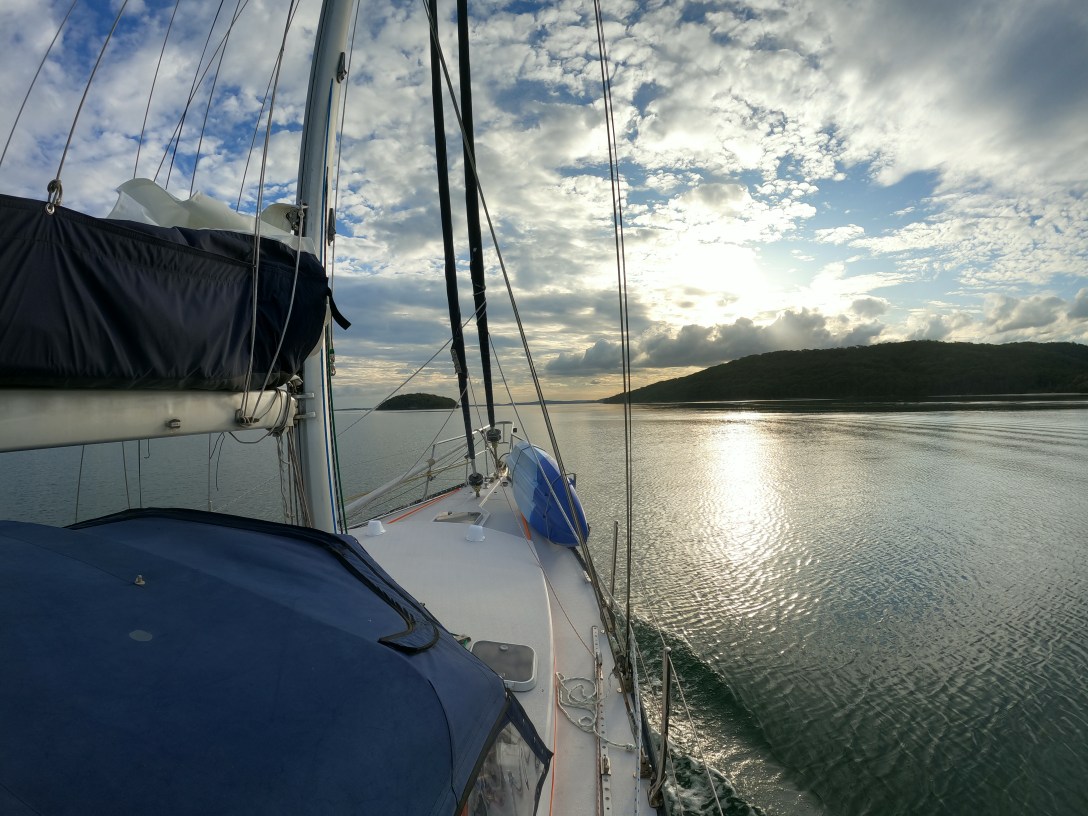
A little while later, we motor through the reef pass (still in the dark) and then, finally, just as the sun is rising over the land, the breeze fills in enough to turn the engine off. Yay! I wake Rose up with a cup of tea so she can enjoy the arrival as we silently slip along in the flat waters of the lagoon, heading for the check-in marina at Vuda point.

We arrive a short while behind Santana (as usual) and tie to them while we wait for officials to arrive. Check in (part 1) complete, we motor into the customs dock for the final stages; immigration and biosecurity, where they take away some fresh foods and our honey… Boo.

And then, fully checked in to Fiji, we are welcomed in the traditional way with a garland of frangipani flowers and a happy clappy song!

Next few days we’ll in the marina washing, catching up with emails, news, work etc.

Tanna

With a name the same as ours (almost) and an active volcano, Tanna was not going to be missed, especially as it’s pretty much en route to Fiji.

We’ve spent just over a week here, getting to know the locals and exploring the area. Port resolution is the only tenable and calm anchorage – where captain Cook based himself when he visited all those years ago. Around the bay, hidden in the thick tropical scrub, are a few thatched huts; homesteads for the very traditional locals. There’s a small village just a short walk inland, really just a collection of huts with a few concrete buildings for important people, the school and the church, a football field and a couple of kava drinking (ceremony) circles under impressively intricate banyan trees.

The Vanuatu people speak English which makes it easy to wander around and meet people. There’s a “yacht club” on a hill overlooking the bay- nothing more than a run down hut on the chief’s plot, with flags left by many sailors over the years gone by.

First day (even before any of the officials had come to check us into the country) we tagged along with some others in the pickup ride to the volcano. This was a very lumpy, bumpy hour journey on the worst “track” I’ve seen, slow and fascinating going through the local vegetation, past villages, pigs and smiling people. Tilly (and many others) rose in the back.

The pickup dropped us at a car park just short of the summit- very late in the day when it was already dark. A short 10 minute walk up and we were at the rim, looking over into a fiery orange pit belching dark ash smoke. Every now and then an explosion threw molten lava into the sky right before us – pretty awesome in the true sense of the word. The eruptions were not as big as they sometimes can be (when tourists have to dodge falling rock!) But sill amazing to experience up close.

We spent the following days getting to know locals, helping out (fixing a broken torch, making a new sign for a local ‘tour’), walking, swimming and relaxing. No snorkeling; water not clear in the bay.

Some names to jog our memories:

Stanley and Werry at the yacht club, Donovan and his beach crew doing the Iwea Discovery Tour, Miriam and David at the village an hours walk/scramble inland, Sam the chief and his wife Jocelyn … And many unnamed grinning kids!

As part of a thank you for us helping erect and paint a sign, locals laid on a beach feast. They caught a small pig on a forest walk the day before, it was killed and roasted, and shared with us alongside lots of local food (taro, a version of spinach, sweet potato, and other unidentified veg, some cooked in the boiling hot spring water on the beach)

I spent some time giving tow rides to local kids behind the dinghy, on the kayak. Rose spent some time drawing. Tilly hung out with the Santana kids and a couple of other Aussie boys who has just come in from New Caledonia.

On the last Saturday we had to get a pickup ride over to Lenakel on the other side of the island as the immigration official hadn’t been over to port resolution to stamp our passports: a couple of hours either way, passing over the ash plains on the far side of the volcano. Like driving on the moon.

A pretty special experience, and for Tilly to soak up such a different, friendly, basic culture was wonderful. She completely grasped the importance of understanding and respecting someone else’s culture, even when you can’t fully communicate in the same language (some of the more remote huts and villages had almost no English speakers).

Thank you Tanna!

To Vanuatu

We left Ouvea at dusk, after walking back from the airport. The passage to Vanuatu was about 200 miles; two nights at sea. The south east trades make it harder to sail east as we’re going into the wind, so we timed out departure for a period of lighter wind; while not ideal, motoring in light winds with the sails up for an extra boost is one of the better ways to cover miles in the right direction.

This passage was a bit noisy as a result, with 28 hours of motoring over two days. Even when the wind picked up on day 2, it was dead on the nose and we needed engine power to make good ground.

As we rounded the southern tip of Tanna island for the final miles before the anchorage of Port Resolution, the volcano came into view. Throwing big black ash clouds into the sky it was pretty dramatic.

We dropped anchor among 8 other boats (including Santana who had arrived a couple of hours ahead of us). Around the anchorage hot steam vents from the cliffs, boiling water streaming into the sea. On the hillside a big plume of steam is rising between the coconut trees. Black sand on the beach. Dense, lush vegetation.

Adventure awaits!

Ouvéa

The only true atoll in New Caledonia, Ouvéa is a huge 25km-across lagoon with the land on the eastern side and shallow (12m) flat water on the west. With the wind blowing over the land, it’s a sheltered spot to spend a few days, and a good place to leave the boats and families when we go back to Nouméa to check out.

First couple of nights we spent anchored off the Hotel de Paradis, swum, walked and relaxed in good weather. The Loyalty Islands are much more Kanak — local — than the main island. Even so far as being firmly anti-French, so we took our french courtesy flags down and made it clear we were English / Australian. Beautiful turquoise water meant lots of sand… But no coral or fish for snorkelling, so for the third night we headed south a few miles to an anchorage closer to the cliffs and coral; off the village/”tribu”/tribe of Mouly.

Local custom here (“Coutume”) dictates that you ask permission from the local chief before you swim in his water, walk and explore. We found the chief, presented ourselves and a gift of rice and cloth, and made it clear we were not going to be fishing (taking their precious resources). Unfortunately this chief was reluctant to let us go up the beach towards the cliffs – from what I could ascertain from his French anyway. We hung out on the beach for the afternoon. Being a Sunday all the local kids were out playing and our gang had good fun with them in the sea and sand.

Next morning I phoned the airline to confirm the flights… They are on! So we sailed up north a few miles to be anchored close enough to walk to the airport in the morning. Jumped in the dinghy to go ashore and find the chief… Who this time was a jovial bundle of welcoming smiles in a scruffy falling-apart tee shirt who had no problems with us doing what we wanted.

The islands are remote, a combination of traditional and modern. People live on separate well-tended plots, usually with a traditional thatched hut and a more modern timber/tin shack next door. Nice to see the huts still in use, in the same way as they will have been for hundreds of years. A few French around, in administrative and police roles, but mainly Kanak.

Wandering along the beach we bumped into an old fisherman cleaning his net. With limited French (and a limited number of teeth) but smiling and welcoming, he nipped off into the trees to bring us back some coconuts to drink.

Now, writing from Nouméa, we’ve managed to check out! Customs, immigration and port captain have given us the OK to leave the country. Passports are stamped, boat papers signed, and James and I are waiting for our flight back to Ouvéa to reunite with the mums and kids (who spent last night at anchor) before setting sail for Tanna (Vanuatu) tonight. It’s a couple of hundred miles, should take two days, bringing us in on Friday at some point.

Vanuatu is going to be remote and very different from New Caledonia… looking forward to it! After that, Fiji, which is a further 4/5 days on from Tanna. As it’s a slightly longer passage, into the south east trade winds, we are going to wait in Port Resolution on Tanna for a good weather window. Might take a couple of weeks, and we won’t have internet in Vanuatu so next update will be from Fiji, perhaps mid September.

I’ll post mini blogs on the iridium tracker page for the next few weeks.

Lifou

There are 3 islands to the north east of New Caledonia ‘s large “grand terre” which are less developed, more remote and sounded interesting: called Ouvéa, Lifou and Maré. Checking the weather forecast at Ile de pins, we could see some nasty wet windy weather coming up, and wanted somewhere to hunker down while it blew over. Lifou has a marina, and while we’re not out here to hop from marina to marina we figured we could tie it in with checking out of New Caledonia; captains fly back to Nouméa to do customs and paperwork while the families and boats stay in Lifou.

A brisk 6-knot overnight sail brought us to the port of Wé in the middle of the eastern coast of the island, where we threaded the boat through a narrow entrance between coral heads and into the marina. It’s a tiny little place, just a few boats, and only just enough space for the two of us. Crystal clear water, one other tourist boat, and a few french live-aboard locals.

Snorkeling just outside the marina was amazing for coral, but not many fish. Tilly getting confident in the water and loving looking at everything!

Hitch hiked to the airport to get a flight back to main island to do checkout paperwork… Flight cancelled due to strikes, but managed to rent a car which meant we could explore the island. Squeezed all seven of us into a tiny hatchback (kids in the boot and on laps!) and found caves, cliffs and jungle walks.

No flights, ferries all full. As well as the airline strike, it’s wedding season on the island. 38 weddings this week! So, getting back to Nouméa is looking pretty much impossible for the next week. We’re going to sail up to Ouvea to have a look at a new island (and where there is also an airport). The sailing angle from Ouvea to Tanna in Vanuatu is not as good (more into the prevailing South Easterly wind) so it’s not an ideal spot to leave from but at the end of the day it’s not a significant difference.

Filled the boat tanks with water, bought a few fresh veg from the local supermarket and headed off at dusk on the 17th for Ouvea, an overnight passage of about 70 miles.

We sail overnight so that the 12/14 hour trip ends at dawn rather that dusk… If we are delayed then we still arrive in daylight, so that we can see the reefs and rocks and coral around the island and anchorage. For a single night passage, it’s not too demanding on sleep, with Rose taking the watch for a few hours either at the beginning of the night or (in this case) a few hours at midnight for me to then take over again for landfall. Tilly woke at 3am ish poking her head up into the cockpit… “Time for my watch” she proclaims! We have a good look around, check the chart, watch some phosphorescence in the waves, talk about the sails and the weather, and eat our “night watch snacks” (the highlight of the watch for her!) After a few minutes she decides she’s tired and heads below again to sleep the rest of the night.

Dawn brings us to the pass into the atoll of Ouvea, dolphin welcoming us to the island, diving and surfing around the bow.

Ile de Pins

Left Nouméa Monday and arrived at ilot Mba after a brisk 40mile day sail. Just enough time to go ashore and explore before dusk. Tons of sea snakes coming out of the sea to spend the night in the rocks and bushes ashore. First sighting of reef sharks, tiny ones in the shallows. Windy, so not great for snorkelling.

One night last week Santana had a sea snake slither aboard through a sink drain into the heads (bathroom!). Not dangerous though. Venomous, but mouth not big enough to bite a human and quite placid.

Decided to make the most of the rare westerly weather to continue down to Ile de Pins next day. Arrived Kuto bay in the afternoon, exactly where I had anchored 7 years ago on Rafiki!

Spent a few days on the island, walking up Pic Nge, the main hill, swimming, tow surfing behind the dinghy, playing on the beach. Then decided to continue out to the Loyalty Islands, another overnight passage.

Coffs Harbour

We woke to a calm morning after the night’s gale, and the weather forecast looked like there was an opportunity to sneak up the coast 120-odd miles to Coffs Harbour where we could check out of Australia (there are only a limited number of Ports of Entry [exit] into a country where the customs and border officials are). Sydney and Newcastle yet again had floods and torrential rain during the storm; we’d dodged a bullet by being a little bit further north (although rain isn’t usually a problem when you’re on a boat, it’s pretty well sealed against water).

I dropped the mooring in the pre-dawn and motored out towards the sea. Port Stephens doesn’t have a sandbar all the way across the entrance, like most of the east coast Australian rivers, but it does get shallow, and the large swell from the gales in the south was pushing up some considerable waves. We loitered around inside the bay, watching a couple of sets coming through, and decided it was OK to push out. Large waves, but very gentle lumps; no breaking water.

Once we were out at sea, the girls got up and joined me on deck, but the sea was very lumpy and not comfortable. Both felt a bit seasick. Whales joined us for part of the trip, some even coming as close as 20m from the boat, their huge bulk making us feel very small. Tilly was so excited!

The light winds meant we had to motor all day, which is not only noisy, but the lack of pressure on the sails makes the boat roll around in the worst way – not pleasant. A couple of times during the day the autopilot hydraulic pump stopped. A tap from a hammer got it going again, but it made me nervous. Single-handing is fine when you have a machine to steer the boat, but without an autopilot things get a lot harder. It was a sign of things to come…

We had a couple of hours of sailing with the engine off from 8-10pm, but then the wind dropped again. With only one night at sea and Rose not feeling up to watches, I kept going through the night. At 0430 the log reads “engine off. dark skies aft. pushing against some current”… then engine intermittently on and off for a few hours until at 0730 the wind backed, strengthened and we were off!

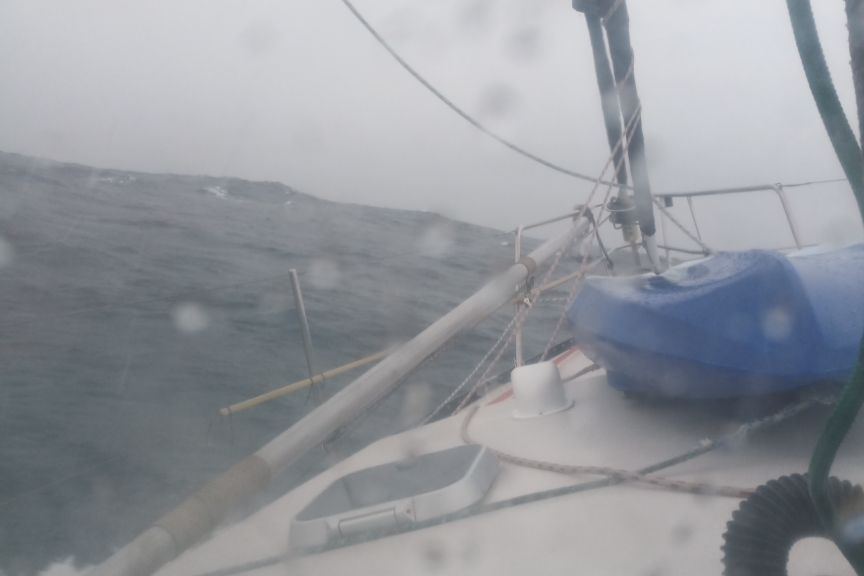
The next log entry at 2100 that night is “Coffs marina. Made it safely in” … the period between that and the last one was a day of nasty, wet, windy and very unpleasant sailing. The wind picked up to a full gale at times, the waves were all over the place due to us being quite close to shore and the wind blowing against the south-flowing East Australia current, but thankfully the autopilot held out.

Approaching a harbour on a lee shore (downwind) is never ideal; if things go wrong the risk is that you are pushed ashore. I’d pushed as hard as possible to get to Coffs before dark, but it wasn’t going to happen. Options were to stand offshore for the night (in a near gale) or try an entry into the harbour. I was tired, Rose was keen to get in, and I had word that the entrance is “all weather”, so we committed. With 30+ knots of wind behind us, and a nasty swell, turning around wasn’t really an option.

Thankfully the leading lights were bright through the torrential rain. Keeping them in line wasn’t easy; the waves were huge; I think I’m glad it was dark and I couldn’t see anything around us. The staysail (inner jib) hadn’t furled properly and was banging around horribly and loudly, I raced the engine hard to get steerage, and we surfed in on what felt like whitewater. Eesh.

There was no way we could get into the marina with the jib unfurled – the wind would prevent us from steering properly, so we anchored in the outer harbour (still in over a metre of swell and lashing rain) to sort that out. Once it was safely rolled away, we motored in to the dock, with James waiting to take our lines and feed us some hot soup – very much needed.

Somehow Tilly had managed to sleep through the whole lot in the forward cabin; flogging sail, anchoring and all. She’s earned her sea legs!

Port Stephens

There’s a large protected bay just north of Newcastle which looked worth exploring, and the short (6hr) hop up there took a bite out of the longer passage to Coffs Harbour later.

A straightforward passage with easy sailing (including some spinnaker time) brought us in to Shoal Bay mid afternoon, where we anchored off the beach. Tilly mastered casting with her new fishing rod and seems to be hooked; she loves it! No fish here though.

After a peaceful night at anchor we went ashore in the morning and climbed Tomaree Head; one of the hills guarding the entrance to the bay. Amazing views from the top; into Port Stephens and out to sea. Even found a little coffee cart for Rose to get her morning fix! Had lunch on a remote beach, played in the sand, then headed back to the boat to move on to the next spot, deeper in the bay.

Bad weather was on the way so I wanted to find somewhere more sheltered, and Fame Cove looked perfect. A small protected bay a couple of hours upstream. No wind, so we motored, coming in at dusk. Picked up one of 5 moorings, one other boat there, with a couple of kids aboard.

Tilly tried her hand at fishing again, this time trolling gently behind the dinghy, and we picked up three fish. Now she’s really hooked! Not big enough to eat though, so we put them back. “But I want to keep one as a pet!”

The next morning we headed over the way to Soldiers Point marina to see if we could find our way into town; yet another trip to the hardware store, and to try and find some fishing gear for the offshore passage to New Caledonia and for in the islands. Larger lures, stronger line etc.

We tied up to the visitors dock and walked for ages; no buses or easy rides round here. Found what we needed, headed back to the boat, spent the afternoon sorting things out, then treated ourselves to takeaway pizza from the marina restaurant. Mmm.

It was dark when we left the dock, heading back to Fame Cove, but dead calm and I had our previous GPS track to follow in, so it was straightforward to get in safely and we found the same mooring ball easily enough.

The forecast gale came in overnight and through the next day, keeping us aboard. I tried out various rainwater collection methods; once we leave Australia and access to marinas, we will need to be self sufficient for as long as possible and collecting rain is an important way to extend our range. In a short break in the weather tilly and I headed over to say hi to the other boat in the bay; a young family living aboard and gradually heading north to the Whitsunday islands.

We explored a little up the creek in the dinghy; in the drizzle. Saw a few birds but not a lot else; and couldn’t go ashore as the rocks were all covered in sharp mussels which would damage the dinghy (and our feet!).

Checked the forecast again, and decided that if the wind had abated by the morning, we’d catch the (narrow) weather window and head up to Coffs Harbour. At this point the Fosters (our buddy boat from Ballina) had been toying with the idea of sailing for Noumea from the Gold Coast, which would have added another 130 miles to our journey north … but they chose the same weather window to go south instead to Coffs for a rendezvous with us.

The Hawkesbury

Just north of Sydney is a huge river mouth; a great sailing location with secluded bays, beaches and anchorages. We wanted to spend some time here away from the city. to test ourselves and the boat off-grid, with the option to put in somewhere for repairs of spares if needed.

Being the middle of winter, it was pretty much empty. A lovely area, but Rose and Tilly had come down with a nasty flu, so we took it very slowly and spent a few days not doing very much while they recovered. Thankfully, the endless weeks of Sydney rain had eased up and the weather was good.

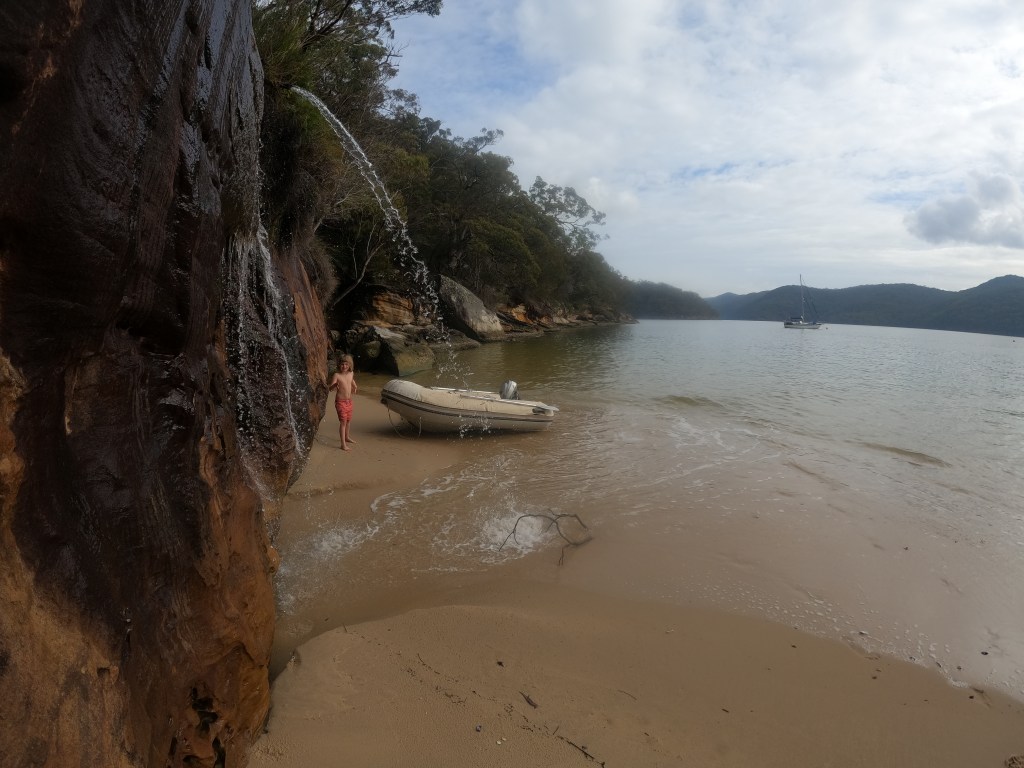
We spent time on a mooring at Cottage point, on moorings off Hallets beach and Cottage Rock, as well as another night in Refuge cove where we managed a walk up to the top of the waterfall.