After another day in Fakarava, we left through the north pass for a short overnight sail to Toau. On the northern coast of the atoll there’s a small inlet, a half-pass that doesn’t go all the way through into the lagoon, called Anse Amyot that I’d read good things about. It’s only 40 miles from Fakarava, but leaving through the pass on a good tide meant we had to sail overnight to arrive in the light. Lots of wind meant we just had the genoa up, and were still making well over 6 knots, so we arrived off Anse Amyot before midnight and had to stall for hours, sailing back and forth.
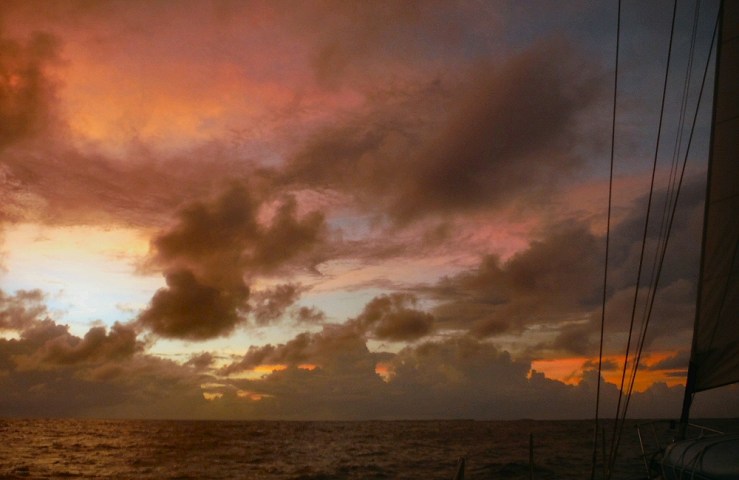
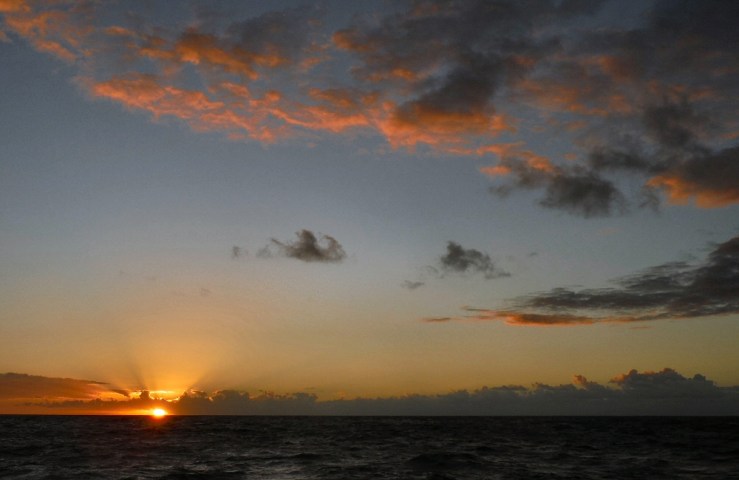
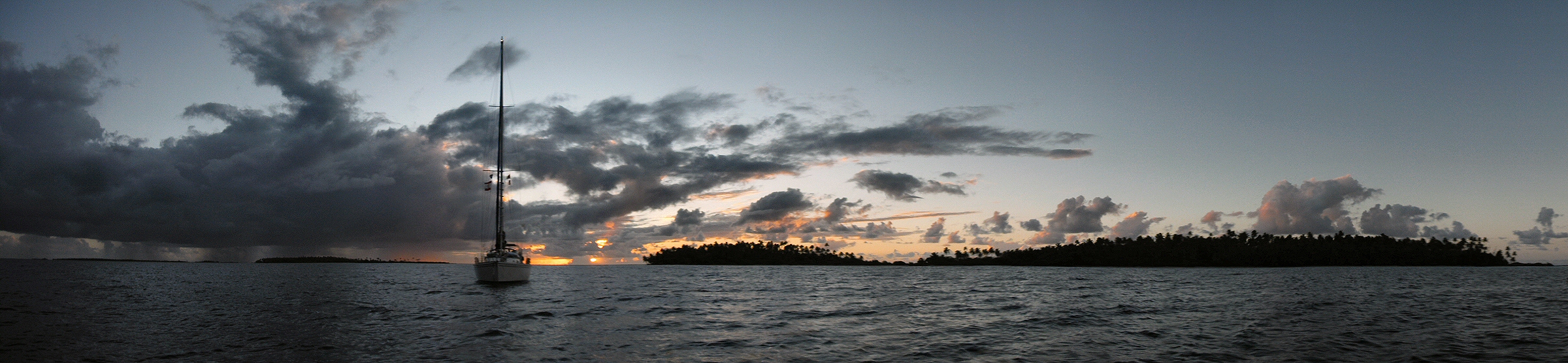
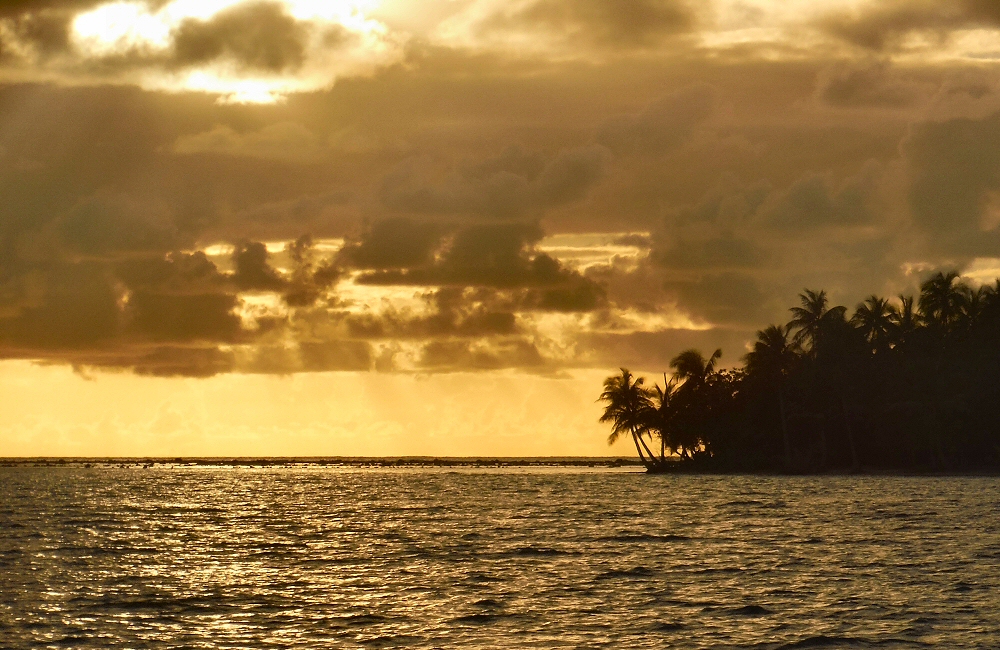
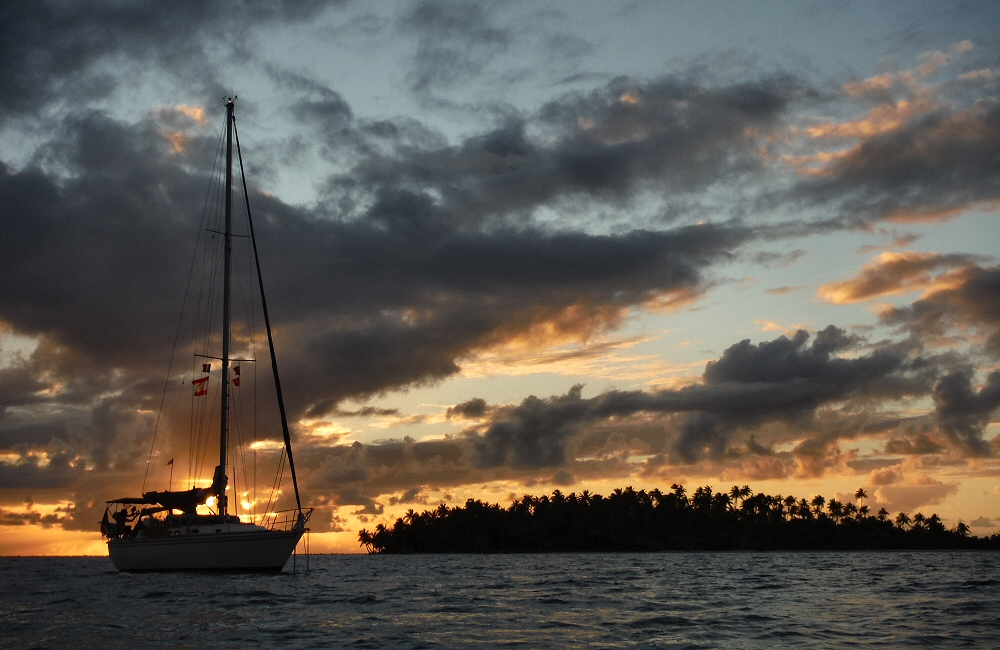
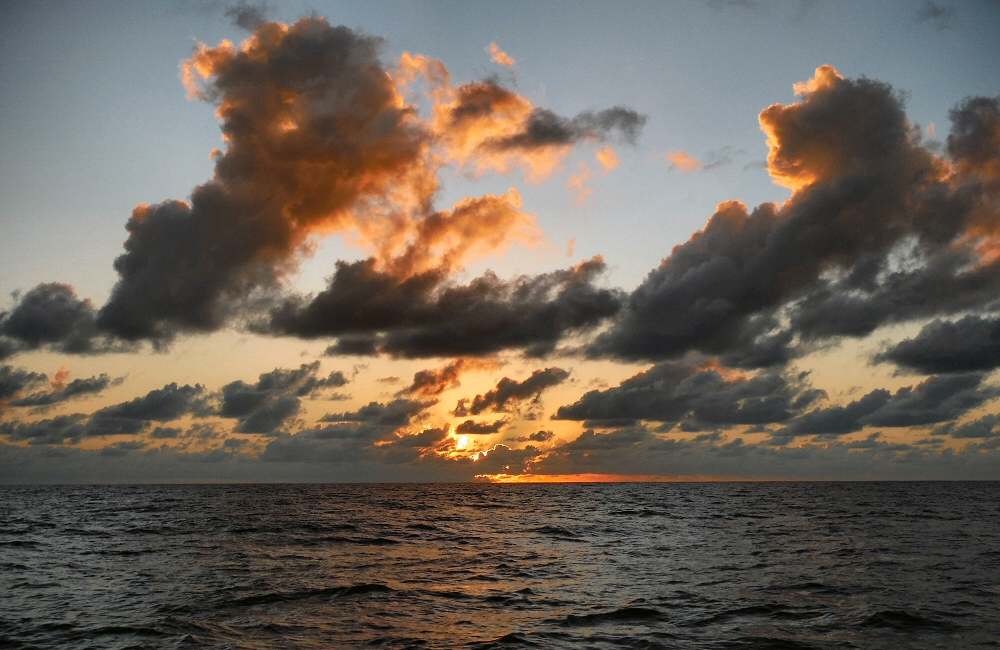
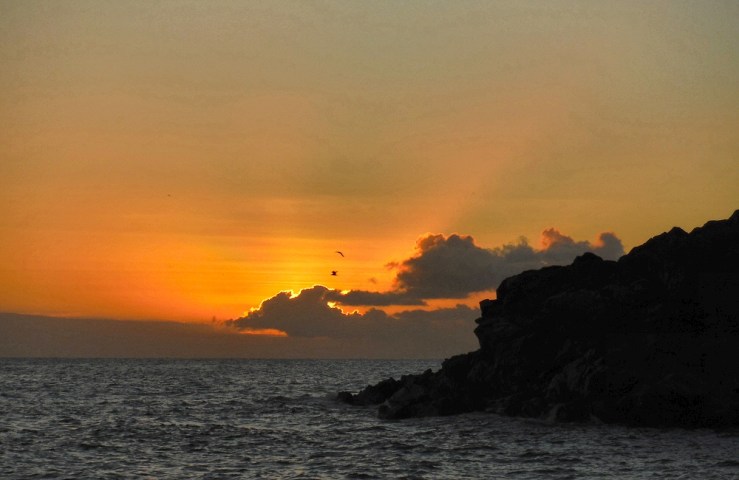
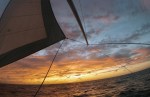
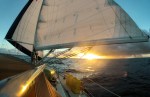
Dawn off Toau
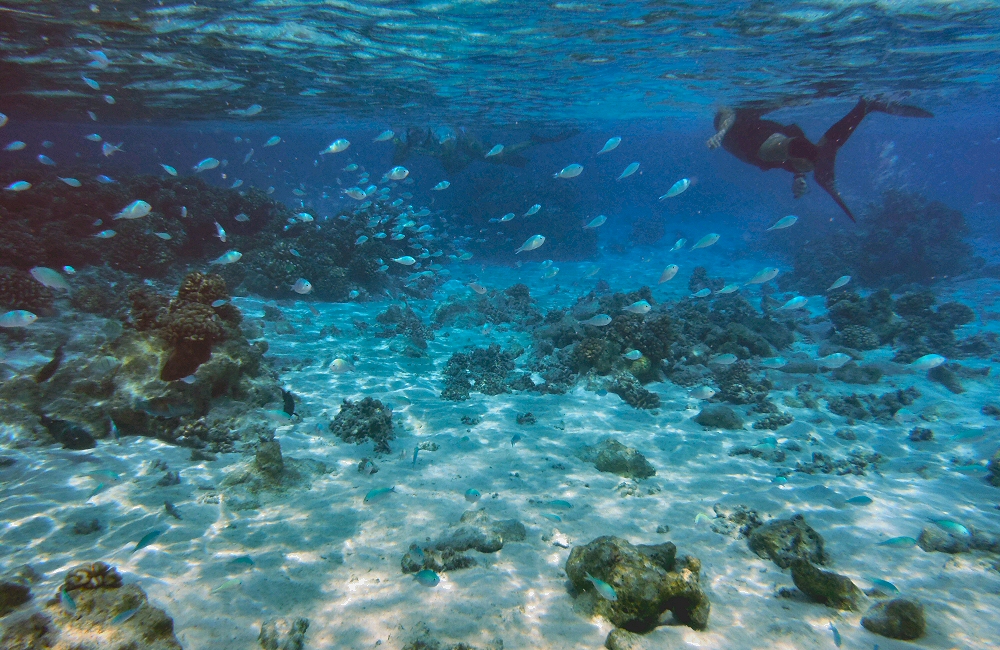
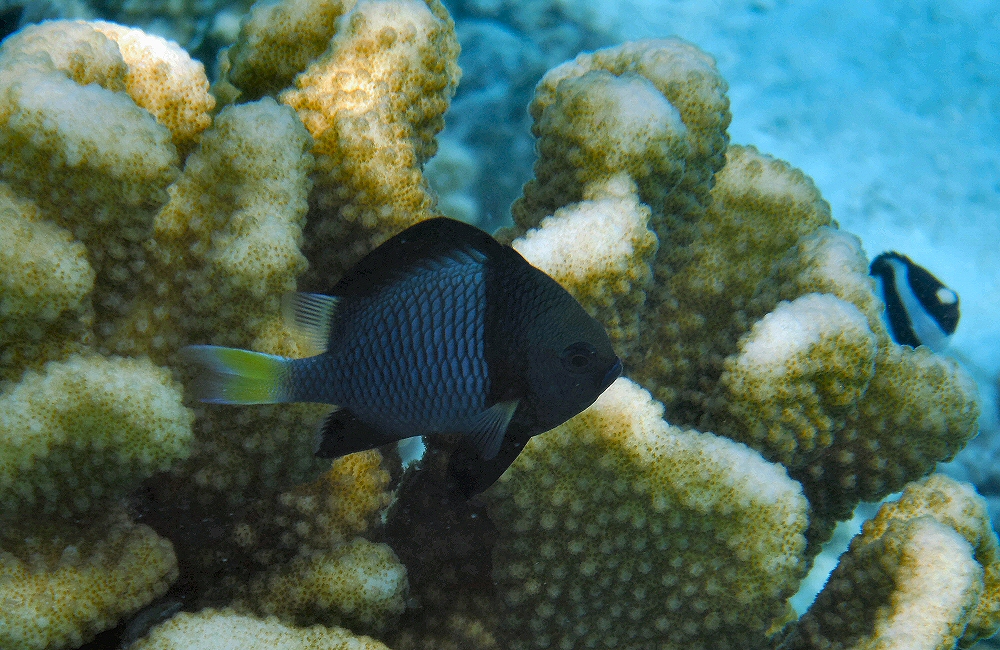
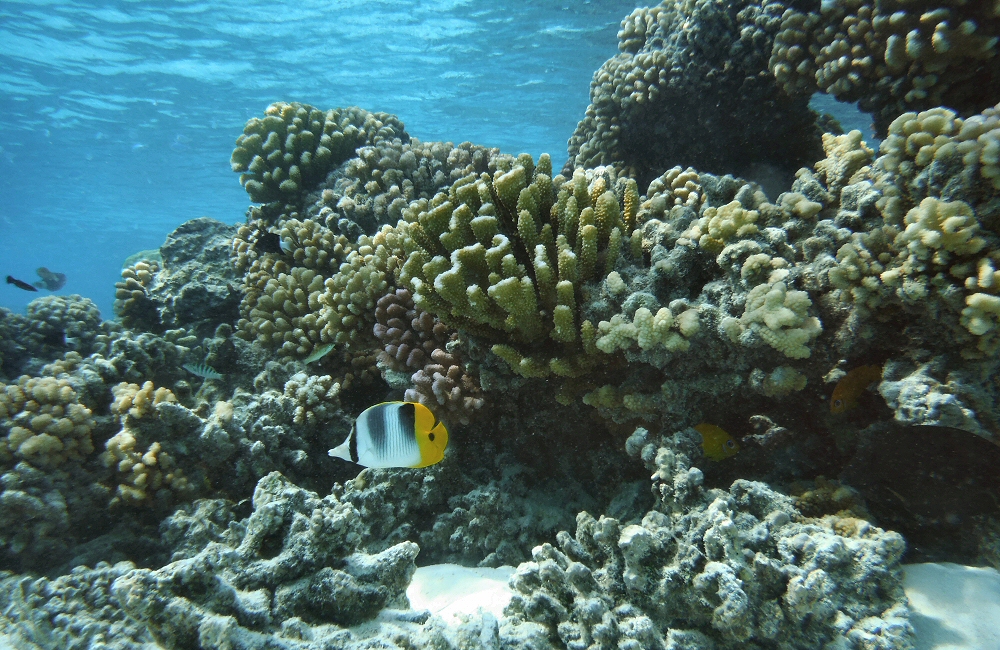
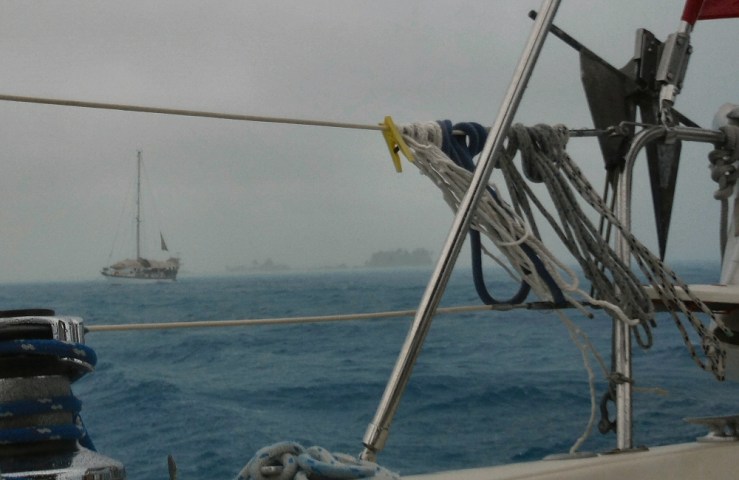
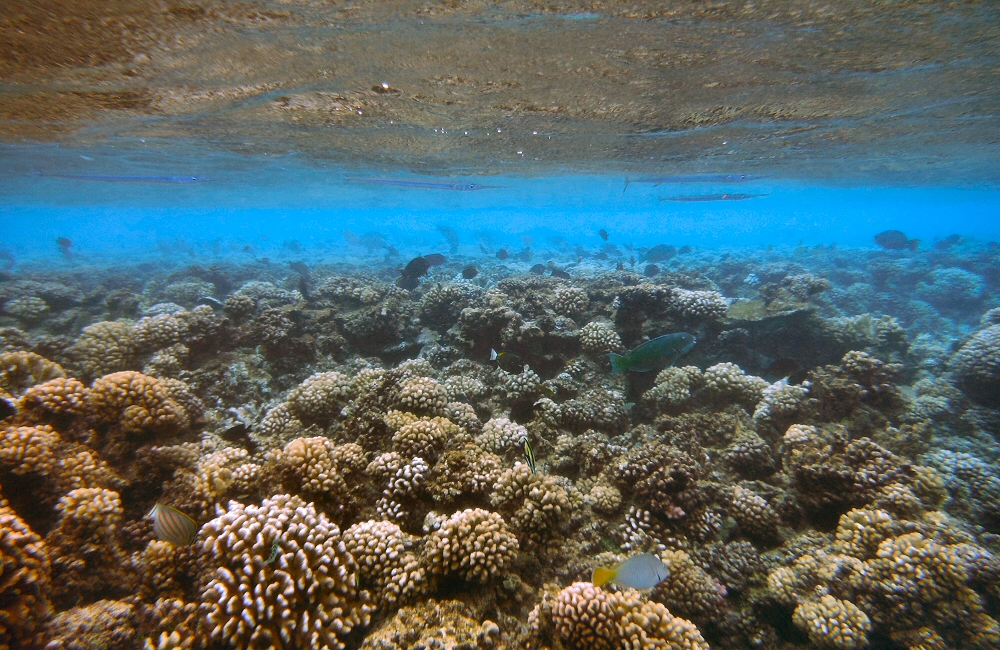
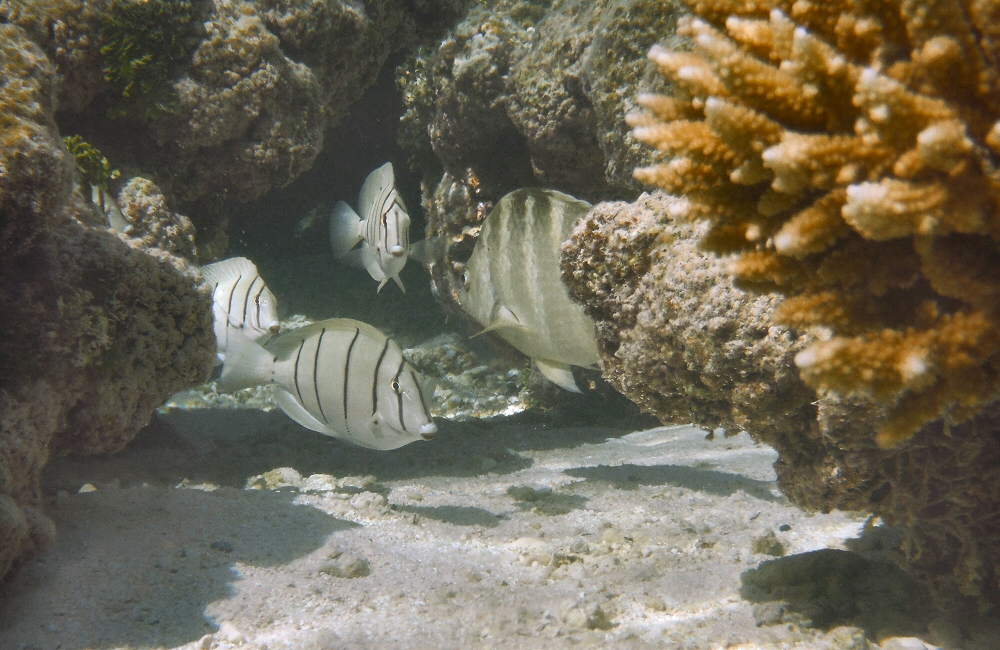
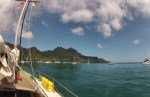
A spectacular dawn was soon followed by gusty winds and strong rain. I made an approach to the inlet, but the rain was so hard we couldn’t see more than a few tens of metres, not great conditions for slotting a yacht through a narrow gap in the reef between rolling breakers. So I sent for the shower gel and enjoyed a fresh water shower. Later in the morning when we’d found our way onto a mooring ball, we hopped over the side to the most amazing snorkeling yet. The tide was on the way in, bringing pure, clear Pacific ocean in – so the visibility was stunning. The pictures just don’t do it justice. No wonder this is regarded as one of the world’s top spots for seeing reef fish.
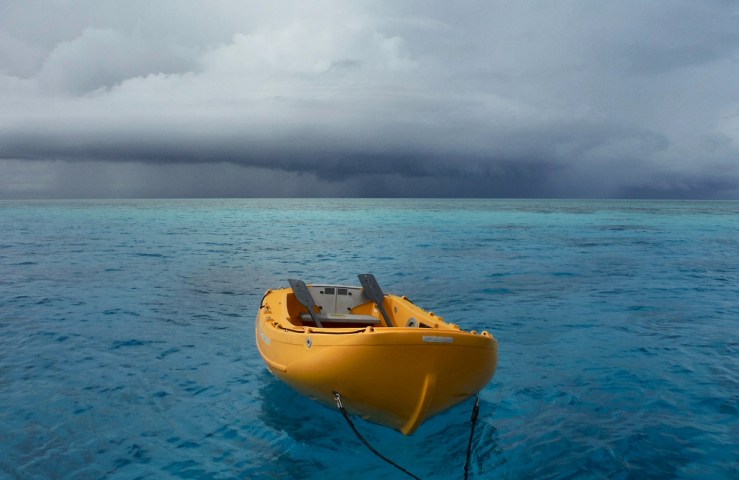
Back on board we sat through another super-heavy rainstorm, and then explored the bay for a while. I took the dinghy to the nearby beach, but as soon as I’d set foot on the shore the no-nos started biting viciously. I think the rain had set them off. Much safer out on the water. I rowed out into the lagoon, and then drifted back to the boat over the coral, only a few inches below the bottom of the dinghy. Peering over the side I could see everything just as clearly as if I was in the water.
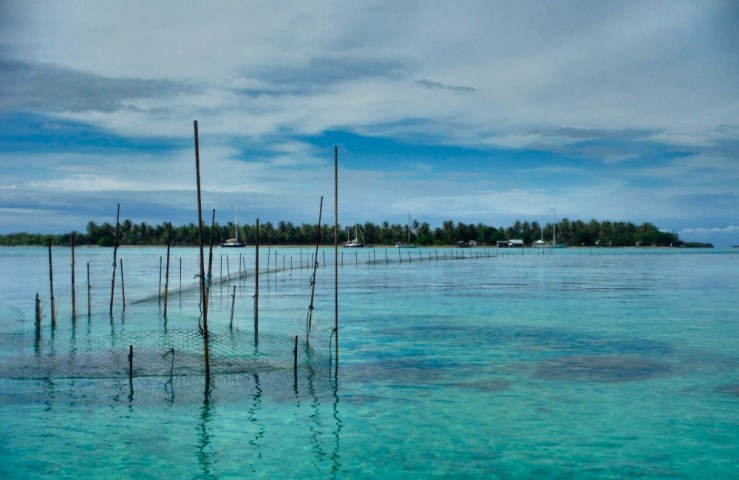
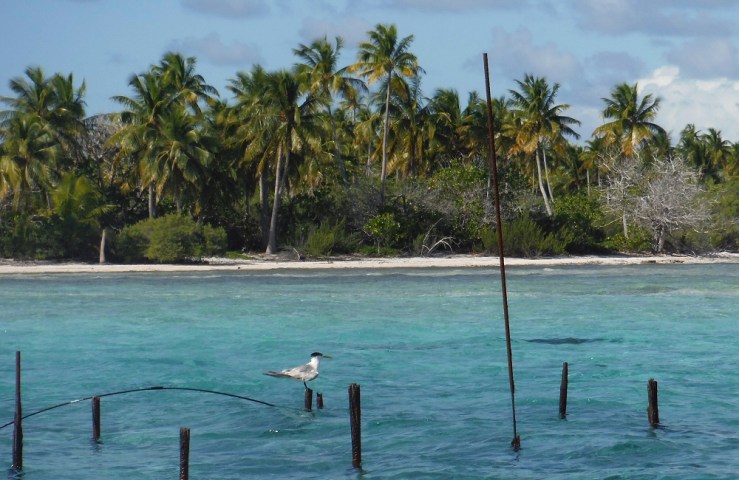
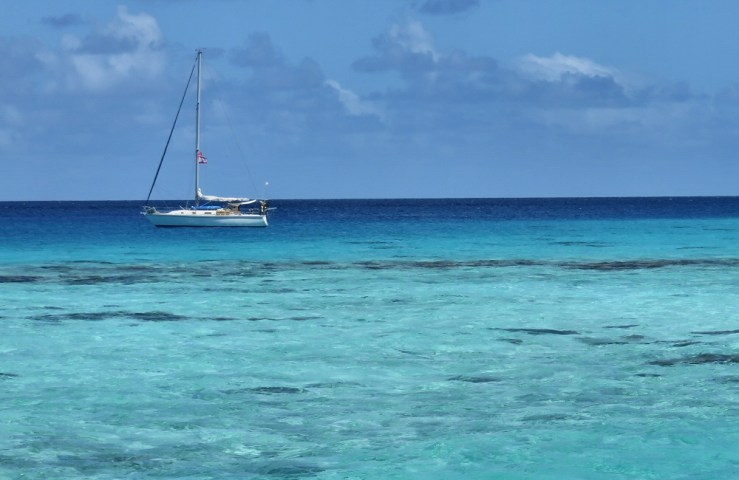
Water still amazingly blue even with a grey skyFish trap at Anse Amyot
Just the one night here, and then off to Tahiti in the morning! The forecasts show not much wind, but we have plenty of diesel and it’s only 230 miles, so we’ll go anyway, and take whatever weather we get. Looks like the rain has cleared away, so I’m going to see if I can make it through a whole night sleeping in the cockpit without getting wet…
Today dawned completely clear. Just a few tiny clouds way down on the horizon, hundreds of miles away. We’ve not had a clear day like this yet, apart from perhaps when we were at sea, back in March. Early this morning there was heavy rain, waking me up and sending me dashing to shut hatches. Even at anchor it’s hard to get a full night’s sleep! The rain clouds were gone before dawn and now it’s hot. Viciously hot. Even with the sun shades up in the cockpit and the front of the spray hood unzipped to let the breeze through, it’s not nice to be sat up on deck. Even though the view is stunning (yet again), we’re hiding below, away from the sun, at our fourth anchorage in Fakarava (16 13.89 S 145 33.50 W). Just 2 miles up the shore from where we spent last night. Hardly worth getting the anchor up … “we should have just let out more chain to get around the corner” Dave said!
Eva is sorting through some of the gazillions of photos that they’ve taken over the past couple of weeks. Dave’s making a fishing lure from a piece of pine that he’s spent the last couple of days carving. I’m sporadically dipping in and out of a few books – not really in the mood to read “properly” today – waiting for some epoxy putty to cure on the windlass (anchor winch). Turned out that we broke a piece of plastic off during the epic session getting the chain up in Makemo. Once the midday heat eases off, and then we’ll head out to explore.
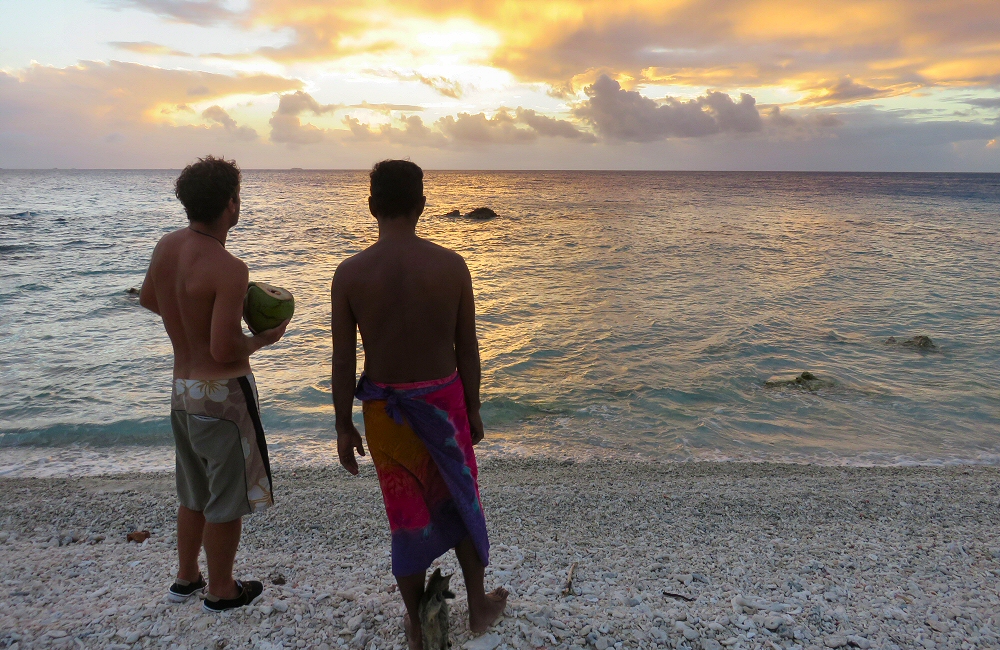
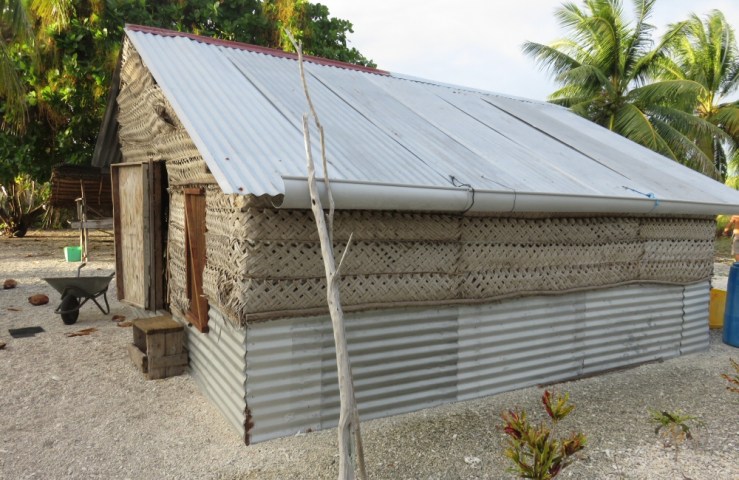
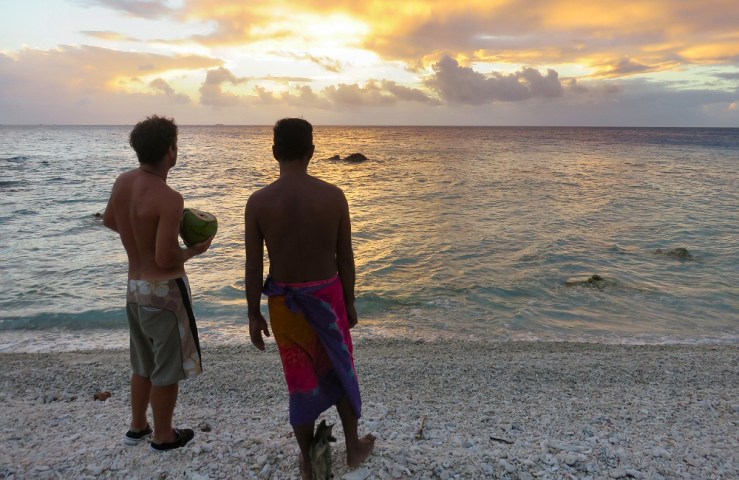
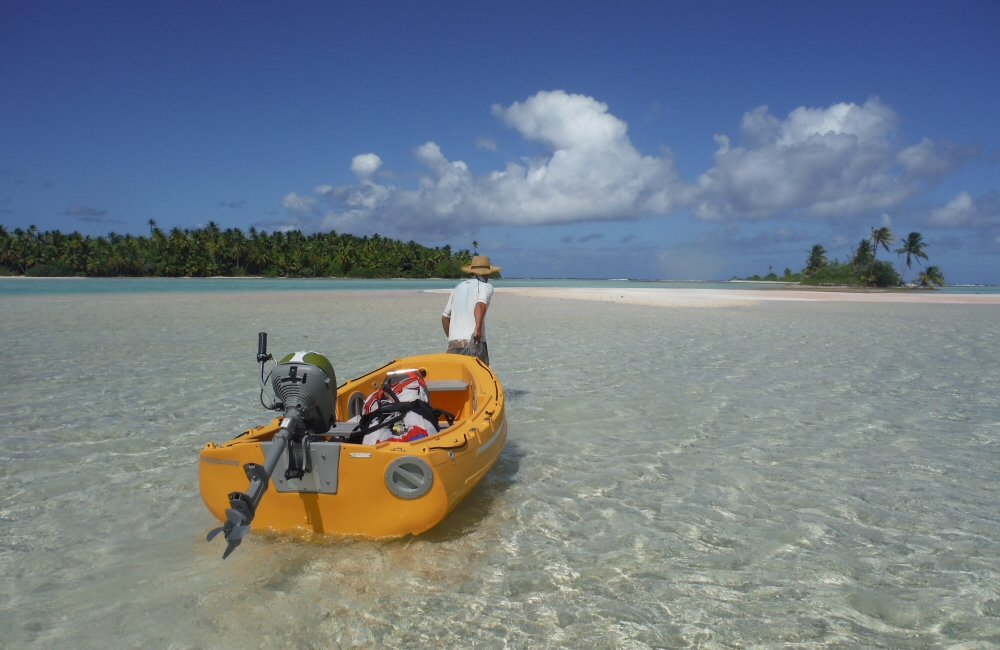
But first, let’s catch up with yesterday. As we approached the anchorage I spotted a dwelling, and then in the afternoon when we went ashore we bumped into it’s occupants. A middle aged man, surprisingly slim for a Polynesian, in a bright yellow and purple sarong. His dog, a timid brown pup trying to be brave by shouting a few hesitant barks at us. And two tiny 3 week old kittens, struggling to scramble over the white coral beach. “Bonjour!” he greeted us with smiling eyes and a warmly offered handshake, strong work-hardened fingers wide apart. We pulled the dinghy up the beach, and wandered through the low scrub to his house. More of a shack than a house; wooden stakes holding up a tin roof, with neatly woven coconut matting as walls. Just one room, with a couple of sleeping platforms of white coral pieces, a cooking area and a couple of open doors. Round the back he had a modern looking water cistern, which he said he’s constantly having to drain because lizards fall in and die, tainting the water. So today he’s “asked for more rain” following the latest suicide. His accent was strong, but I could understand most of what he was saying. Chatting in French, he lopped a couple of coconuts down using a long stick with a hook on the end, sliced the top off and handed them over. Mmm, fresh coconut milk.
Photo Dave/EvaPhoto Dave/Eva
He showed us around his land, which he’d been clearing for years, along with his sons. Removing the scrub and bushes by burning them back, leaving just coconut trees and coral. Here and there he’s planted flowers and other domestic plants, in upturned coconut husks which provide a little something in the way of nutrients. He said he also bought “bon terre” from Tahiti in ton-loads, which was delivered by boat, good soil for getting plants started in this harsh ground. Sprinkled around the base of some of the coconut trees like a white collar was light coloured coral collected from the beach, contrasting with the darker old reef coral that made up the rest of the property. He’s put a lot of effort into making it nice. Would have been fun to stick around for the evening but the sun was sinking, and the no-nos starting to bite so we made a promise to return in the morning, and retreated back to the safety of the boat.
A couple of days ago we ran out of water in the 50 gallon aft tank. The forward tank had a few gallons left as reserve, but not much, so it was a sign to start getting more active with our water making. Back in San Francisco I installed a machine that turns sea water into fresh water via reverse osmosis – basically squeezing salt water through a really fine membrane at super high pressure. It means that we don’t have to plan our voyage around where we can pick up water. It’s been working really well, but the pump does use a lot of electricity. This morning I got the batteries back up to a happy charge level using the engine for a couple of hours, running the water maker at the same time. Once the sun was up high enough to feed the solar panels and provide the hungry machine with enough power, I left it running while I joined the others ashore to explore with our new friend. Took some spare mesh netting as a gift to hopefully help him with his lizard problem.
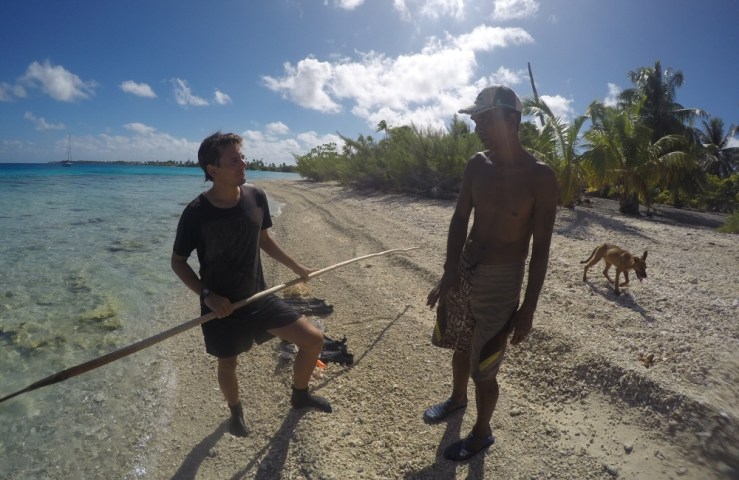
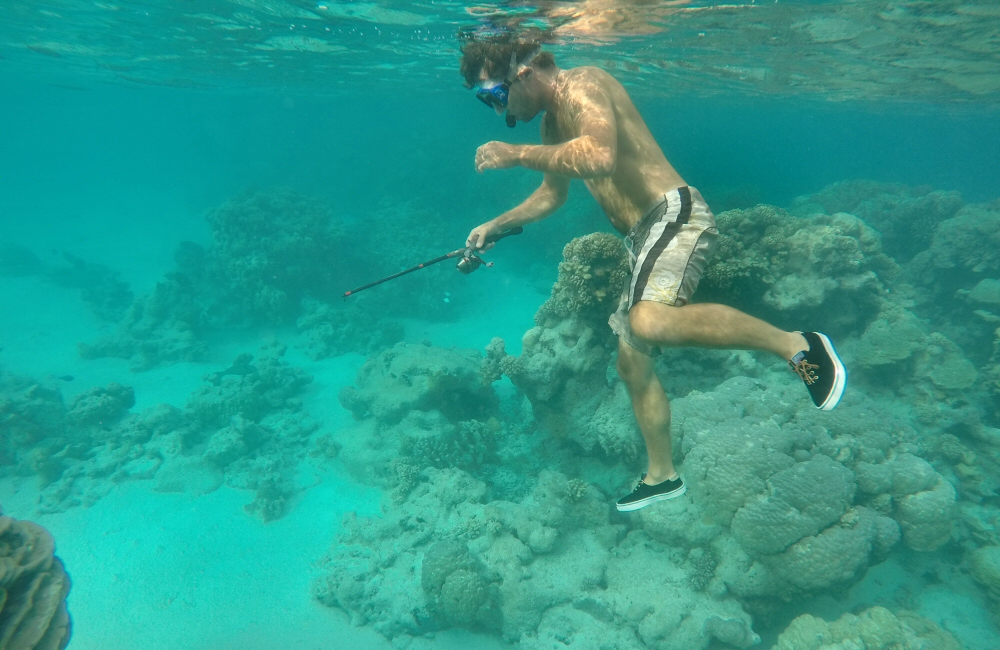
Dave learns about spear fishing
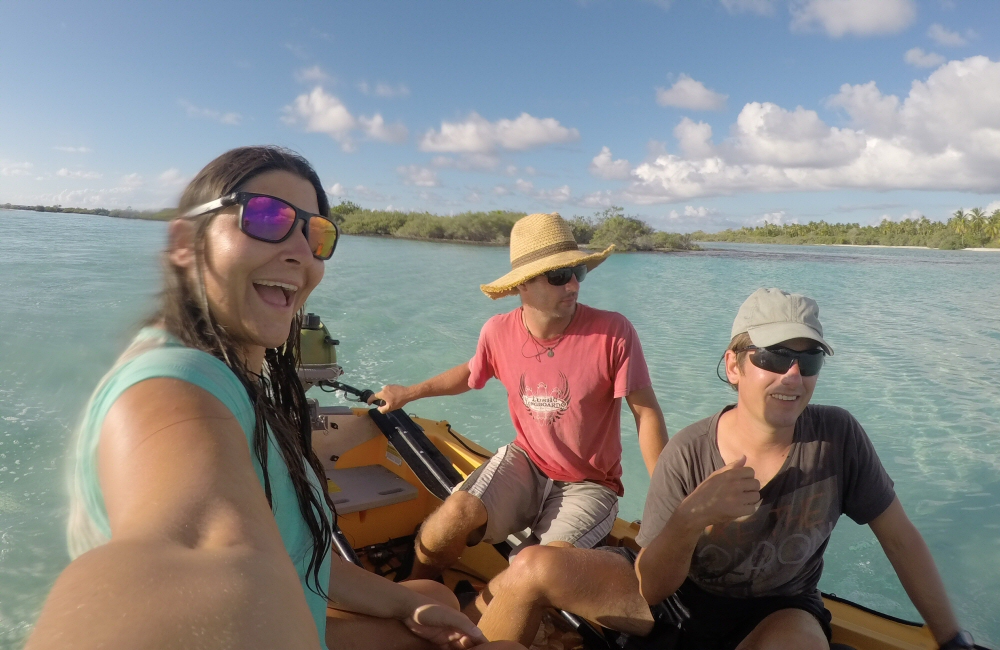
I couldn’t understand his name (and didn’t ask him to scrawl it in the sand which would have been a good idea) so let’s call him Freddie. It sounded a bit like Freddie. Yesterday, anyway. He called himself something else today. So Freddie, cold beer from Rafiki’s stores in hand, showed us over the motu to the reef on the ocean side, and all over his property, pointing out various shrubs and bushes along the way. The plants his wife put down last year, the coconut trees his sons planted “when they were this high”, indicating a three-year-old’s height with his hand. He says he’s got three houses, one up in the village where his wife is, and one further down south, but he likes it best here – I can see why.
See Freddies place on the corner
But, again, it’s “time for us to move on” (an all too common phrase at the moment) – we’ve snorkeled all the reef here and want to see what’s around the next corner … which brings us to this baking hot afternoon, sat just around that next corner, waiting for the day to cool down.
Eva handed over the watch to me at 0400, saying we were getting close to land and maybe we should slow down a bit… the south pass of Fakarava was supposed to have slack tide late morning, and we were only 6 miles away, so yes, we needed to slow down. I spent my watch mainly hove to (sails backed and boat not really moving anywhere), waiting for the sun to peek over the horizon and give us the light we needed. Just before dawn, I put the helm across, set the sails, and Rafiki was back in action, taking us toward the pass.
Another dawn at sea
Sometimes passes are OK with some outgoing or incoming current, so it was worth a look. As we approached, the wind picked up considerably, blowing the strong ebb tide into standing waves, so I decided to wait a few hours for slack. We tacked out to sea and back again a few times, the wind building all the time. It was gusting over 40 knots by the time we came around for our 4th peek at the pass. It was choppy – we had a fair bit of water dumped into the cockpit by short, sharp waves, but it looked OK just inside the outer end of the reef, so I went for it. Sure enough, as soon as we were just a bit closer in, the water flattened out and we cruised through. The water was so clear that the section 4m deep looked like we were about to hit the bottom – erk! – gotta trust those charts…
Fakarava South Pass, Tetamanu
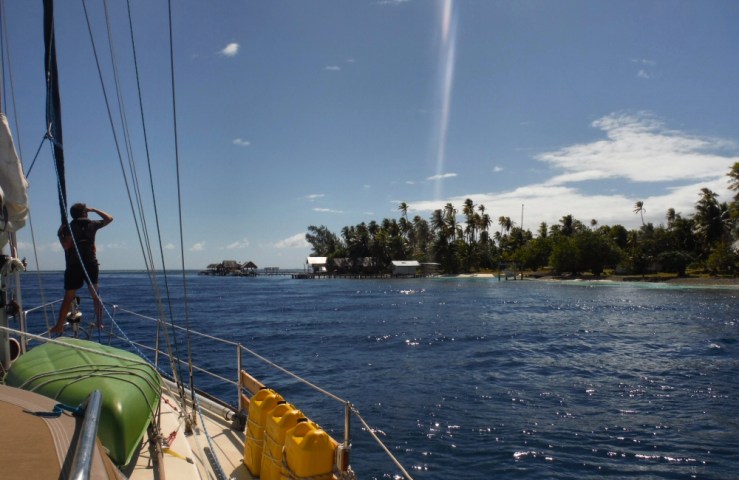
On the right hand side of the pass is the village of Tetamanu – now in ruins, but with the church still standing, supposedly the first church in the Tuamotus, built in 1874. A series of cabins made of palm and thatch line the waterfront, each one with a small deck jutting out over the water on stilts. When we walk around the village later, we discover that the village is now just some resort accommodation and a dive centre.
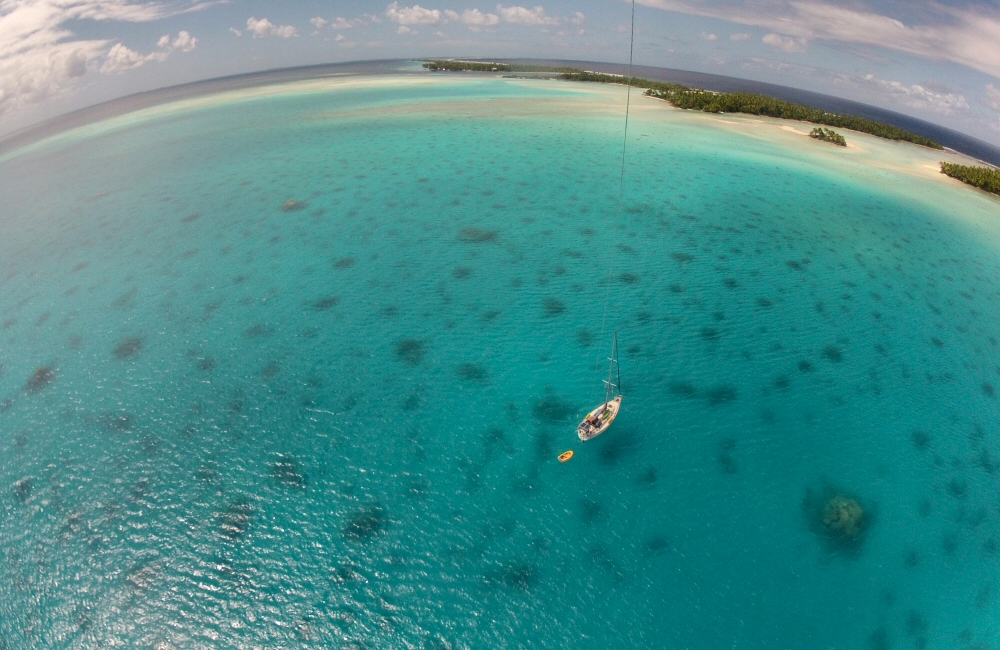
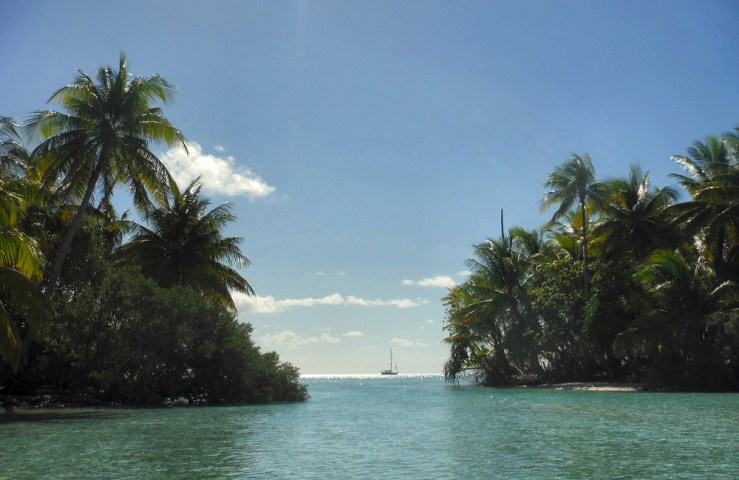
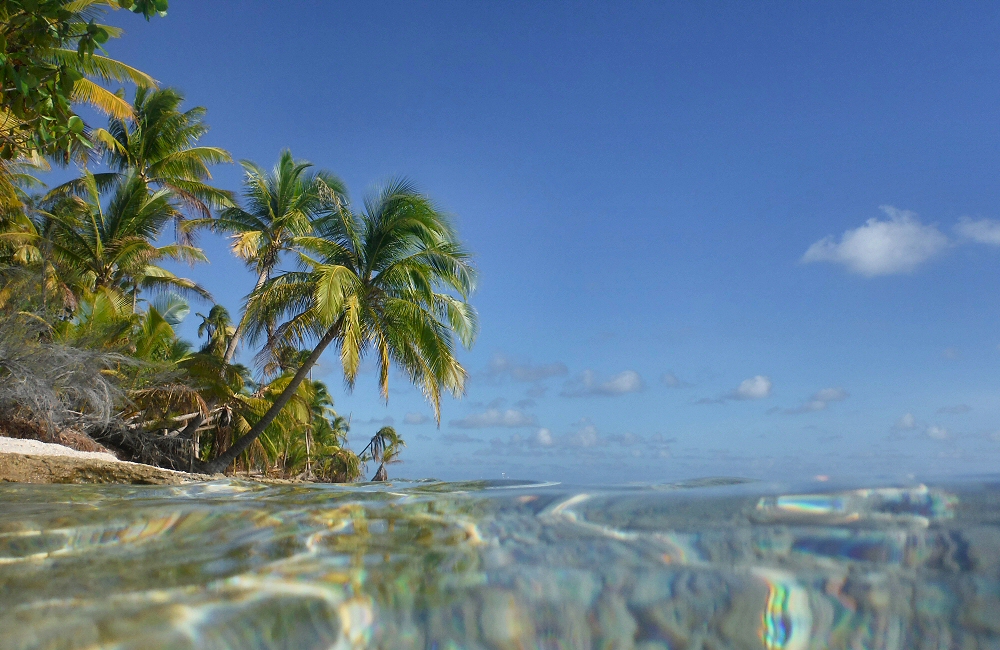
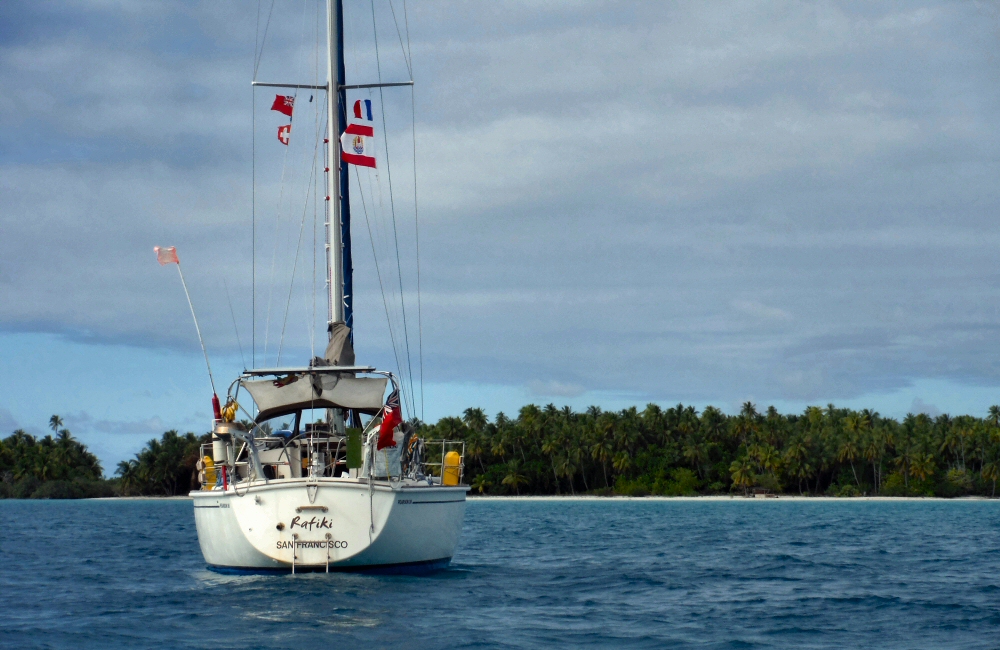
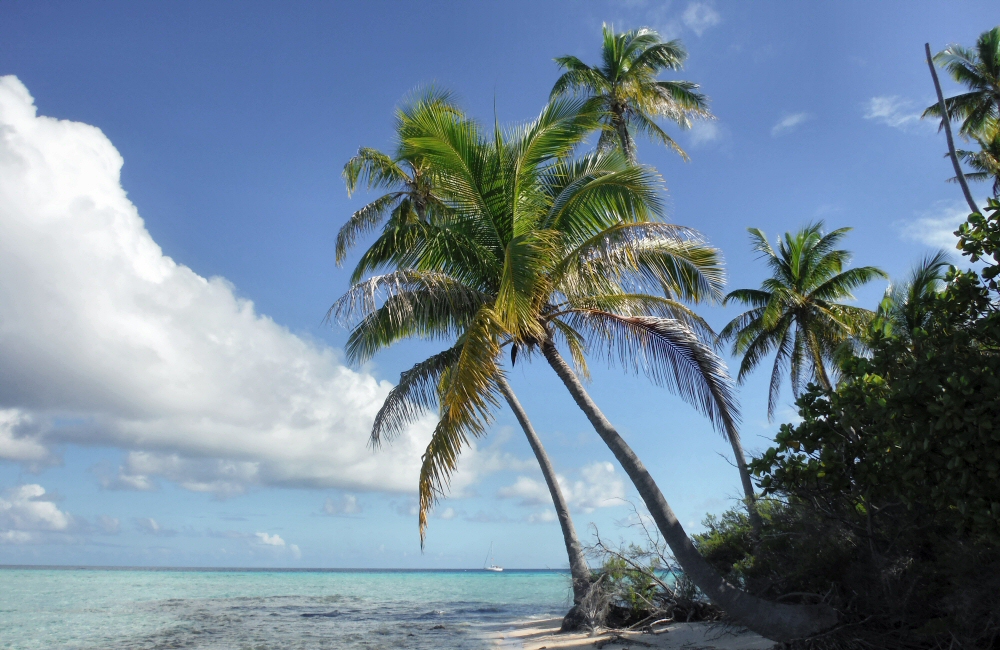
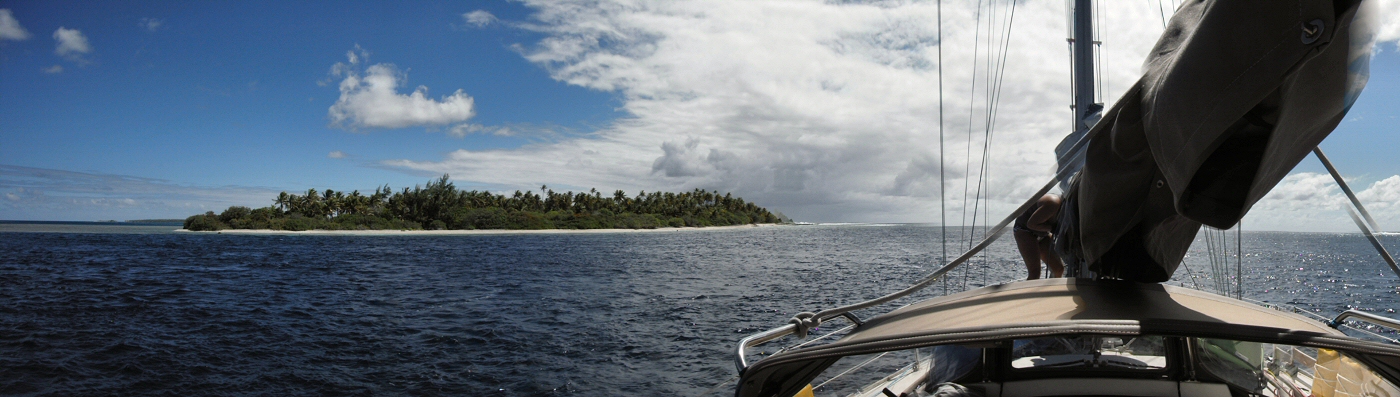
Once through the pass, we go left, around a large shallow patch, to anchor in clear, incredibly turquoise water. Here and there are darker brown freckles – coral heads. It’s so hard to judge the depth of each one, so we meander through the maze, and drop the hook in a space that looks mainly sandy. I dive down and set a float half way along the chain, so as we swing around with the wind, we don’t wrap it around any coral. A squall passes over, raining hard on the pass, but just missing us. The sun chases the cloud away and activates the colours – turning up the brightness and saturation dials to max. Wow. What a place. There’s only one other boat here. Upwind of us are three or four motus – low sand islands covered in green palms and bushes – flowing between them are shallow channels of incredible blue, where water coming over the outer reef makes its way into the lagoon. There are a couple of tiny islands separate from the rest, with just a few coconut trees on each, standing proud on a base of bright sandy colour sand. Their survival in this arid environment is a miracle. Just sand and coral … turned into trunks, leaves and coconuts with a little help from the sun and some water. Amazing.
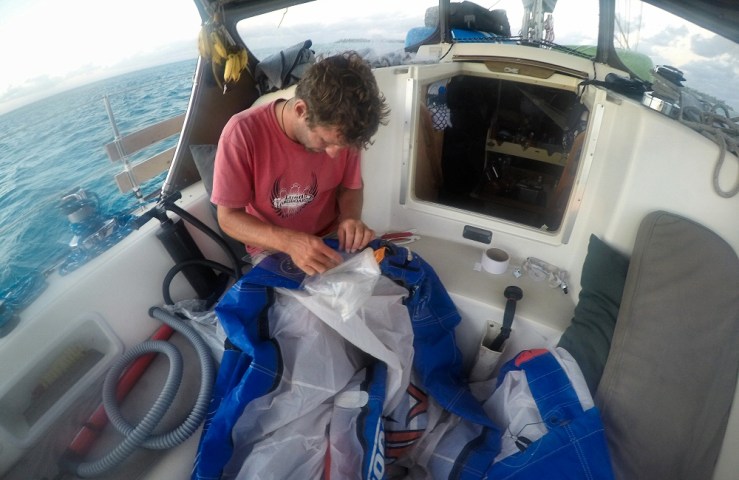
There’s a guy out kite surfing! So I rush to get my gear out of the forward cabin and dash to the beach, buzzing. An epic place to kite. I pump up the first strut. Pssshh. Won’t go. Well, not ideal but maybe I can fly without that strut. Try the second. Pssshh. Arse. I need that one. Ah well, I have a second kite on the boat, it’s a bit big but if it flies, I’m sure I’ll be able to hold it down. Buzz back to Rafiki, pick up my 13m, and roll it out on the beach. Pump, pump. Pssshh. No! Try another strut. Pssshh. NO! Neither of my kites will pump up. Excitement turns into anger and frustration. I’ve brought my kite surfing gear half way around the world to one of the most amazing places to play, and it won’t work. I’m not a happy chappy. Later, I try and repair them back on the boat, but the repairs keep failing. It’s well after dark by now. I decide to go and sit on the foredeck, kept company by our last bottle of cider, and slowly my frustration dissolves into the stunning night sky.
Trying to fix the kitesExploring between the motus
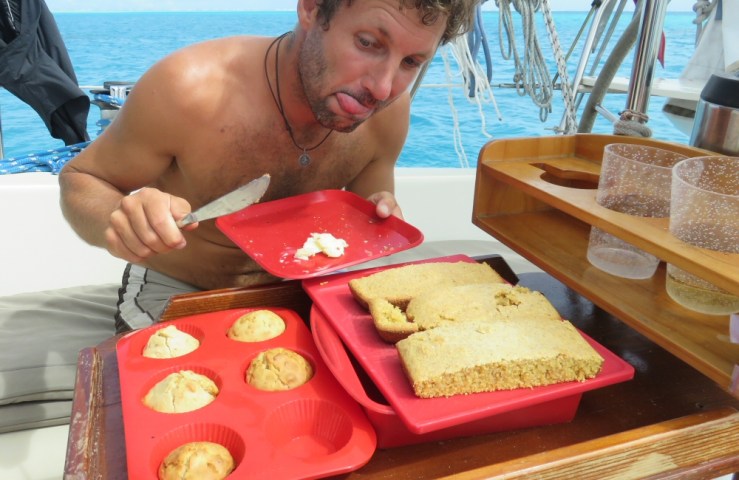
We spend a few nights here, tucked behind the islands out of the worst of the wind. Even though it’s still gusting 30 at times, it’s so much more relaxing to be downwind of land. The water is flat, and Rafiki isn’t bucking around, feeling like something’s going to break at any moment. And if there’s a problem with the anchor, we just drift out into deeper water. Every now and then a stronger, rainy squall passes through. One wet morning I go into a baking frenzy – pineapple muffins, onion bread AND polenta bread, all in one go. We have a very carb-heavy lunch!
Morning squalls – rain and wind… means baking!
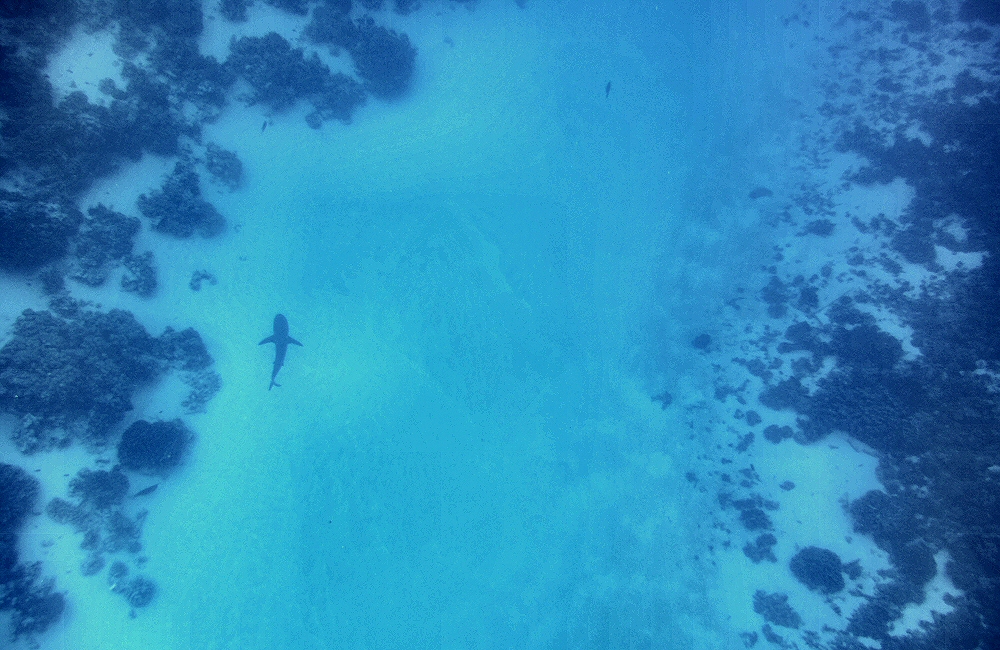
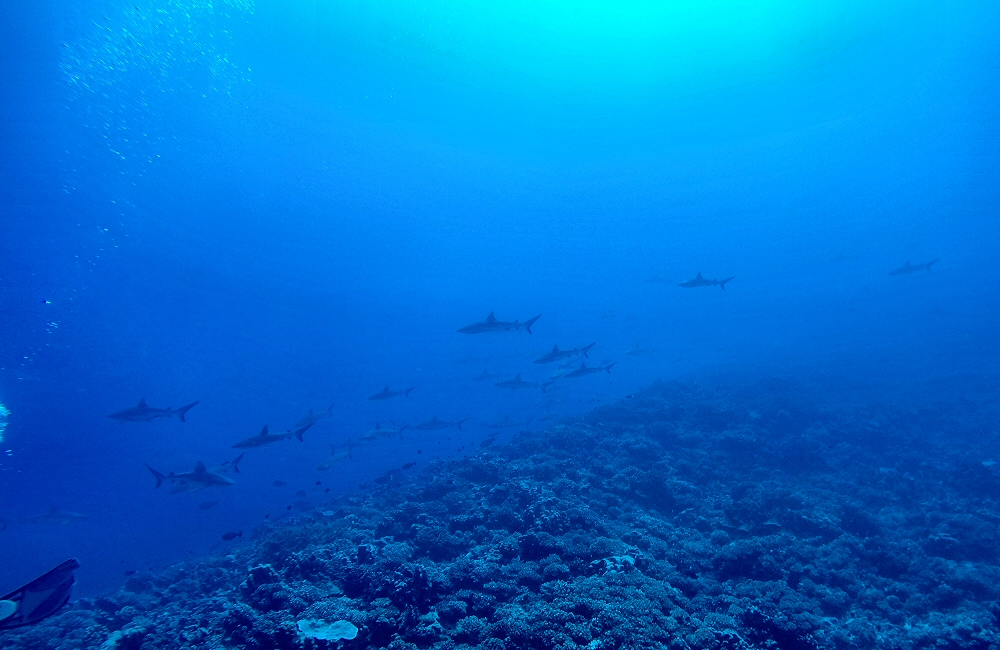
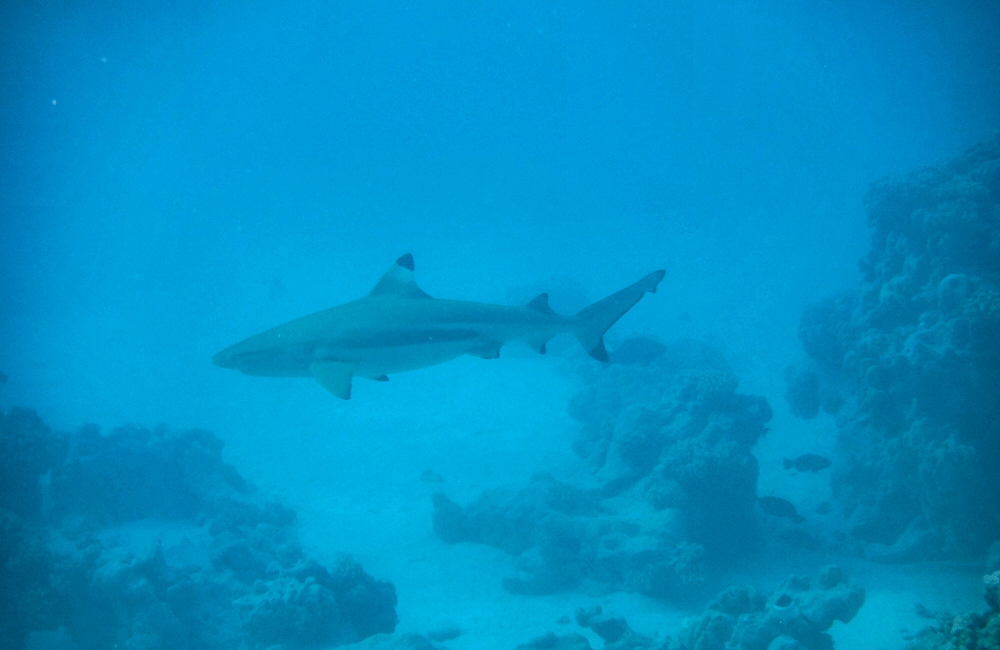
In the afternoon it cleared up, so we took the dink over to the pass, motored out into the swell, and hopped over the side. Wow! Over 30 metres deep and you can see the bottom like it’s only just beyond the end of an outstretched arm. Drifting back into the lagoon with the current was one of the most amazing snorkelling experiences ever. Grey shark were patrolling the middle of the pass, black tip shark being nosey and exploring around everywhere, always seeming to be behind you when you turn around, white tip shark hanging out on the bottom in sandy patches, gently swimming their sinister sharky side-to-side swim. By now we’re comfortable in the company of these fellas. None of them are much bigger than 4 foot, and they are all well fed on reef fish (so we’re told!). As we approach the shallower water, the coral and reef fish become the stars of the show. So many types of poisson, I try to count them, but I soon get confused.
We stop off at the cabins and dive centre on the way back to Rafiki, to see what’s going on. Have a beer, and end up deciding to dive the pass next day. In the evening, we hang out with Chris, Jess, Chris, Ari and 2 1/2 year old Isabel on the other boat in the anchorage – Namaste. These guys keep their boat here in the Tuamotus in the summer, going back to California to work for a few months each year. Not such a bad life. They say this is their favourite spot in the whole archipelago, and I’m not surprised. Back on Rafiki, I read the PADI dive book late into the night, reminding myself of how it all works – it’s been six years since I last dived…
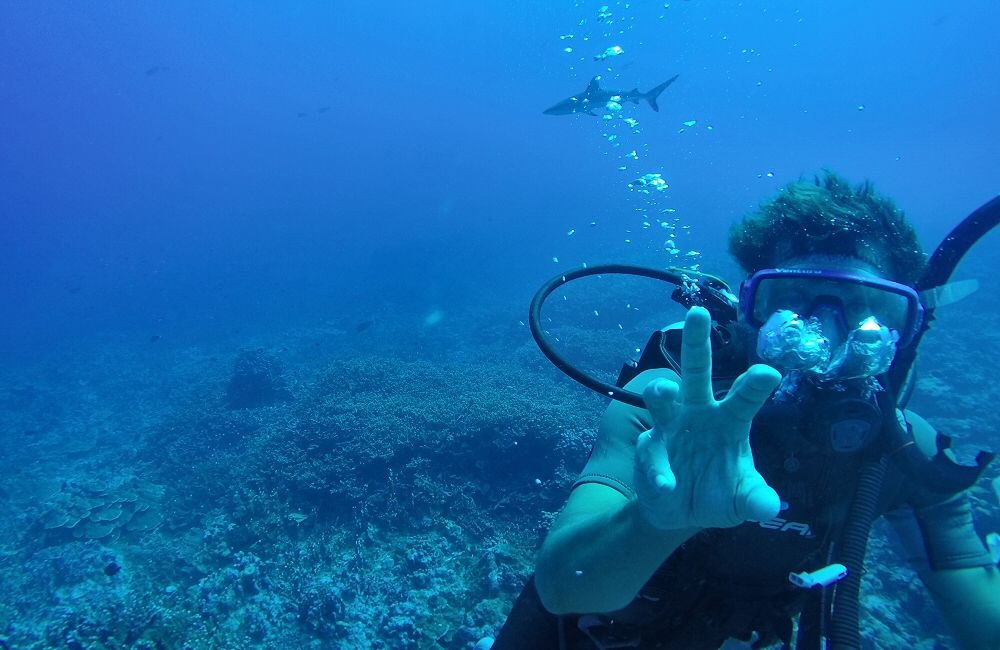
The dive through the pass was amazing. Dealing with scuba gear and being deep underwater came back quickly (thank goodness). After a brief and slightly concerning splash around on the surface, first coming up right under the dive boat and then having my BCD vent air noisily making me think I had a leak, we descended quickly to nearly 30 meters, and then drifted back into the lagoon with the current. Half way through, we stopped and grabbed onto the reef to watch a “wall of sharks” just a few metres away, in the middle of the pass at the edge of a coral precipice. Perhaps 80 of them, just slowly swimming against the incoming tide. They say that when a “big guy” comes through, like a hammerhead or tiger shark, these fellas scarper. Not today though. I’m OK with that.
That was yesterday. And then today, we made a short trip ashore to explore one of the motus we’d not yet visited, then weighed anchor and headed north into the atoll towards the other pass, where we’ll exit in a few days’ time. Anchor comes up just fine – whoopee! Sky is clear, wind is light. Visibility into the water is good. Beautiful. Along the way, at a reef like the ones we usually avoid, I hold Rafiki on station, bow into the wind, and Eva jumps in to have a snorkel around the coral.
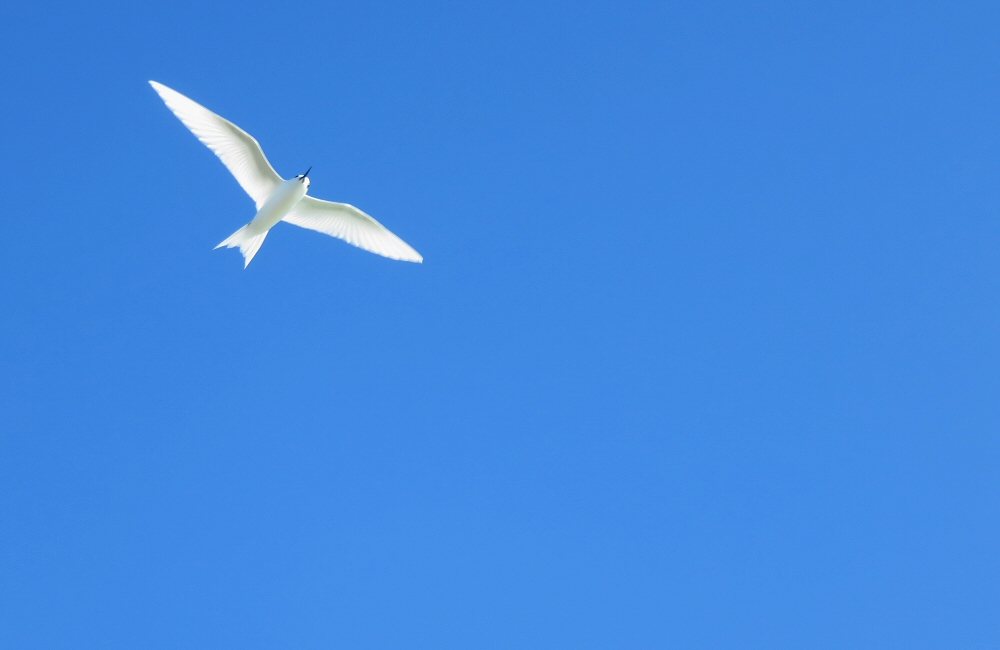
Just in time for lunch, we make it to an anchorage marked as Tukaega (16 20.3 S 145 29.7 W), again in mind blowingly blue water, a couple of hundred yards off the motu. Tucked out of the wind behind a dense thicket of palms and bushes, flat water, few coral heads, just how I like it. Nobody else here other than the fish and a couple of brilliant white tropic birds dancing around each other way above our masthead. They are so white that they reflect the bright blue of the sea on the undersides of their bodies and wings, like the yellow of a buttercup reflected under your chin.
We spent the afternoon exploring – seeing what’s in the water and on the land, soaking up the magic of the place. As I pick my way through the palms, big crabs scuttle away from every footstep, and tiny lizards scoot off into their hidy-holes. I tried to find some nice shells on the beach, but there’s nothing – just lots of dead coral. Sometimes there’s a little shell that looks OK, but it always ends up having somebody living inside.
It’s now late in the evening (for sailors- it’s just after 8pm); the nearly new moon is bright in the sky, but not so bright that it overpowers the other stars, and we can still just about see the milky way. Jupiter is shining brightly next to Leo, Orion is sliding drunkenly on his side towards the horizon, and the southern cross is happily saying “you’re way south the of the equator!”. There’s enough breeze to keep the mosquitoes away, and to make Rafiki jiggle around so that halyards knock and water slaps cheekily underneath the back of the boat as it rides up and down. Bellies now full of Thai chicken curry, we’re a happy crew.
Spent one night at the anchorage off the main village of Makemo, in the company of a French boat and what looked like a charter catamaran that came in through the pass at the midday slack tide. Just after we arrived, the French boat decided to re-anchor a little further offshore, but something didn’t go smoothly and they ended up very, very close to the reef, gunning the engine hard, man on the bow shouting “Avant, Avant!” and “A gauche! A droit!” to the lady on the helm. Fortunately they made it out. When we took the dinghy over that way later, there was only a few feet of water; they must have been scraping the bottom. It’s a lee shore here (wind blowing us towards the land) which is never a nice place to be, so after just the one night, and with a fresh stock of baguettes, we motored / sailed a few hours WNW to anchor at a spot three quarters of the way up the atoll (16 31.2 S 143 49.3 W). I’m also keen to get to uninhabited waters as soon as possible.
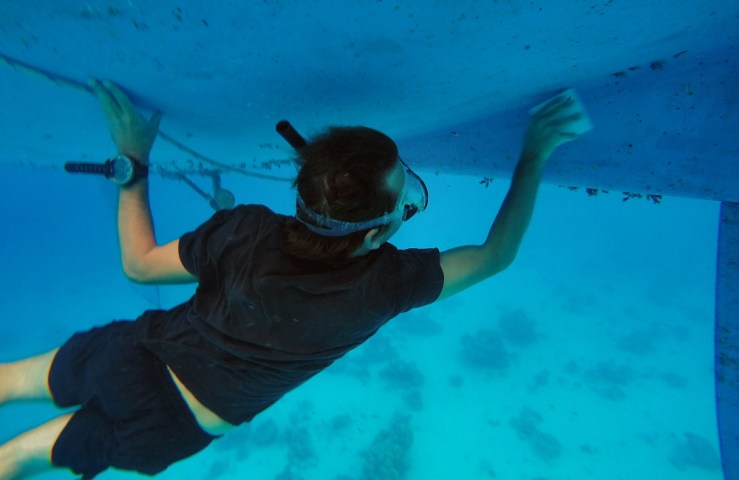
Dave cleaning the bottom
The lagoon is generally about 20m deep, with coral shallows rising up vertically from the bottom every half mile or so. The really shallow ones are easy enough to see when the light is good – when the sun is out and high above – but it gets a lot harder when it’s overcast, or if the coral is just a bit deeper. So Dave sits half way up the mast on the first spreader where he can see a bit better, acting as lookout. After a while, we get a feel for the area, can see that each reef is marked on the chart, and the chart is accurate, so we turn the engine off and drift downwind with just the jib up, winding our way through the shallows.
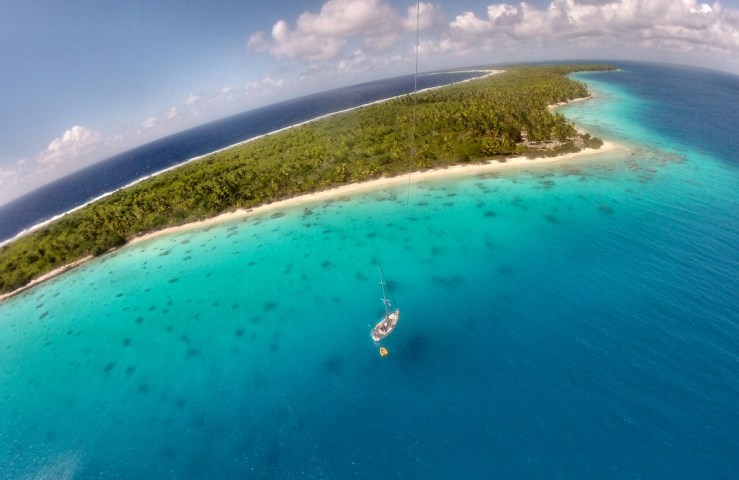
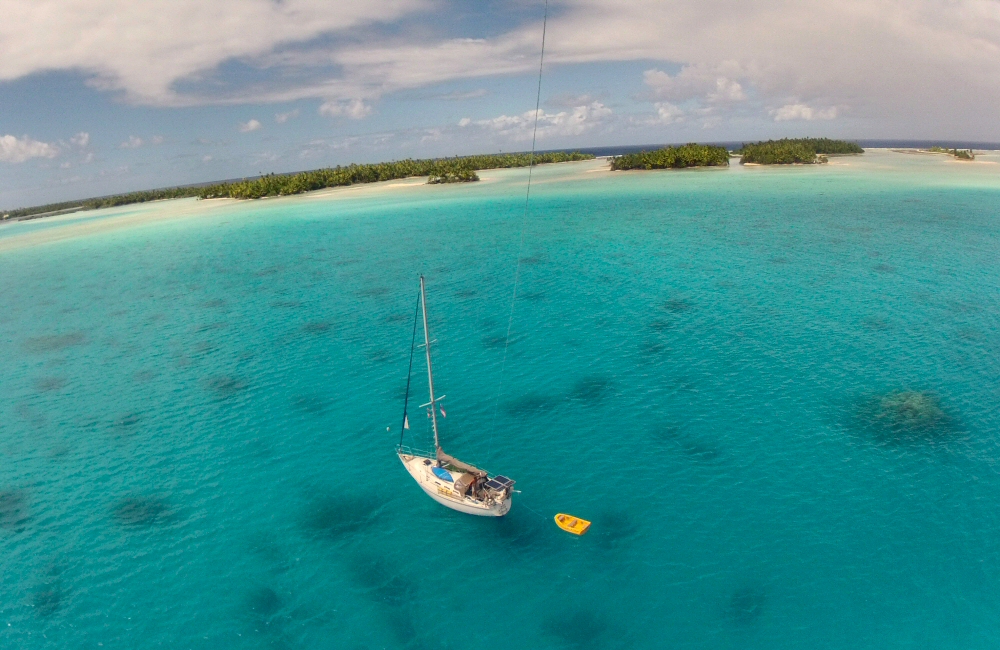
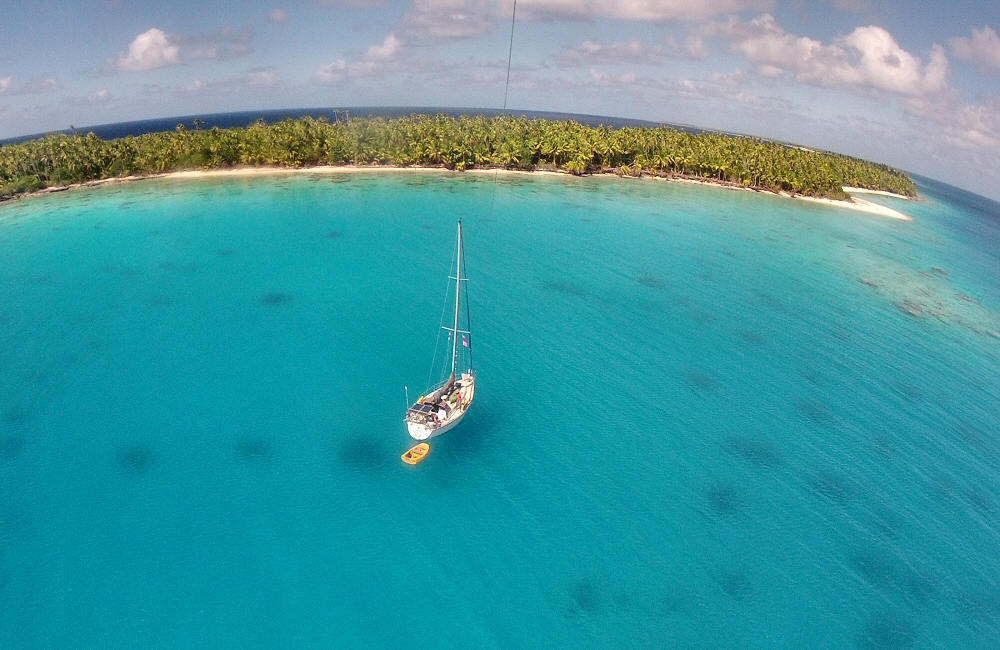
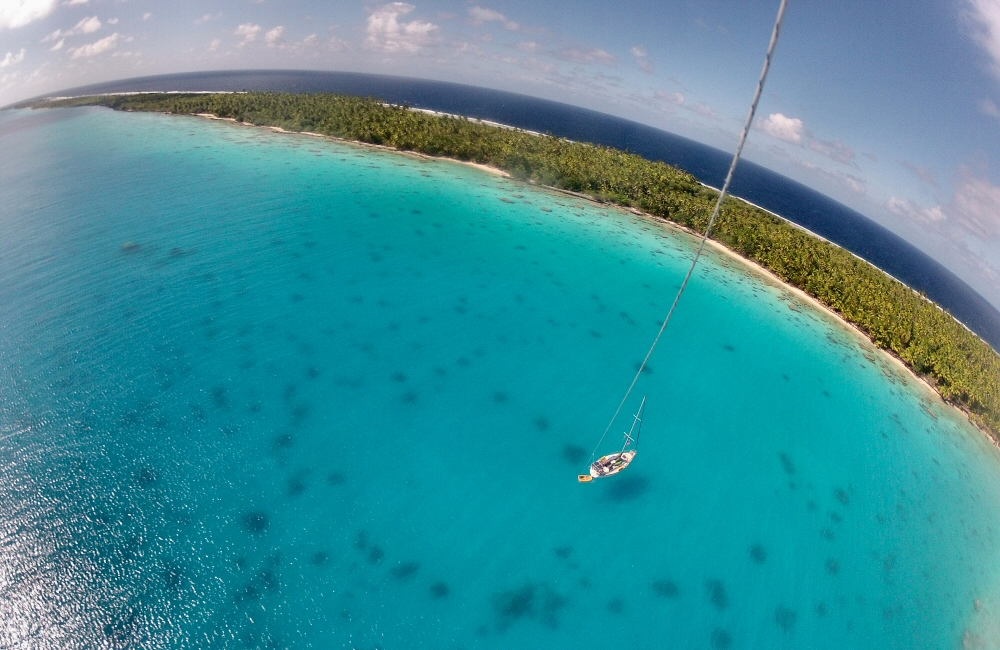
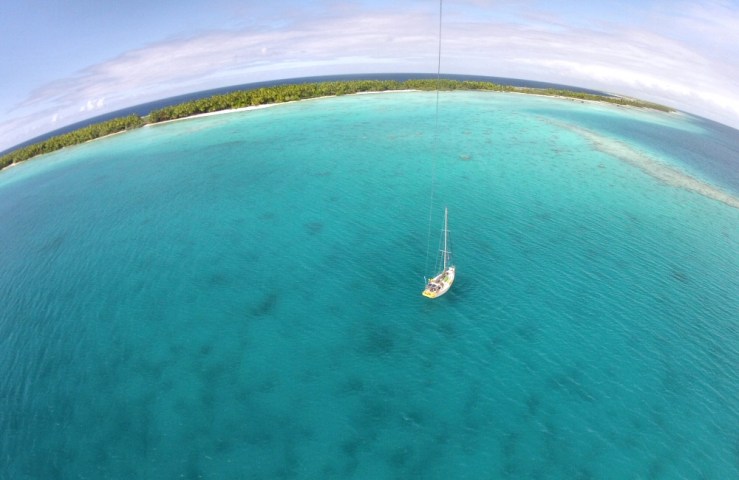
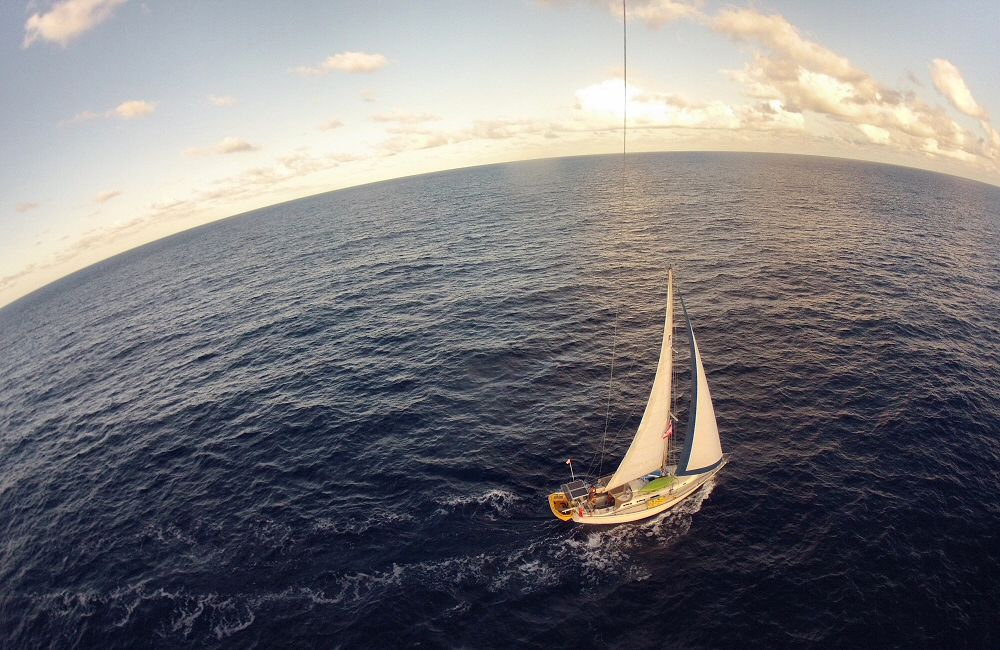
This anchorage is tucked just behind a bend in the motu (the land bit of an atoll), with a reef extending out from shore, which gives us much more protection from the easterly wind. There’s just enough breeze to send the kite up with a camera. Amazing colours – bright turquoise water, speckled with dark spots where there’s a coral head lurking below, then a hundred yards away a fringe of white sand before a thin strip of land, thick with green vegetation – mainly coconut palms, but also other stuff I can’t identify from the boat. Beyond that, the rich blue of the deeper ocean.
Anchorage at Makemo
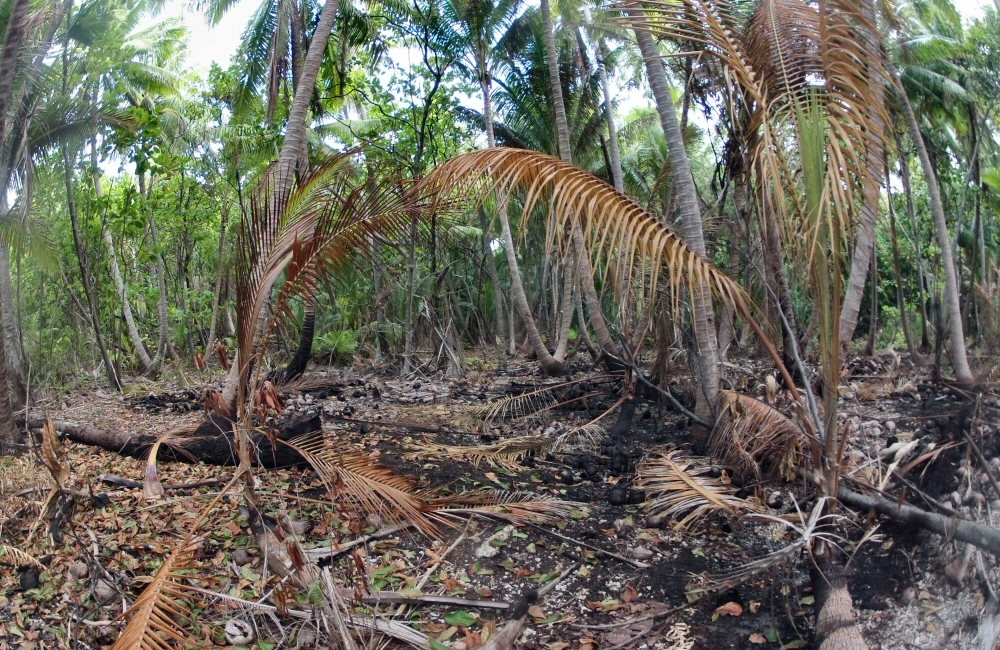
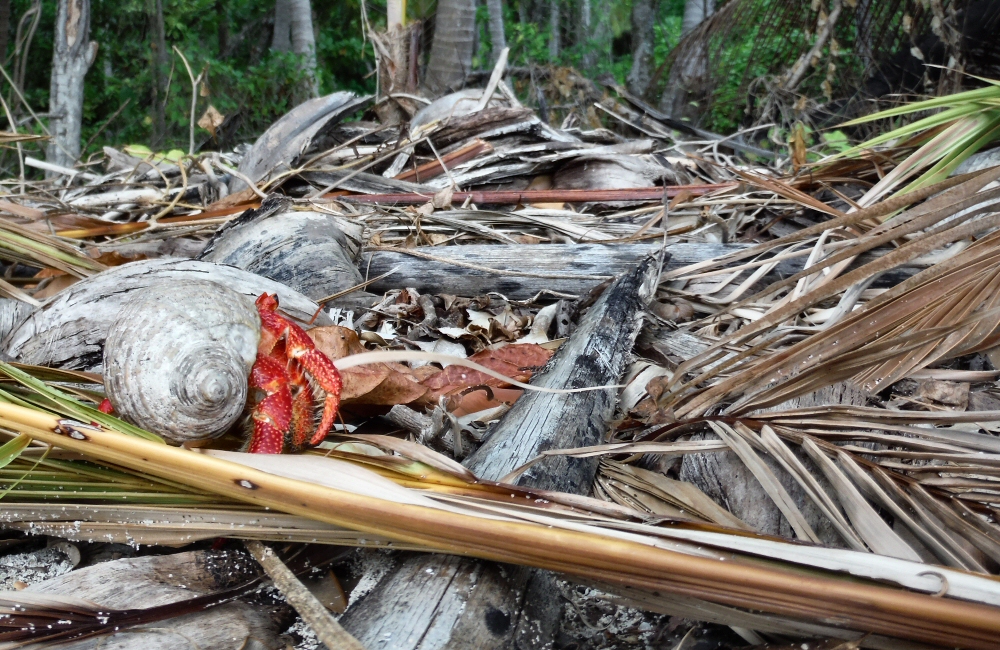
There’s a small ramshackle assembly of sticks and corrugated steel on the beach, it would be flattering to call it a shack, the only sign of human activity in what otherwise is a wild, uninhabited place. Amongst the trees there are piles of half burnt coconuts everywhere, and freshly cut palm fronds, can’t be more than a few days ago that someone was busy here. Looks like the meat and milk has been taken out of the nuts, maybe harvested for export? There’s the ruined foundations of a house – a low, square stone wall, coconut trees growing in and on it. Wonder when it was last lived in? Fast growing tropical bush reclaims abandoned dwellings so quickly, it might only be a few years. Nothing in the way of animal life other than the crabs and rats which scuttle around our feet. I hear no birds. It’s still damp from last night’s rain, upturned leaves holding tiny pools of water, sometimes with a bug in, having it’s morning swim. A bit further along the motu I discover a row of beehives, giving off an amazing smell of honey.
Back in the water we snorkel, but it’s a bit dead – not so much to see. Enough to catch a fish though, which breaks the line, snaps the rod and gets away! In the morning, we motor NW to find a place to anchor by the other (west) entrance to the atoll – Passe Tapuhiria. This time it’s my turn up the mast as lookout. We drag a fishing lure, but as usual it turns out to be just fishing, no catching. We motor around in the reefs and coral on the east side of the pass, looking for somewhere decent to drop the hook. Nothing looks great, so it ends up going down in 13 metres over coral. When the engine’s off I dive down and take a look. Ugh – coral heads EVERYWHERE. Tomorrow we’ll discover that this is going to make a tricky departure.
But first, time to see what’s under the waves. Amazing reef fish, SO many different sizes, shapes, colours and characters. And SHARKS! It’s a little unnerving snorkeling with sharks circling around, but these black tips are not known to be aggressive… we stay close to the dinghy anyway.
And of course the obligatory sunset photos …
Anchorage at N end of Makemo
Night brings rain and a stronger easterly wind, and because we’re on the western side of the atoll, there’s a good 40 miles of fetch for the wind to build up a reasonable set of waves. Soon Rafiki is bucking around viciously, the chain grinding noisily on the coral, every now and then catching on something and bringing the boat up short with a judder. I let out more chain and stretchy snubber line, which takes a lot of the jolt out, and lets me get some rest. But it takes us closer to the lee shore, and I don’t get a lot of sleep. Just before dawn, wind rises to 30 knots, and I’m looking forward to getting out of here, but worried that we’re not going to be able to get the anchor up.
Same terns we saw in California
Slack tide is due at 1300, and expecting it might take a couple of hours to untangle the chain from the coral, we start the process a couple of hours earlier. It’s a mission. And nasty, with the bow pitching up and down at least a metre, I’m concerned that when the chain comes up short, the anchor firmly hooked under coral, something’s going to break. Eventually, after an hour and a half of maneuvering backwards, forward, left, right, chain in, chain out, with me in the water with goggles giving directions and heaving on the buoy line, Dave driving the boat and Eva driving the windlass, the anchor comes free. More and more sharks are gathering to watch the action, so I’m glad to get out of the water and motor through the pass and out to sea!
Motu on the west side of the pass out of Makemo
Sails up, engine off, now 90 miles overnight to Fakarava.
Up until last night, the passage from the Marquesas to the Tuamotus was one of the easiest, most perfect trade wind sails I’ve ever done. 3 days of non stop 20 knot winds on the beam with almost no swell; Rafiki was cruising along in the high sixes under double reefed main and full jib, very comfortably. We just passed the time reading, sleeping, watching the sea go by, watching the sky … it’s amazing how days disappear.
Then in the evening, a thicker band of clouds built on the southern horizon, just where we were heading. The night ended up being dark, wet and squally. New moon is in a couple of days so no light from Mr Blue Cheese, and thick clouds hid the usual canopy of stars and Milky Way. Wind shifting all over the place, and varying from nothing to 35 knots, so we were all kept busy on our watches. I’m always the standby guy for the others when they are on watch, so I didn’t get a lot of sleep.
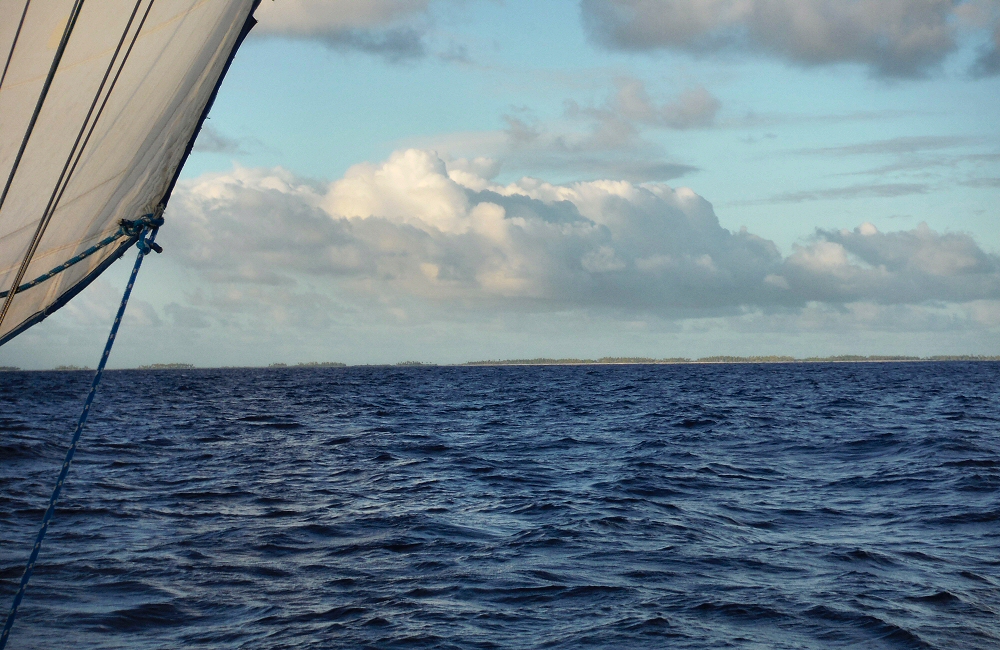
Dawn at 0530 brought a treat, as we left the darkness of the night behind us … land! At first it just looked like regular waves do on the horizon – lumps that come and go – but these lumps weren’t moving. Low and subtle, but definitely land. It’s the atoll of Makemo, a thin strip of land surrounding a lagoon – our first stop in the Tuamotu archipelago. 40 miles long and about 15 miles wide, the strip of land rarely more than a few hundred metres across, and only going partially around the lagoon. It couldn’t be more of a contrast from the towering peaks of the Marquesas; the atolls are just sand and a few coconut trees.
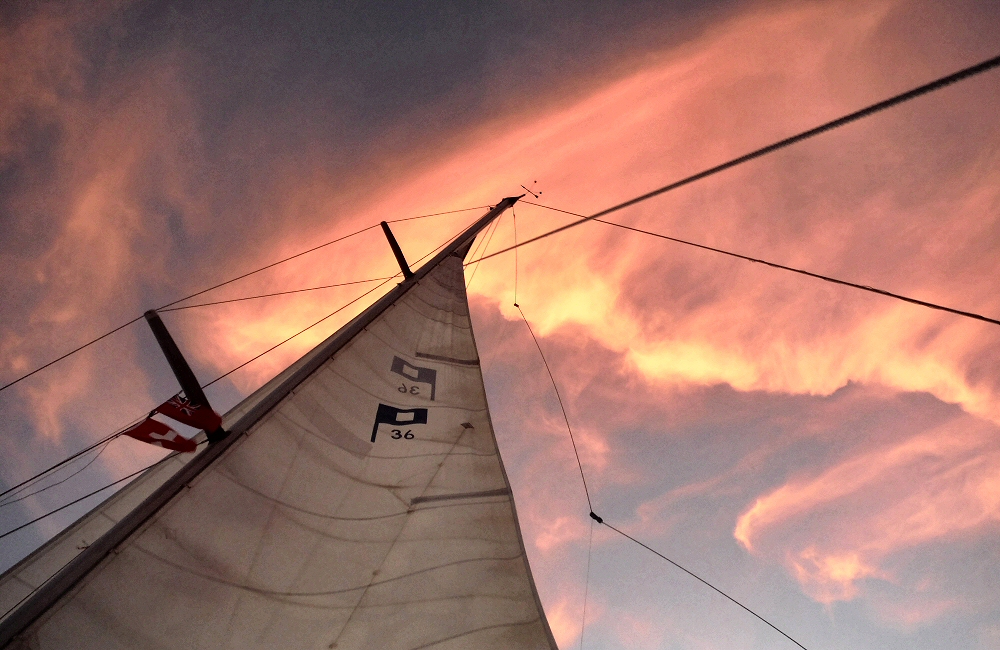
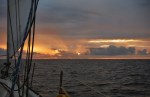
I spent a couple of hours tacking into the wind toward the island while the others slept, and at 0830 we made our final approach to the pass. I love the morning hours when I have the boat to myself. Just me and the ship. I usually make a fresh cup of coffee and just watch the night emerge into day. At sea you can see for such a long way. The sunlight catches the tops of tall clouds way over in the west well before there’s any sign of it appearing on the eastern horizon. Gradually greys and blacks turn to lilac, peach, salmon and eventually the hot piercing blue of another tropical day. When the others get up I have to make a conscious effort not to get grouchy, the peaceful solitude disappearing in a flash with the first word of conversation.
Some atolls are completely closed, we’re not visiting any of them as it’s not so safe to anchor on the outside (and it’s really really deep – over a kilometre just a few hundred yards off the reef). Some have one pass in the fringing reef, and some have more. Where there’s a pass, the tides bring the sea in and out twice a day. All the water in the lagoon needs to channel in and out through the pass, so it’s usually deep, but narrow – with fast, boiling currents at peak flow. Also, most atolls have a low, exposed, reefy south western side, which lets the waves crash over the top when the wind is blowing from that direction. The water can’t get back over the reef, which adds more water into the mix, so that sometimes, even when the tide is coming in, water is still flowing out of the pass. When the current in the pass is flowing in the opposite direction to the wind, then nasty standing waves can kick up, making things pretty dangerous. Add to this the fact that there aren’t accurate tide predictions for most of the atolls, and it becomes quite a navigational challenge.
My first atoll pass – a few butterflies in the stomach, but visibility good, approaching half an hour before estimated low tide, and not much wind or swell for the last few days to fill the lagoon with extra ocean. Spinning out of control and running the boat onto the reef is not something I want to do however, so as we made the final push into the narrow pass, I was on full alert. The current flowing out was fairly weak – 2 knots – so we motored hard against it and gradually edged our way into the lagoon, the water around us a confused mix of prickled wavelets and whirling eddies. Amazing colours. The sea has been an incredible shade of bright blue for days, even when it’s overcast, and when it gets shallow over the reef or sand it just explodes with vivid colour. Palm trees line white sand beaches just up from the surf on the reef, colourful buildings from the village stand amongst trees on the right hand side as we go in, and a couple of leading marks ahead guide us through into the deeper water. We’re through!
This is the south pacific I’ve been waiting for. We anchor in crystal clear water just off the village, D&E take the dinghy ashore to explore, and I tidy the up boat, have a swim, dive to check the anchor, and relax. We’ve found some wifi, so I’ve added some photos to previous posts too. The plan is to spend a few days in this atoll before moving on.
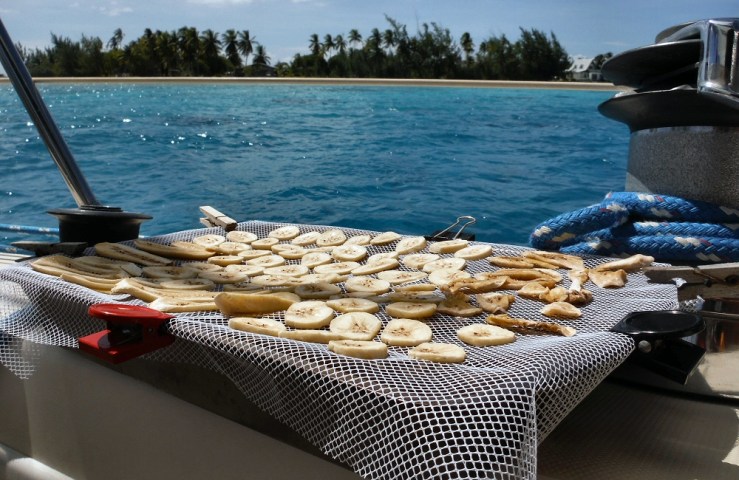
Anchored at MakemoAll the bananas going ripe at one, drying some
Sat Apr 11th. The 30 mile passage to Ua Pou was fast- 30 knots of wind most of the way, with a reasonably large sea. Wind and waves from our port side, on the beam, and not too choppy – not uncomfortable. The easterly trade winds are funneled between the islands of Nuku Hiva and Ua Pou, accelerating them to a strength sometimes twice as much as normal. I’m always amazed by the way that two land masses relatively far apart and relatively low can make such a difference to the wind and sea.
Ua Pou
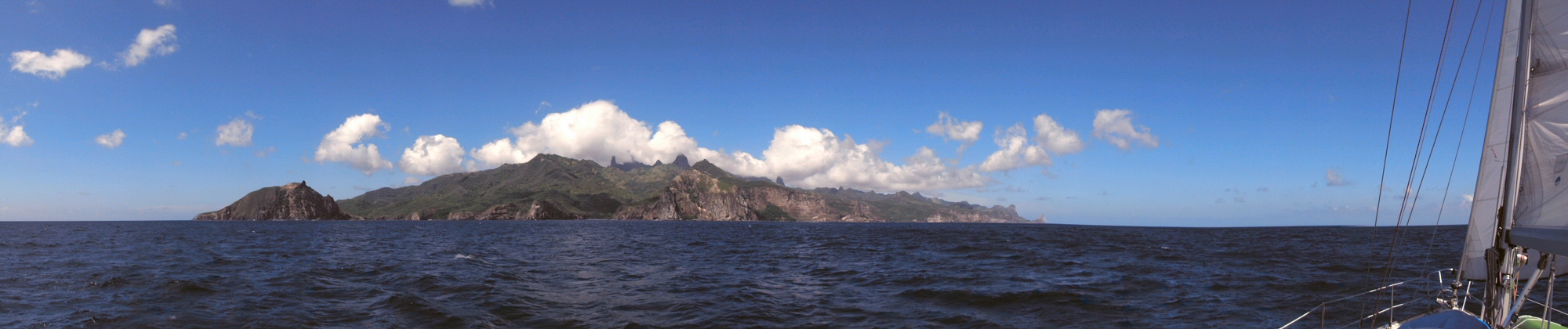
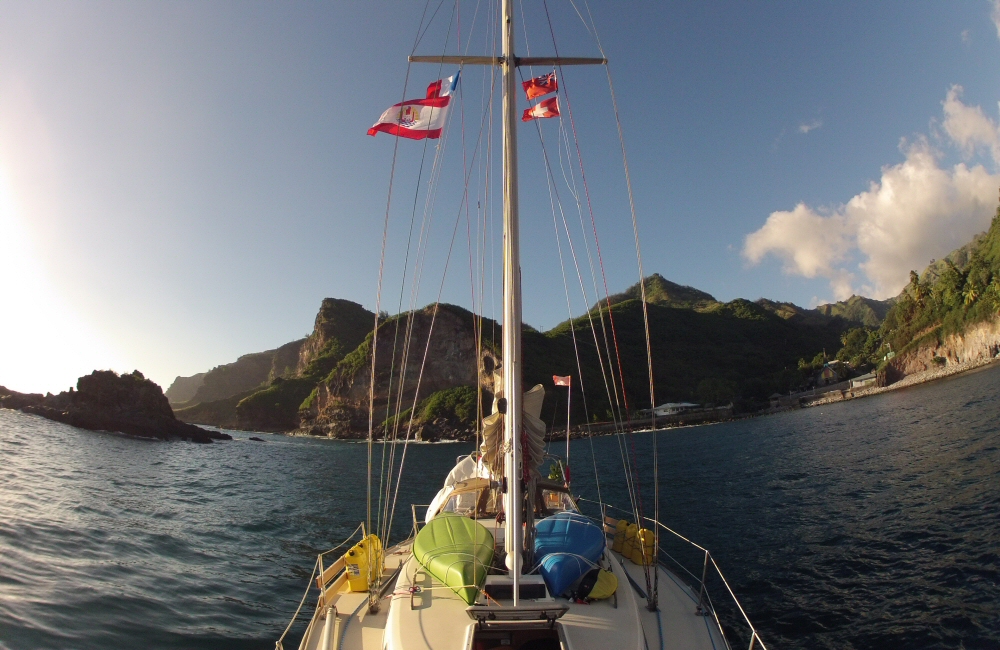
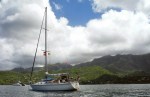
By early afternoon the dramatic skyline of Ua Pou had cleared out of the haze. Sharp needles, towers and spires of bare rock scratching the bottom of a layer of cloud. Reminded me a little of the Isle of Skye. An incredible sight as we approached – Eva and David comparing it to the Torres del Paine in Patagonia, but here surrounded by a thick tropical green carpet and blue, blue ocean. As soon as we rounded the NW corner into the lee of the land, the wind disappeared completely, and then after a few minutes, further down the coast just a few hundred yards, it strengthened from the other direction, coming around the other side of the island, which is about 8 miles north to south and 6 miles east to west. To shelter from the easterly wind, I picked an anchorage on the west coast – Hakamaii bay – a small indentation in the rugged and rocky coastline just big enough for a boat to anchor. As we approached I wasn’t so sure it would have the protection from wind and swell that we needed, and it was pretty small – the tightest spot I’ve taken the boat into so far, on a remote rocky shore at least. But after a few minutes motoring gently about in the middle of the bay, I felt more comfortable, so in 12m of water we set the bow anchor with a buoy (to retrieve it more easily if it snagged) and a stern anchor to stop us swinging into the rocks on each side.
Dave retrieves the stern anchorHakamaii sunset
Nestled in the bottom of the valley at the head of the bay was a small settlement with a colourful church facing the sea, the cross on its spire a little wonky, a few modern looking houses, a pickup truck, a clean white satellite dish and on the hill to the south, banana trees and a brown horse precariously munching on grass on the cliff edge. The sea crashed into the land on a beach of large, light coloured boulders, at the top of the beach a row of traditional outrigger canoes, and in the water a load of kids playing noisily. As we anchored, a guy in a canoe paddled out of the bay and around the cliff to the south. Seems like a gently, happy place.
Sun Apr 12th. A peaceful night at anchor. Church bells ringing early in the morning wake me up – I managed to spend all night dozing in the cockpit without getting rained on, though some very light drizzle in the early hours made things a little damp. Not long before the hot sun dries everything out. Rowed Dave and Eva ashore to take a look around the village, but the surf crashing on the rocky beach put us off landing. An old man waiting ashore signaled to us that the southern side of the bay was another landing spot, from where you could climb the cliffs and walk around to the village, so I dropped them off on the rocks instead. I suspect we’re the first boat to anchor here this year, and he was looking forward to foreign visitors. But D+E didn’t manage to get up the cliffs or into the village, just spent some time exploring the rocks.
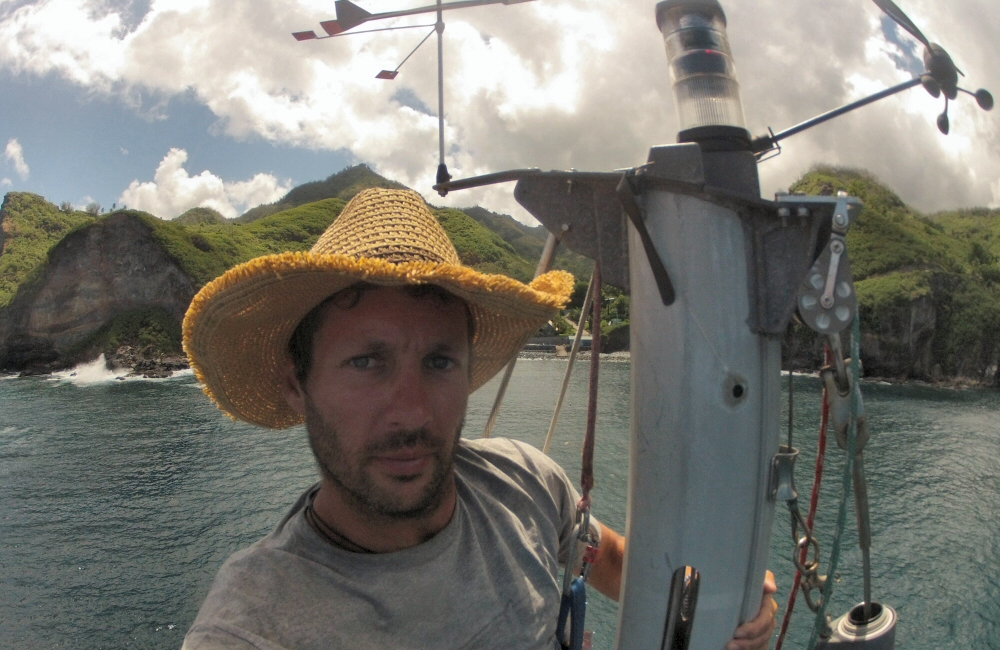
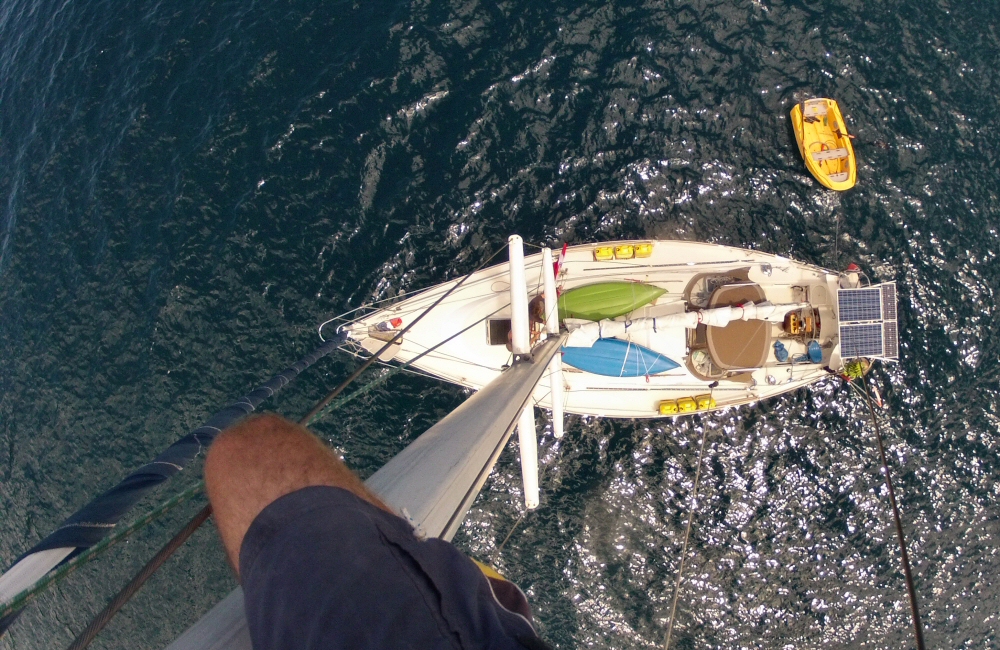
Crew hauled me up the mast to check masthead and rigging, I sealed the bulkhead of the aft cabin with silicone where water had been coming in from the stern compartment following the heavier rain squalls, and then we weighed anchor to set off for the Tuamotus at midday. It’s a 480 mile passage, and at an average speed of 5 knots I’m expecting 4 nights at sea, planning to arrive at the atoll of Makemo early on Thursday morning, just before slack tide, so we can go in through the pass in the coral reef without too much current.
Even though we’ve spent almost no time in the Marquesas archipelago, Ua Pou is our last island here. I feel like I’ve got a good sense of what the place is like, and we have limited time. I want to spend a couple of weeks in the Tuamotus before meeting Rose in Tahiti at the start of May, so we have to push on…
In the morning, the sun shows a dramatic view. Taiohae bay is surrounded by high mountains, all rich with green vegetation apart from where black volcanic features show through; rocks, caves, cliffs. It’s hot and humid already. There was rain in the night, which has washed the salt of the passage off the decks. We drop the dinghy in the water and motor ashore. There’s a concrete wharf and a few buildings, large wooden tables on the dock where the local fishermen butcher their catch. Cars, people, so much to look at! It instantly feels like Polynesia; palm trees, black sand beach, stone carvings and big men with tattooed faces. All the women wear a flower behind their right ear; usually a white frangipani but sometimes a red hibiscus. The land smells damp and earthy. Behind the dock there are a few buildings- a snack shop/restaurant under a marquee because their store front is being renovated, a small clothing shop, and a door to a place called Yacht Services. There are a few fresh veg stands under a roof nearby – we’ll come back later for that.
We have a wander around town – it’s not large, I think there are about one to two thousand people here; but it’s still the largest town in the Marquesas Islands. There’s a tarmac road along the waterfront, and a few other roads running up into the hills behind. The buildings are all in good shape and it all looks smart. First stop; Gendarmerie, to clear in to French Polynesia. As we’re EU citizens, it’s a quick and painless process; just a few forms to fill, and then post one off from La Poste opposite, where we also find a cash machine to get some money out. We pick up a baguette sandwich from a man that is trying his best to be a woman, find out where we can get the propane tank refilled, and catch up with folk back home briefly on the internet.
Coming ashore again later in the morning, the rusty ladder I’m climbing up breaks and lacerates my foot deeply. Blood everywhere – pumping out of the wound with each heartbeat – so I lie down and stick my foot up in the air to slow the bleeding. Another sailor comes by with some iodine and a bandage, we wash the cut, I slap the dressing on, and decide to hobble up the road to the local clinic. We have all the medical stuff we need on board; cleaners, creams, stitches, antibiotics – but as we’re near professional help I may as well make the most of it.
After a couple of hours in the clinic, chatting in French to the jovial nurses Roland and Jean, waiting for the doctor to come back from lunch break, and getting the job done, I’m ready to hobble back to the dock. Annoying, since I need to keep it out of the water until it’s fully healed to prevent coral infection … fortunately the Marquesas aren’t a beach or snorkelling spot, and hopefully by the time we get to the Tuamotus in a week or so it will be all better. Just a good reminder of how careful we need to be. Eva and David start up in song … “Captain hinkbein [and the rest in German]…” – something about a peg-leg captain hobbling along. Ha ha.
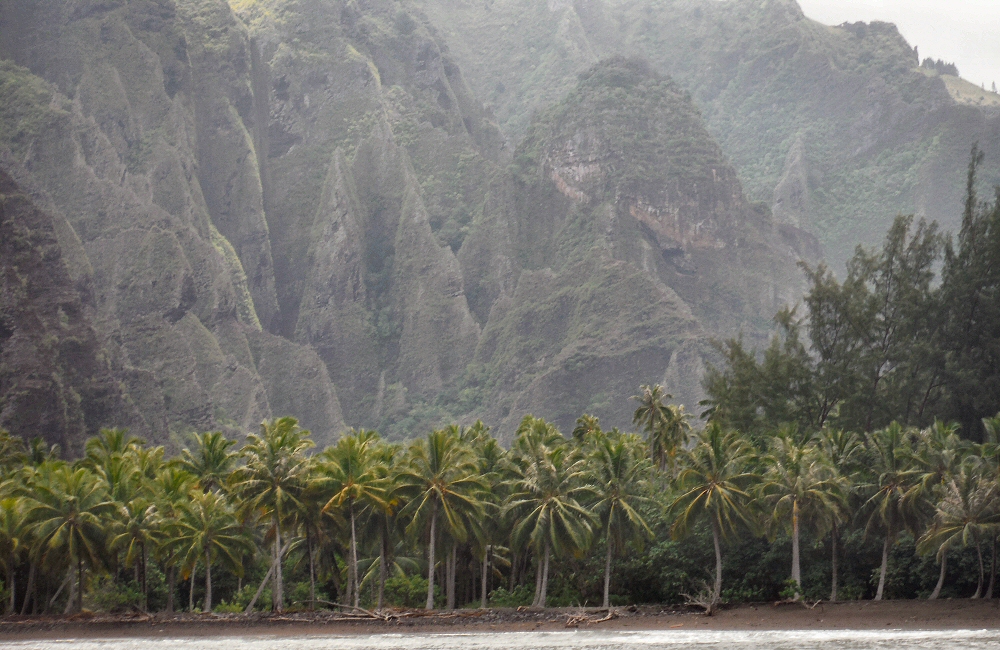
Next day when the local supply ship has moved off the dock, we fill all our bright yellow jerry cans with diesel, pick up the gas tank and by mid afternoon, set sail for the next bay 5 miles along the coast. The sun sets just as we’re getting in, but there’s enough light to show an incredible backdrop of huge black fluted cliffs, rising straight up to 1000+ metres.
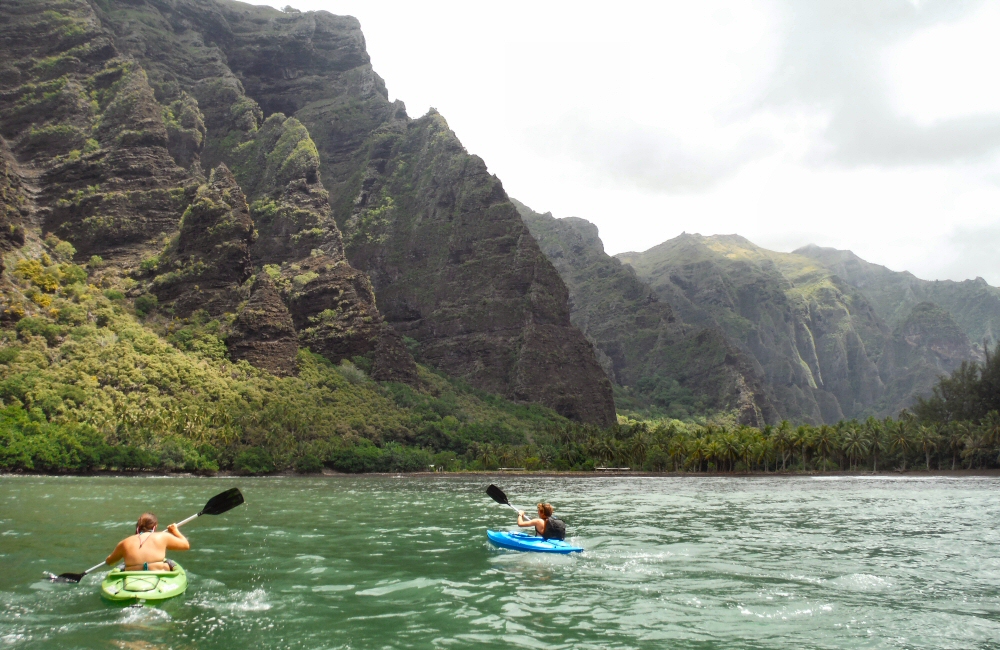
In the morning the dramatic anchorage really impresses. The cliffs are viciously jagged, climbing into the clouds so steeply that it’s mostly bare rock, green bushes clinging on here are there, with a light dusting of yellow blossom. On the other side of the bay, the hills are lower and rolling. There’s only one house, in a clearing cut from the trees. Smoke rising from a fire, cockerel squawking, washing hanging on a line, a couple of small motorboats anchored just offshore. The bay is in two sections; like rabbit ears, the east lobe where we’re anchored, and the west lobe where there’s a black sand beach, and a row of palm trees under the cliffs. We get the kayaks off the deck, put the dinghy in the water and all paddle round to the beach.
Dave and Eva wander up the valley to the “3rd highest waterfall in the world” – a 5 hour round trip hike – and I sit on the beach for a while. With just one operating foot, getting ashore through the surf, and then dragging the dinghy up the beach was interesting. Thinking maybe it’s not so wise to be hanging around under the coconut trees, I move down onto the sand and just sit there, soaking it all in. Soon the biting bugs arrive, so I head back to Rafiki to relax for the day.
6 hours later I get a call on the radio – “We need a pickup!” – Dave and Eva have found a young polynesian couple and bought more fruit than they can carry in the kayaks, so need me to row round in the dinghy. They carry the fruit out to me as I wait in the small surf; papaya, pamplemousse, star fruit, guava, lemons, oranges, and half a tree of green bananas. We’re going to have to work hard to get through all this before it goes off! It’s dark by the time we get back to the boat; we have dinner and then, as usual, I fall asleep in the cockpit soon afterwards.
It’s a calm, quiet anchorage, with two other boats here, one of whom we made the crossing from Mexico with, and the other a Canadian boat who is on a similar schedule to us, so we might see them again further down the line. Tomorrow, we’ll set sail south for Ua Pou, the next island.
Two days ago, at 4pm, I write in my journal; “Since early this morning we’ve had 25-30 knots of wind, and chunky seas. We made 146 miles yesterday, equaling our best day yet. It’s 300 miles to Nuku Hiva – if we can keep up this pace, we’ll be in on Wednesday, will try and arrive in the light”.
I decide to aim for an evening arrival, before dusk. I’m not happy coming into a new port at night, so if we don’t make it, it may be a case of waiting around offshore for the night, which would be nasty, and an anticlimax. We need to do 300 miles in 48 hours. That’s more than we’ve managed in any of the 48 hour periods since Mexico. Ambitious. The wind stays up, and we are under full sail, trying to average over 6 knots. We’re on a broad reach, with the strong trade winds coming from our port side, and I’m trimming the sails all the time to keep up speed. There’s a current with us, giving us a welcome boost of more than a knot at times, and we sometimes see 8+ on the speedo as we surf down the face of the bigger waves. Hoping for the wind to stick with us.
50 miles from land, I’m looking out across the horizon every 5 minutes, but really we’re still too far offshore to see anything. At 6 feet above sea level you can see for 4 miles before the curve of the earth gets in the way, unless you or your target are higher, in which case you can see further. On a clear day you can see France from the cliffs of Dover, which is 22 or 23 miles, because you’re higher up. So even though the islands here rise to more than 1000 metres, I think 50 miles is a bit optimistic. But I keep looking!
Now late morning on Wednesday, and there should be an island 20 miles off to port, 600 metres high, but I can’t see anything yet. It should be there. These days it’s not a case of worrying about whether you’re in the right place, using the sun and stars for navigation. My GPS chart plotter says land is right there, and I trust it. But it’s hazy. I’m wondering whether the island will slowly rise over the horizon, or whether it will appear out of the haze. I keep looking. And then at 1210 I see the slopes rising into the clouds! Land! Faint lines, only just visible, could almost mistake them for gaps in the cloud. But within a few minutes it’s clear, this is LAND! It’s Ua-Huka; not the island we’re aiming for, but pretty special after having completely empty seascapes for nearly a month. We’re still scanning the fuzzy hazy horizon ahead for signs of Nuku Hiva… which appears mid afternoon as we get within 15 miles.
It’s dramatic. Looking from the left, the land rises vertically out of the sea to about 600m, and then climbs up into the clouds along a vicious crenelated ridge. Sometimes there’s a fuzz on the ridge where a stand of trees has managed to grow. The peak is hidden in cloud; first a horizontal band of streaky grey and white, and then out of the top of that, a fluffy bumpy mass of cumulus, bubbled up by tropical afternoon heat on black volcanic rock. Further to the right (the island is pretty close by the time we see it), a number of steep ridges tumble back down out of the clouds, closer ones being darker, and gradually getting lighter as they go around the island, like mountain ridges fading into the distance.
Within a couple of hours we’re approaching the cliffs on the left hand side, and around the corner is first Baie de Controlleur, and then Taiohae bay, the Port of Entry. Are we going to make it before dark? It’s still a close call, and we have to keep up speed. The sun is starting to get lower, dropping behind the clouds that cloak the island, silhouetting it against a grey sky, so we can’t see any of the fabled lush green slopes. Only gnarly black shapes – the land looks young and unweathered, fresh out of the sea just a few million years ago.
Dolphins race, twist and surf in the waves around us to welcome us in; Eva says “whales to say goodbye [from Mexico], dolphins to say hello” – it’s a pretty special arrival. I have to interrupt her photo session to get the genoa gybed and up on the pole out to port so that we can keep up the pace. Still a few miles to go, and the light is leaving us. We’ve sailed fast, and beaten our best day by a long way; 156 miles noon to noon! But we’re not finished yet.
Finally we turn the corner into the bay, get the sails down, and motor in past a huge white quartz cross, slicing through the cliff on our starboard side from summit to sea, maybe 200m high and 400m wide. The horizontal band is a little darker, harder to see than the vertical stripe, so at first in the half-light it looked like a huge waterfall pouring off the top of the island straight into the ocean.
Loads of boats! Maybe forty or fifty other yachts here – I’m really surprised to see it so busy. I think we’re only the third boat in from Mexico this season, so the others will have come in from Panama and the Galapagos, or else perhaps Tahiti and other places west of here. Just as it’s getting too dark to see, we find a spot in between a few catamarans, close in to shore, and drop the hook. I pick up the scent of evening flowers. Lights of cars move up and down the sea front, sailors buzz back to their boats in noisy little dinghies after an evening meal ashore. So many new things for the eyes, nose and ears to deal with – it feels more than a little surreal.
Anchor down. Engine off. Rafiki lies still and quiet for the first time in weeks. Passage over. Amazing. We made it! 28 days at sea, 2712 miles as the seagull flies, 2919 miles sailed (and drifted). Nothing (major) broken on board, nobody injured. We rustle up some pasta, a celebratory gin and tonic (I forgot to put the champagne in the fridge), and before I know it I’m asleep in the cockpit, job done.
We’ve arrived in the Marquesas! Made landfall at Taiohae Bay on Nuku Hiva, just before sunset, the day before yesterday. 28 days at sea, 2800 miles, and 2 timezones later. Just a few photos for now… lots of things to do now that we’ve reached land.
Boat’s ready, crew’s ready. Time to go! I’m just about to untie the dock lines and say adios to continental soil for a very long time. The passage ahead fills me to the brim with excitement. It’s going to be an experience different from anything I’ve done before, and I’m looking forward to the challenge. It will be a test of determination, endurance, motivation, engineering, navigation, leadership and most of all, seamanship.
The first leg is 2,800 miles to the Marquesas Islands, which I expect will take between 23 and 28 days, depending on the weather. The first challenge is to get off the coast of Mexico into the NE trade winds. The weather can be quite calm for hundreds of miles out to sea, so the trick is to wait for a pulse of wind coming down from the north to carry us out into the stronger wind. Many boats are still waiting here, watching the weather forecasts for a significant signal to go, but a few are now starting to push out from Mexico to try and find wind. I think it’s better to be making some headway, if only slowly, than sitting in a hot, airless marina twiddling thumbs.
We sail south west for about two weeks (!) to the northern tip of the doldrums – an area just north of the equator where the NE trades and SE trades meet. Up until this point it should be pretty plain sailing, with the wind behind us or off to one side, warm and relatively calm. Often, sailors complain of too little wind. Once we get to the doldrums (otherwise known as the ITCZ – Inter Tropical Convergence Zone) the weather gets much more unsettled – think monster tropical thunderstorm cells, squally weather, and rain … interspersed with dead calms. The idea is to cross through this as fast as possible, which is why the line on the map above ducks southwards for 500 miles or so. We might have to motor through here, so I’ve loaded up with many cans of extra diesel.
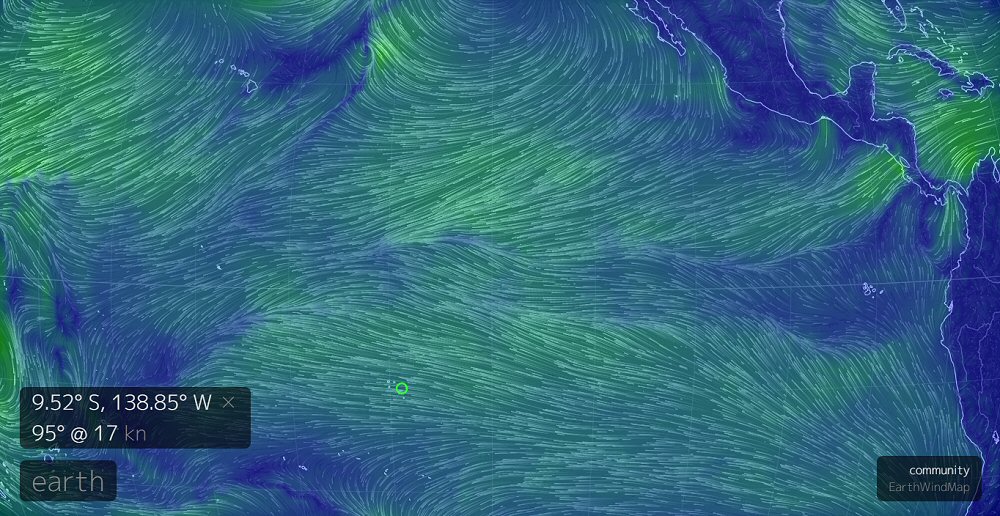
You can see the current wind conditions on earth.nullschool.net, an excellent representation of the GFS global weather data. The green dot on the image below is the Marquesas islands.
Pacific winds on 9th March, showing a wide band at the doldrums (ITCZ)
Once we’re through the doldrums, we turn to starboard and with the south east trades behind us, make the final 800-odd miles to either Hiva Oa or Nuku Hiva in the Marquesas. We should be able to average 4 knots or so, which means we average 100 nautical miles a day. That’s the plan, anyway.
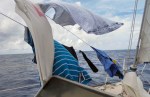
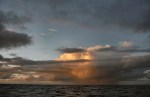
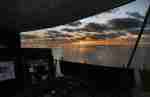
I’ll be sending updates from the satellite phone to the blog, but no pictures. It’s only sea and sky anyway, so nothing much to see! Though I’m expecting some pretty epic skyscapes as we go through the doldrums…
Mother earth, give us fair winds and calm seas.
Rafiki, do what you do best and carry us safely through whatever conditions come our way.
Off we go!













 Road and Ocean