Don’t you just love it when a store decides to run a big discount on something that’s been on your wishlist for a while? Today is West Marine’s “Friday deal” – which is a tidy 40% off all bulk rope. Whilst it was tempting to go overboard (how many phrases have nautical origins?!) and replace most of the tired lines around the boat, I was able to restrain myself to the “need” rather than “want” list.
The other day on the trip up to Point Reyes we got some nasty riding turns on the jib sheets, partly due to the ancient, flattened and fluffed ropes. So they were up for replacement. I got blue ones thinking that all the other lines aboard were white … making it easier to give instructions – “pull the blue one”. Getting back to the boat I see that the jib furling line is also blue. Oops. Ah well. At least now I’ve got two more tired, end of life ropes hanging around … perfect for holding the kayaks down!
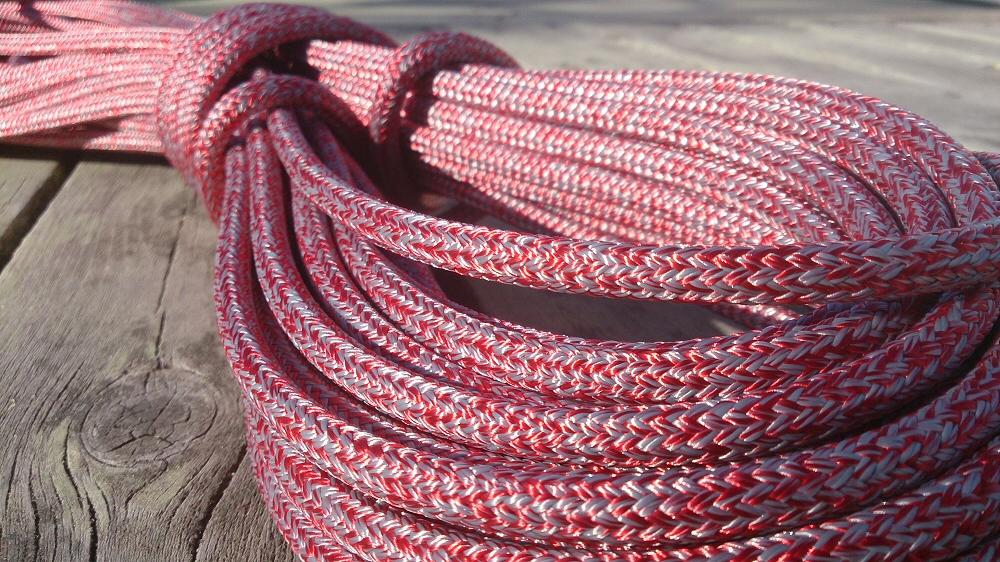
I have no halyard backups to use in an emergency if the jib or main halyards go, and at some point I’m going to be looking for a spinnaker, so it also made sense to get the line for a new halyard too. Ended up with 8mm dyneema. I’m amazed by the breaking strength of this stuff – it claims 7000lb, which means that I just need 3 lines to hold the WHOLE BOAT up in the air.
So, now I have another job for the next trip up the mast; fit a spinnaker halyard crane and run the line. It’s also going to need a cleat on the mast.
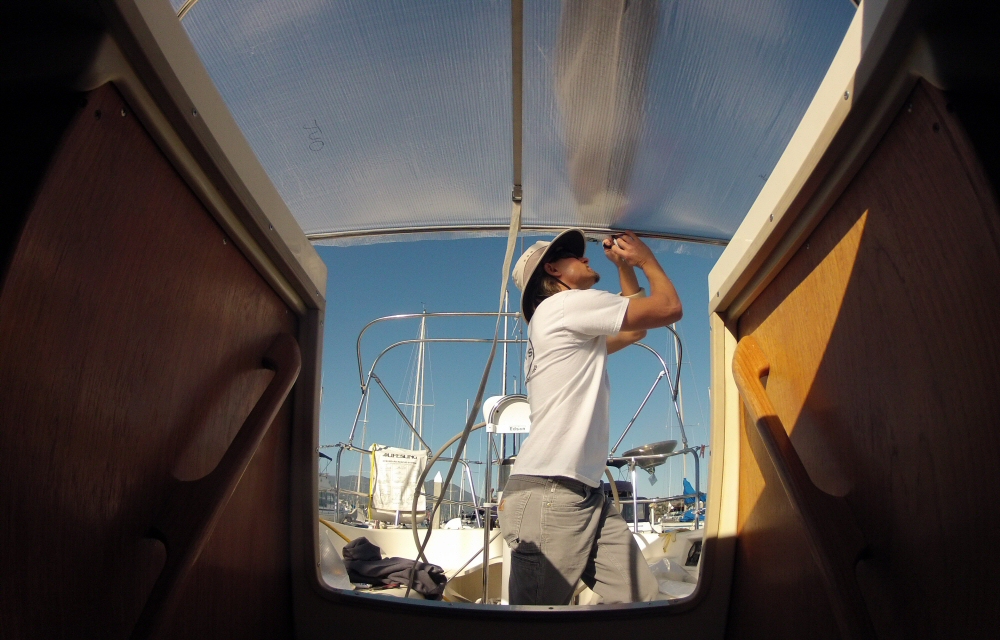
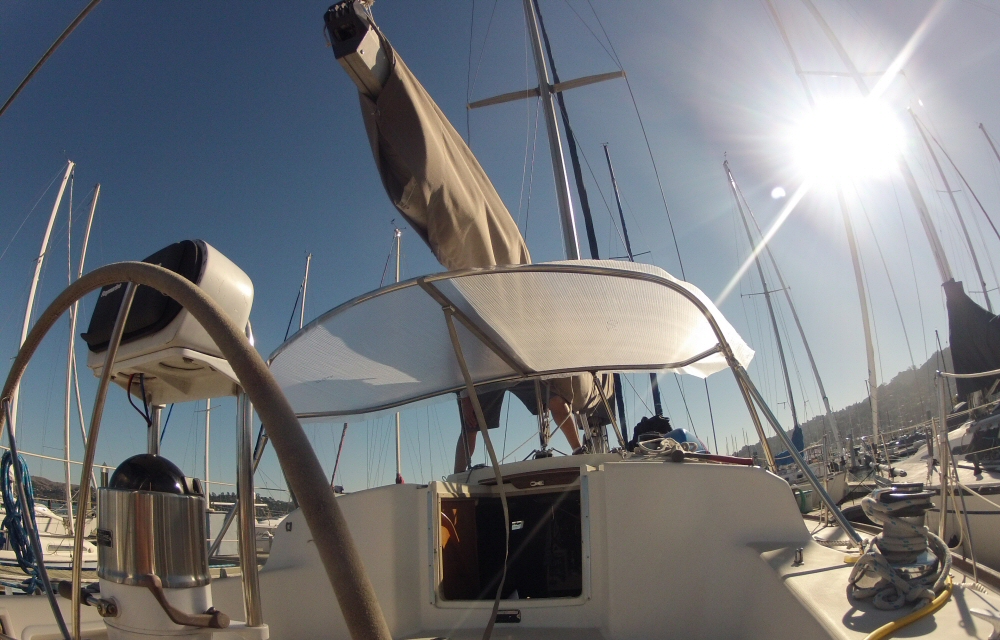
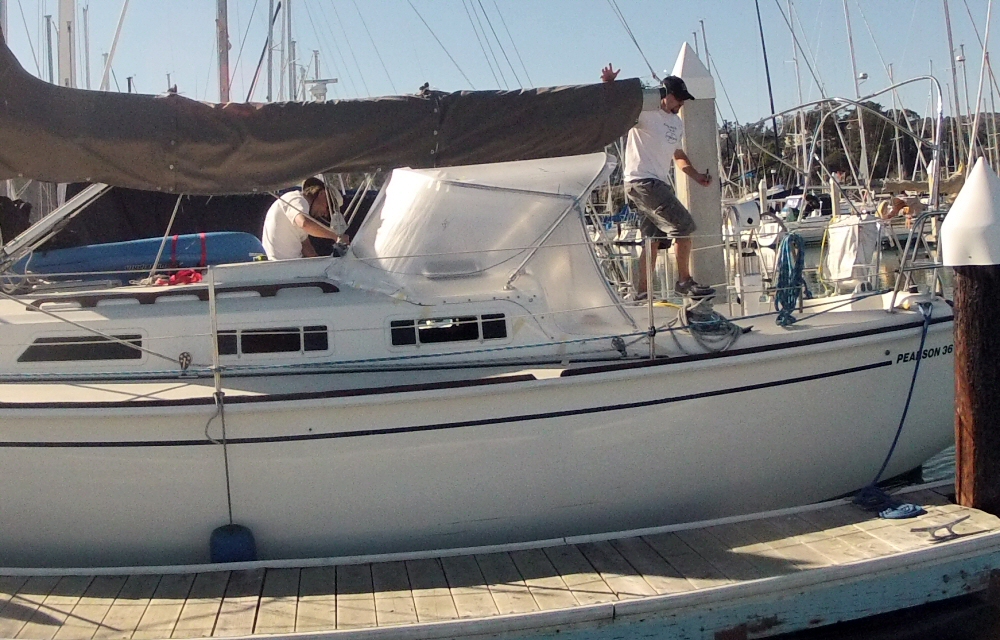
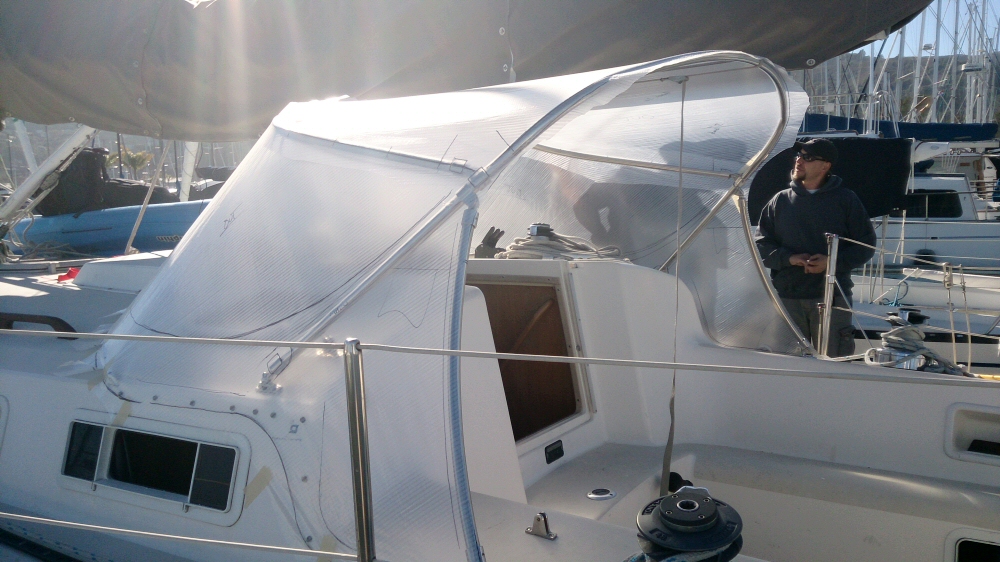
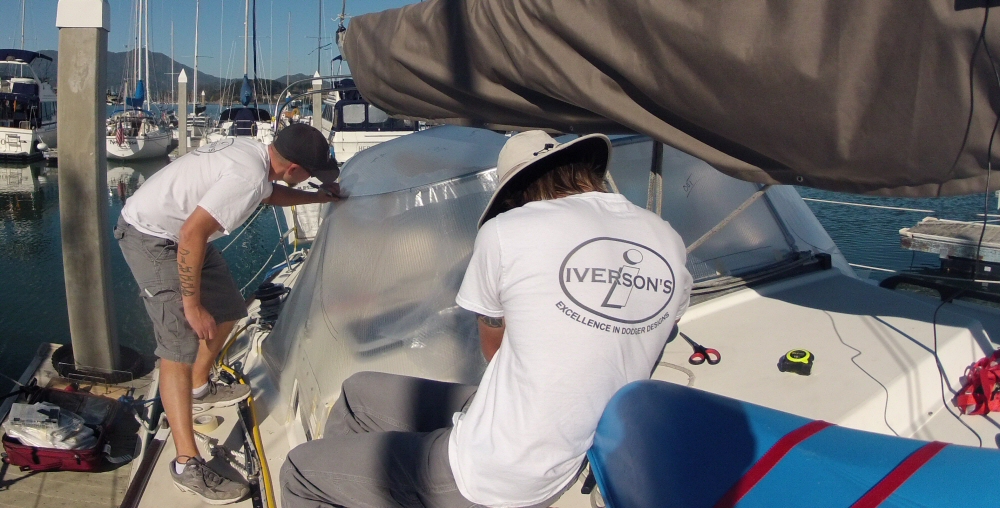
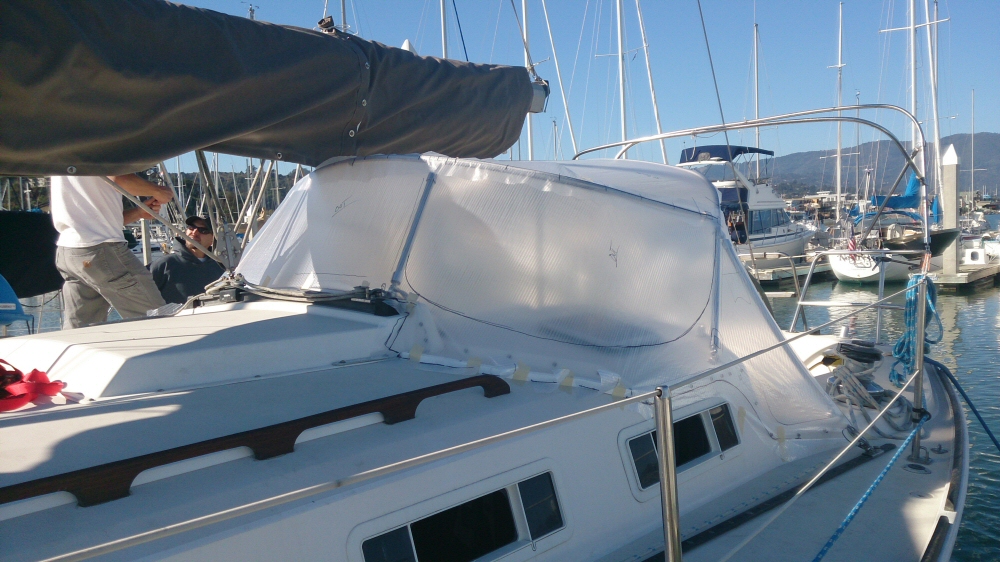
Today I was working from home. The internet is fast enough to do what I need now that we’ve installed a WiFi booster and aerial – it claims to work up to 5 miles offshore with a good signal and line of sight! But where we are a few boats down from the dock transmitter is fine too, even though there’s a big beast of a motor boat in the way. Anyway, the reason I based myself here today was to be around for the first stage of the dodger install. Two guys from Iverson’s came down from Washington and up from San Diego – they also have a few other jobs in the area. The frame was mailed to me last week, and today they set it up and measured out the panels.
I love sailing without a dodger (what we call a spray hood back in the UK). It gives you so much visibility, and you feel much more like you’re part of the world around you. On Rancote we almost always sailed with the fold-able spray hood down. Thinking about that always makes me feel lucky to have had such good weather for our trips over the last few years. Either that, or exceptional planning and weather awareness. But we’re going to be heading off for longer offshore trips when it’s going to be wet, windy and grim, and we’re going to be heading south when hiding from the sun is just as important as hiding from the spray. This thing will have fully removable windows so we can use it in sunshade mode too. The trickiest decision is going to be choosing the colour! We got a new sail cover a while back in taupe, thinking that we’d get the spray hood done in the same, but having looked at samples today I’m thinking that a coffee brown would be nicer. These white plastic boats could do with a bit more brown.
It’s been super warm, too. And really peaceful. The wind is blowing slightly onshore which means there’s no highway noise at all. Only the chink chink chink of halyards against masts, and the gently plop plop of tiny waves lapping against the hull. And yes I did manage to get some work done. However it does really set the mind thinking about getting away from the dock and off to new places, away from cities and gazillions of people.
Rose got back from a trip to the David Hockney exhibition at the De Young museum with Kate and then we took the kayaks out for a paddle as the sun went down. You can just see the city in the background. Last night was the full moon – a “mini moon” – the smallest this year. I bought some 7×50 binoculars last week and we checked out the night sky last night – with Jupiter above the moon as it rose. I was sure I could see Jupiter’s moons – is that possible through binoculars?
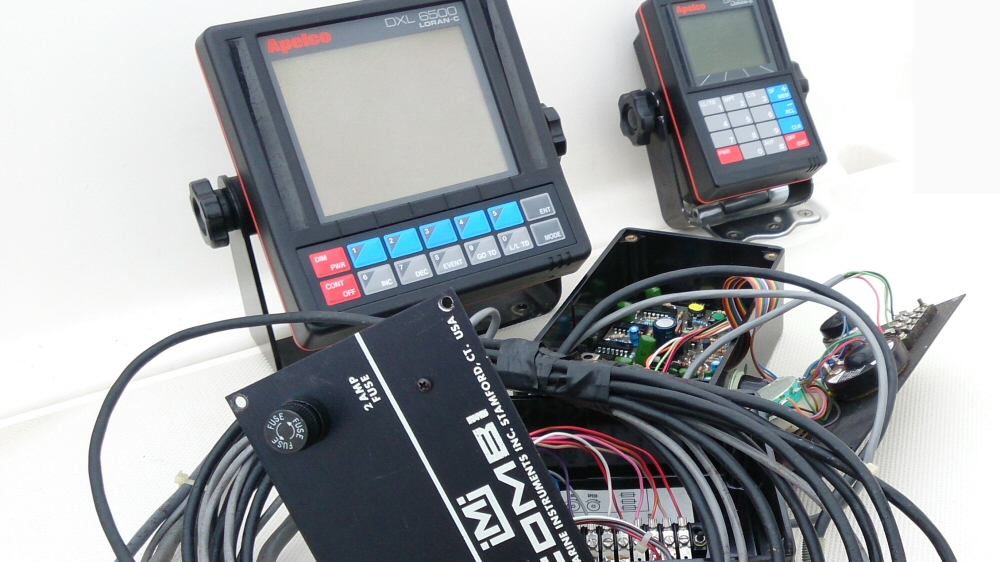
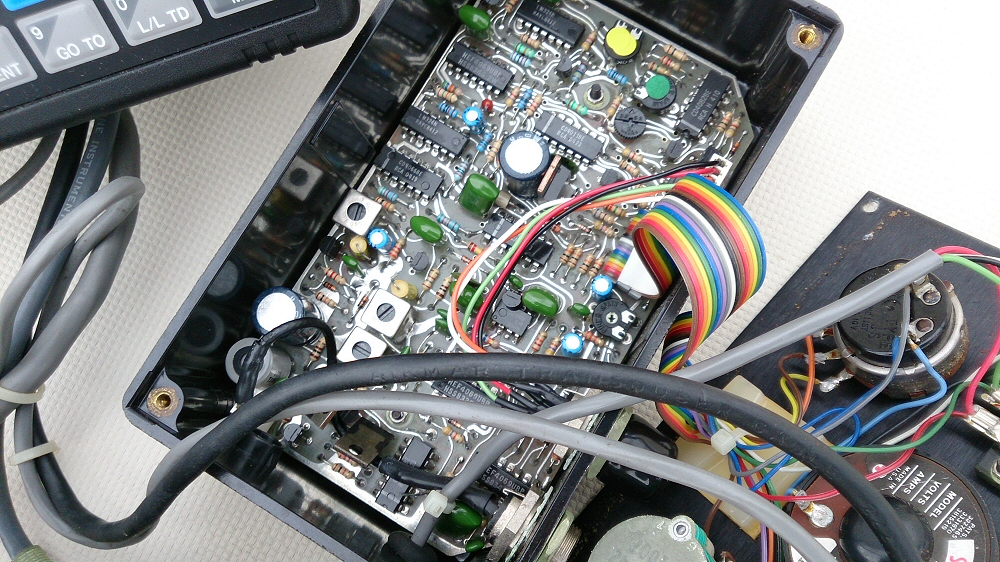
One of the big projects on the boat over the past few months has been installing a new set of electronic instruments. I bought the boat with original kit still installed – speed and depth sensors, and a Loran setup for navigation. From the first owner’s receipts I can see that it all added an extra $20,000 to the price of the boat! I didn’t even need to check if it still worked. It may well have done, considering how fastidious the previous owner was about cleaning… or maybe it didn’t, since I don’t think he was so hot on the sailing side of things. The reefing lines weren’t even set up properly. But I digress.
Old skooolMore art than electronics
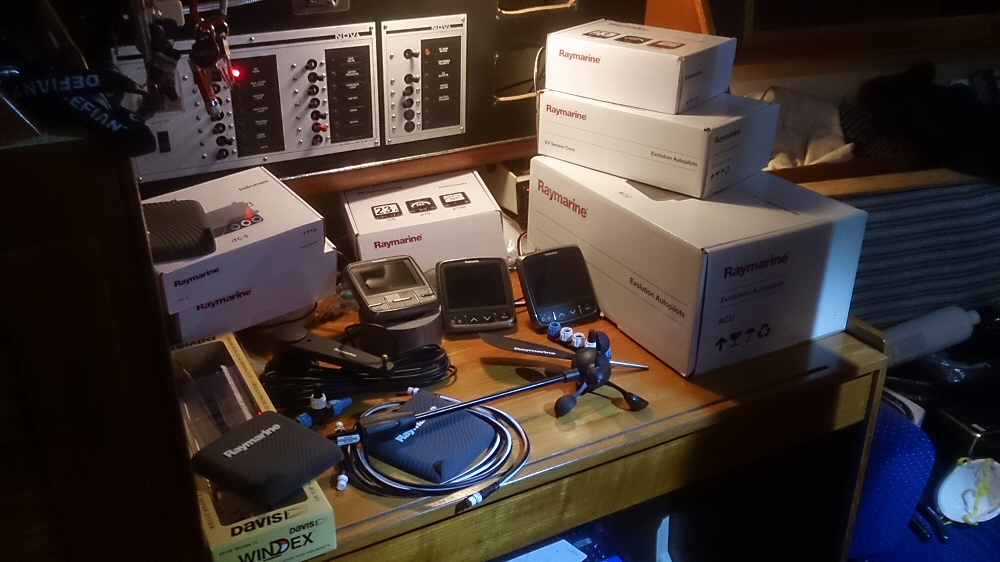
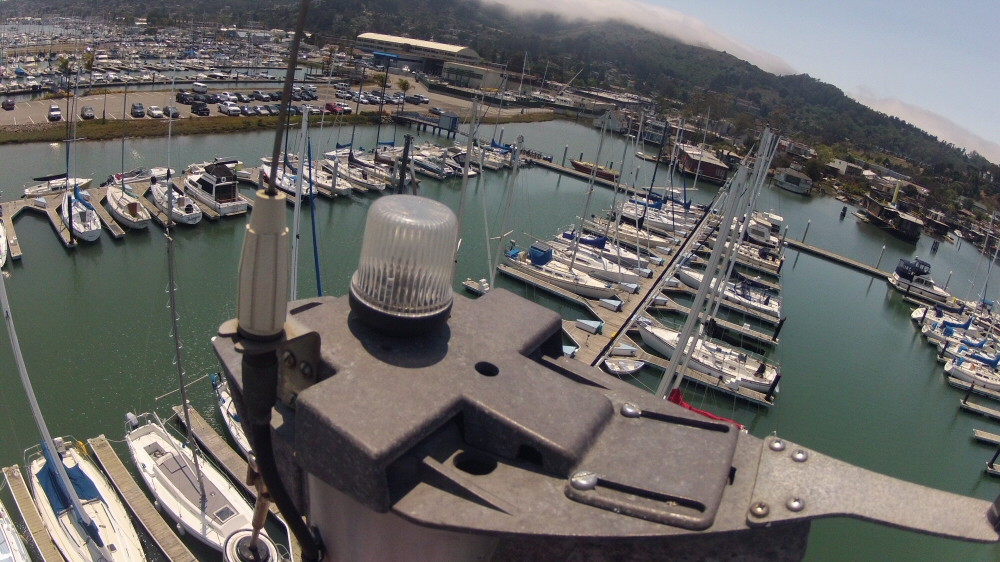
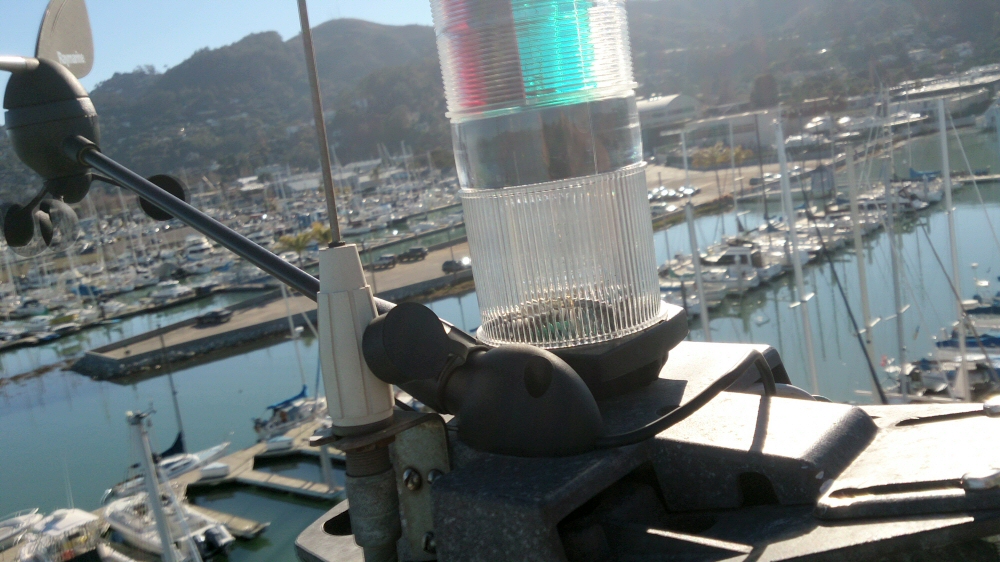
I spent weeks researching options whilst still in the UK. I knew I wanted a modern below-decks autopilot which was going to need a modern boat network system, and pretty much most of the other stuff hung off that. Warning – this is probably going to turn into quite a technical post! So, having chosen to buy the Raymarine Evolution system, it meant that Raymarine stuff was the most sensible for the rest of the system. I needed new speed and depth sensors, new wind speed and direction sensors, and some way to tell the autopilot where we were going and how fast we were travelling (Course Over Ground and Speed Over Ground from a GPS). Because there was no wind instrument before, it also meant I had to run wires all the way to the masthead. There were no masthead nav lights either, other than an old non-functional anchor light – so whilst I was up there I planned to add an all-round tricolor. I considered LED for this, but having read too many stories about excess VHF interference after a few months, I decided on classic tried and tested incandescent light bulbs. Hey, I can always switch the bulbs for LED ones later.
New goodies
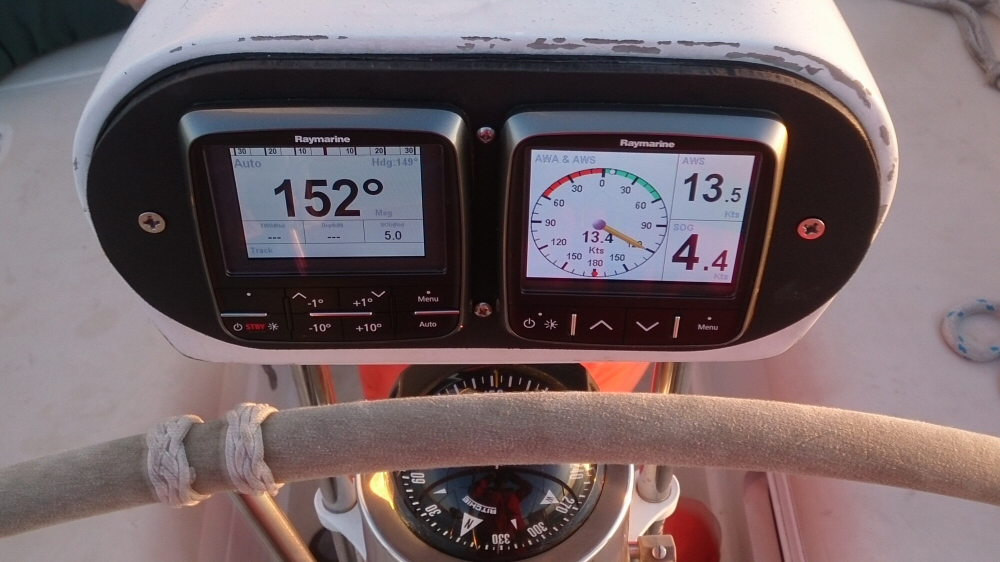
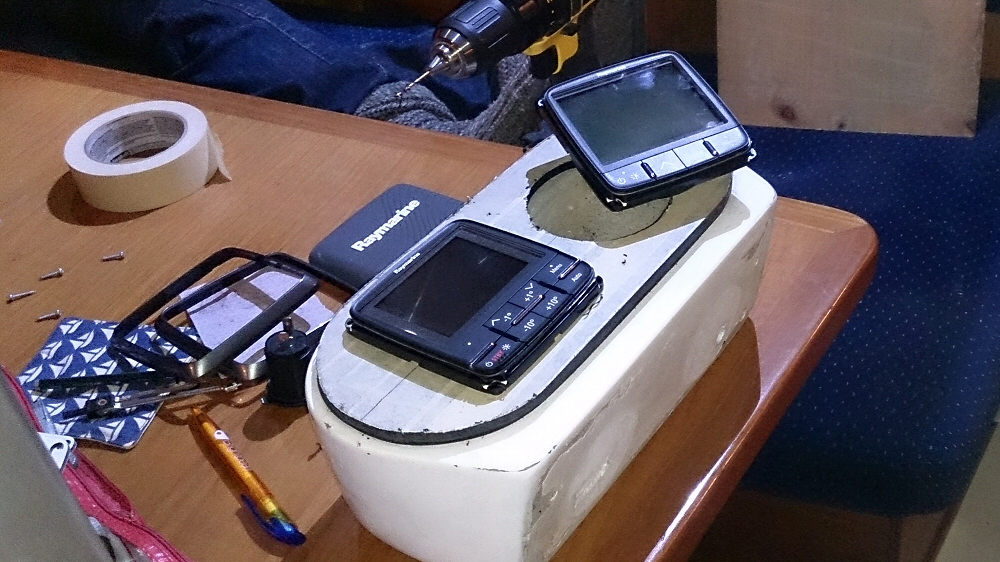
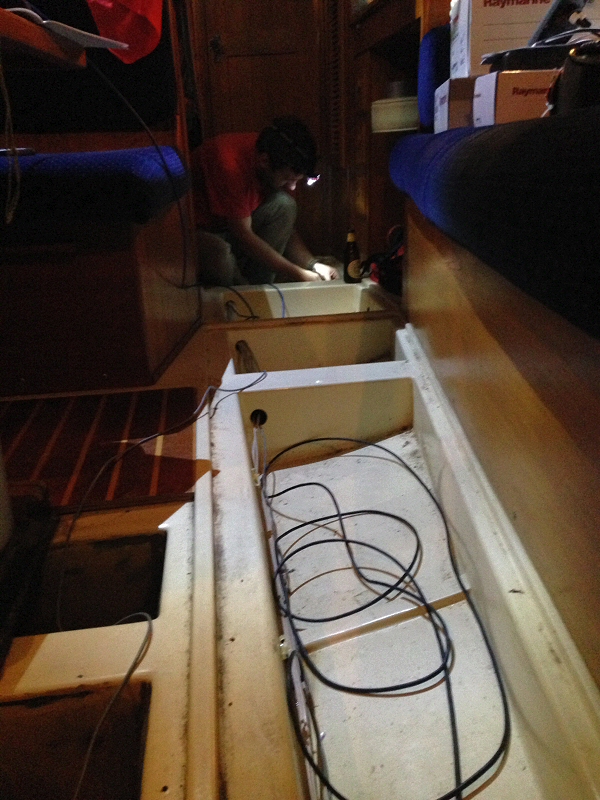
Once all the kit arrived it was a case of spending a good few evenings routing wires around the boat ready to add the sensors and other gubbins. At the masthead is the Raymarine wind jobby, with a wire that runs down the inside of the mast to a converter device under the forward saloon seat which converts the signal into the SeaTalkNG that the rest of the network needs. Also plugged into this is the speed/depth/temperature tri-ducer, which needs the boat to be hauled out of the water before I can fit it. I’ve an i70 display unit at the chart table, and one at the helm. There’s also the autopilot control head at the helm. I modified the original instrument pod at the helm with a new plastic fascia. Not too glamorous, but waterproof and solid.
Instrument podSystems are GO
The Evolution course computer and drive controller sit out of harm’s way at the back of the huge cockpit locker.
Running wires under the floor
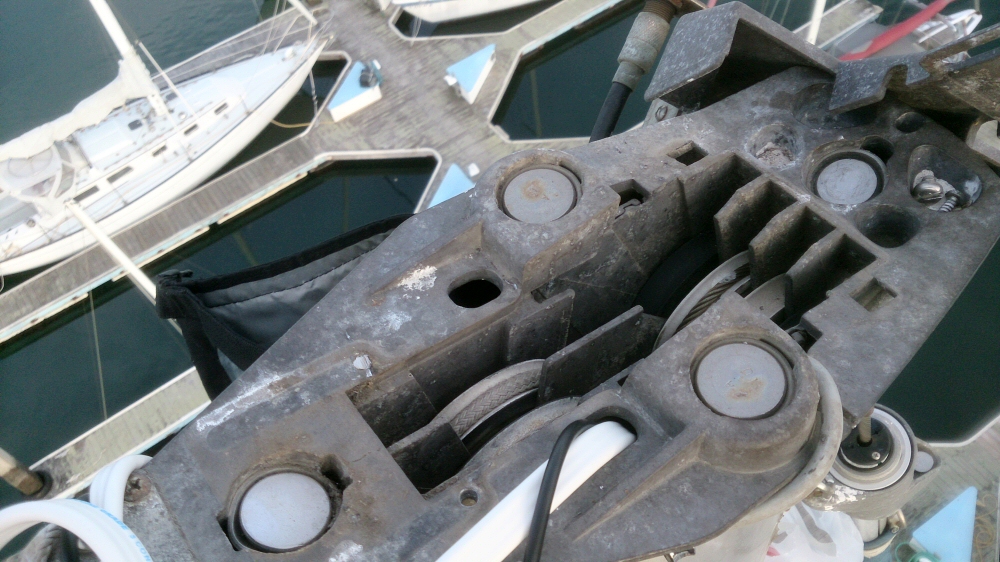
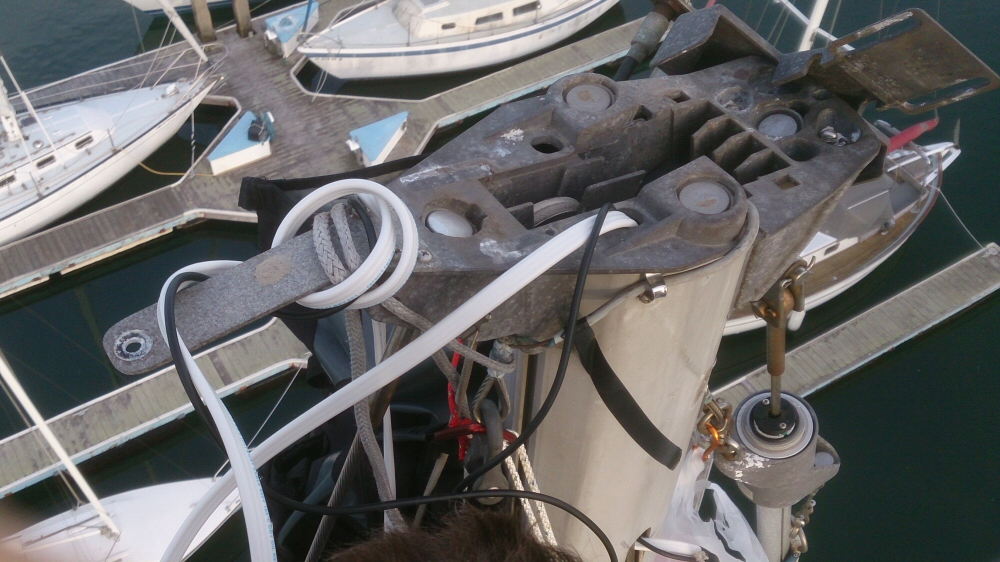
Rose hauled me up the mast one Saturday to get the wires in. Fortunately the messenger line was still intact (a line added by the manufacturer for just this purpose). The idea is that you tie your wires to it, then haul the line down through the mast. I fed them down from the top with Rose pulling from the bottom. It’s a keel stepped mast which made this job easier than I expected – though it still took a good few hours. I was still up the mast as it got dark, not yet finished. An hour or so later I was nearly hypothermic, so had to abort for the day. Everything was connected and fixed on – just the mast cap needed bolting down.
Before …and after!
Mast cap offFeeding wires
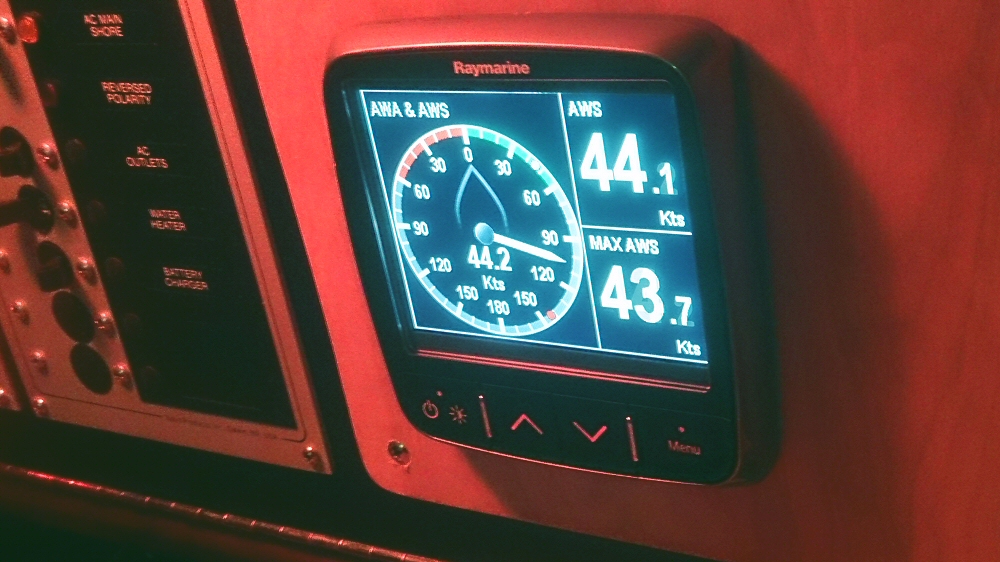
Once everything was plugged in (apart from the autopilot drive unit, which needs some serious engineering / fabrication that’s beyond the odd evening’s work), I fired up the system and the displays came online. Sweet. Now I could see the wind speed and direction at least. A couple of nights later it got pretty windy. We never had technowizardry like this on Rancote, so it’s all going to feel rather extravagant.
A frisky night!
I spent some time hunting a good deal on eBay for a GPS unit and ended up with a Garmin 17x NMEA2000 unit for 90 bucks. Pretty good. Better than the $300+ that Raymarine are asking for one of their units. That went in without any problem, so now we can see where we are. One of the challenges is that the instrument network is uses a system called SeaTalkNG (which is compatible with NMEA2000), but the VHF radio I bought in April, perhaps a little prematurely, only interfaces with a GPS signal on NMEA0183. I’ll figure that one out later.
And that just left the autopilot drive unit to install. This was going to be the biggest challenge, and needed some thinking time. It’s a beast of a machine which can pull up to 750 pounds on the rudder, which means it needs to be mounted REALLY strongly somewhere in the transom. As it’s such a critical piece of the project, and as I’m by no means a fibreglass construction pro, I thought I might get the guys at the local yard to do this. After getting a quote for well over $2000 I soon changed my mind. They wanted to haul the boat out of the water to get it closer to their air powered tools, and whilst it was out give it a new coat of paint on the bottom. The local yard doesn’t let you do your own work due to environmental regulations, so we had to pay labour for painting … anyway it was all going to be well over budget so I decided to do it myself.
After a load of templating with cheap, thin timber I put together a solid marine ply shelf that was screwed and glassed in over the period of a couple of days. It’s solid. And now I’ve the confidence to tackle most other fibreglass jobs that come along. Granted, it’s not the most beautiful of jobs, but hidden away down there nobody minds. Finally I bolted down the drive unit, hooked it up and we were in business. The Evolution autopilot “dockside wizard” took a few seconds to run through and then we were running. Just in time for our cruise over the bay to see the new year fireworks. Let’s see how it all runs when we get to sea.
The last piece of the puzzle is to get the speed/depth sensor put in, which I’m going to do when we haul the boat out for a bottom paint at Napa Valley Marina in January. The depth sensor actually works from inside the boat if I mount it into a short piece of PVC tube filled with water – which is great for the trip up the river but of course not a permanent job.
Paperwork for the ship’s radio licence arrived today, which means I now have an MMSI number which is needed for DSC calling, and most importantly it means that I can send instant mayday calls with the DSC distress button on the VHF radio. I’ve not yet got a GPS connected up to the radio, so we’re not quite there yet, but this is first base. It cost $160 to register with the FCC here, whereas in the UK (if I recall correctly) it’s free to get listed on the Small Ships Register. The boat is registered in California however, so I can’t use the SSR – and it’s going to be a lot easier in foreign ports if the boat papers and licences are all US rather than a mix.
One thing I’ve not really had to do much of over the past few years is build things. Somehow I’ve managed to get by with a basic set of tools, borrowing where I didn’t have what I needed, and I guess a fair bit of luck with things not breaking. And a bit of planning – buying stuff that didn’t need much fixing up.
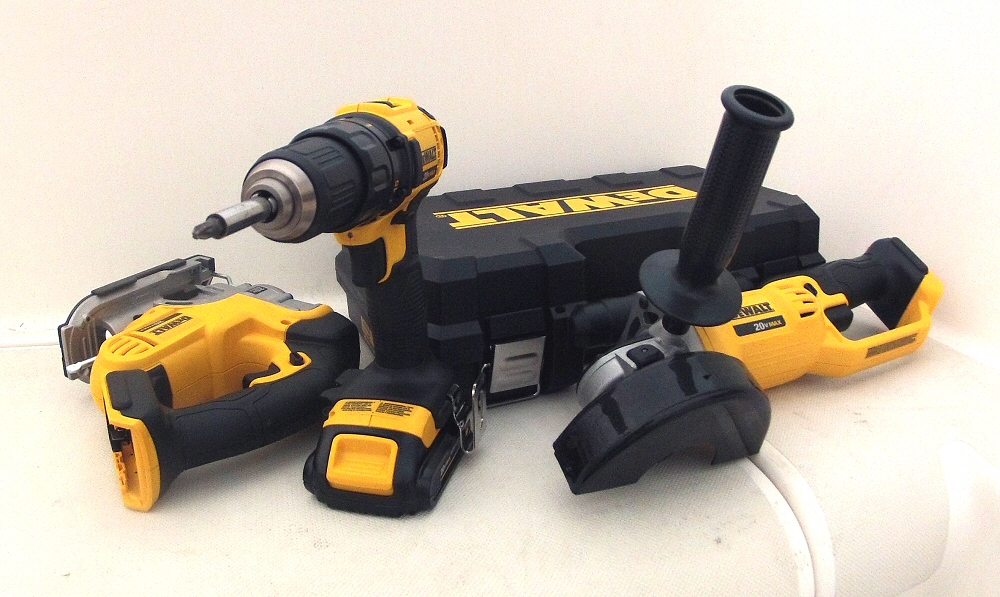
Now, however, I have a whole new list of projects reaching out ahead of me for at least a year; working on the boat, converting a van… which needs tools! Like an excited kid at Christmas I spent an hour at Home Depot in the power tools section, figuring out the best combo. It all had to be battery powered, too – so that I can repair stuff and build things offshore. I ended up with a nice new set of DeWALT 20v tools. Just the fact that I’ve devoted an entire post to this shows how much I’m looking forward to getting my hands dirty and building / fixing stuff again. It’s been a while!


 Road and Ocean