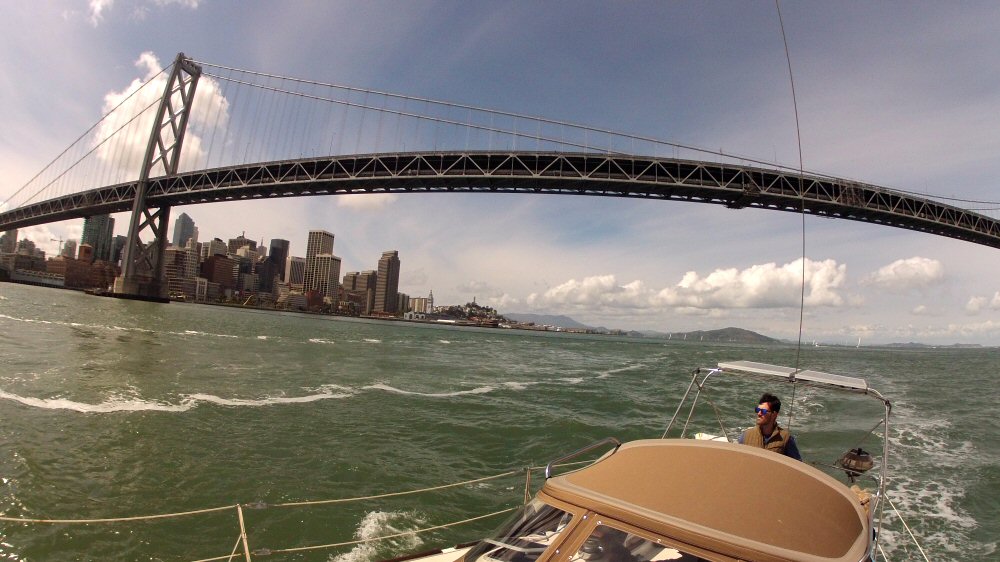
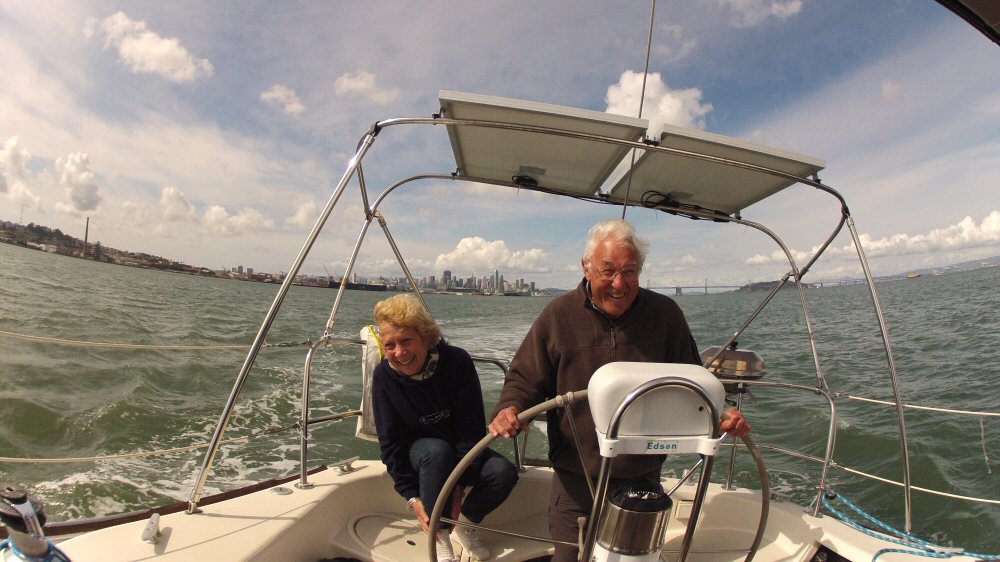
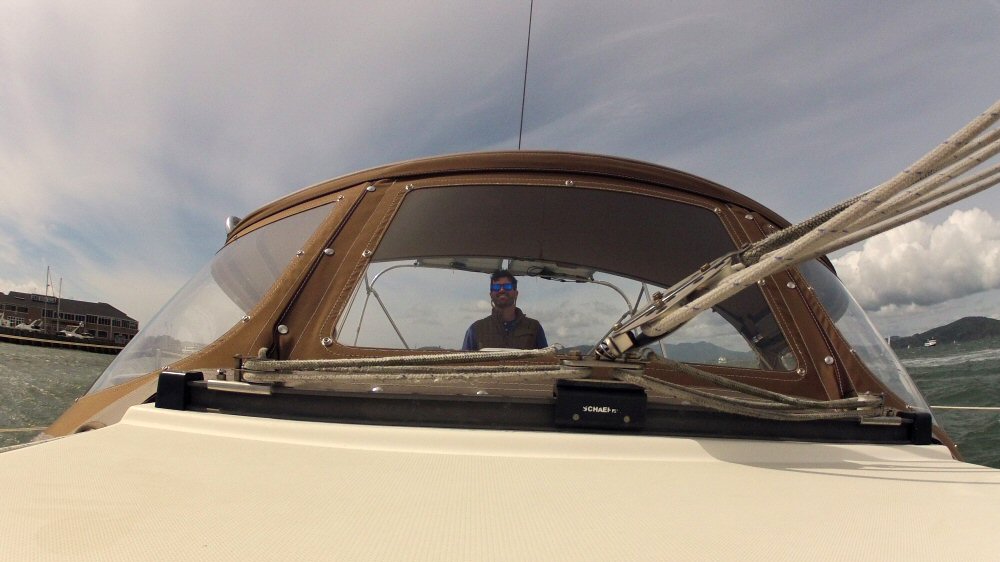
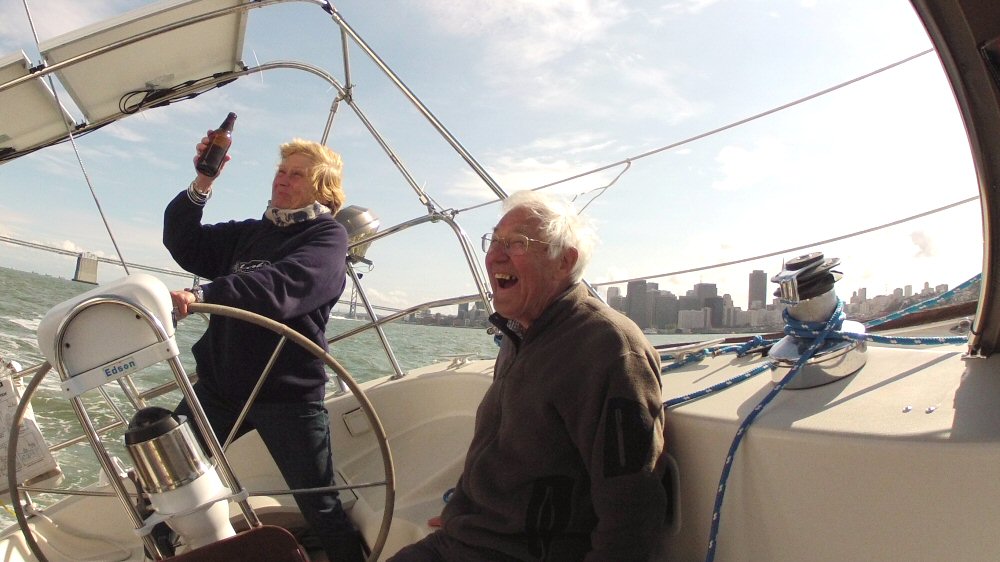
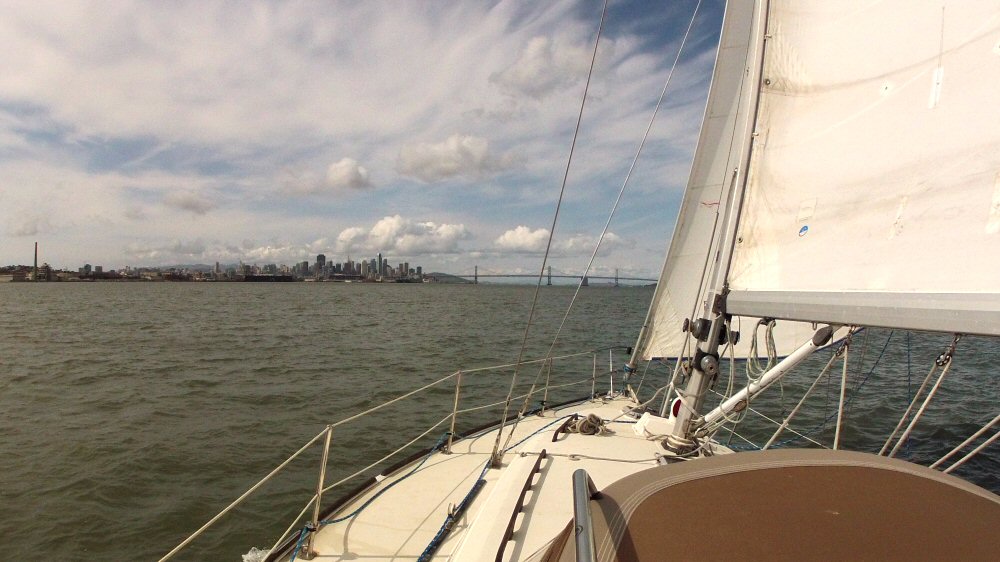
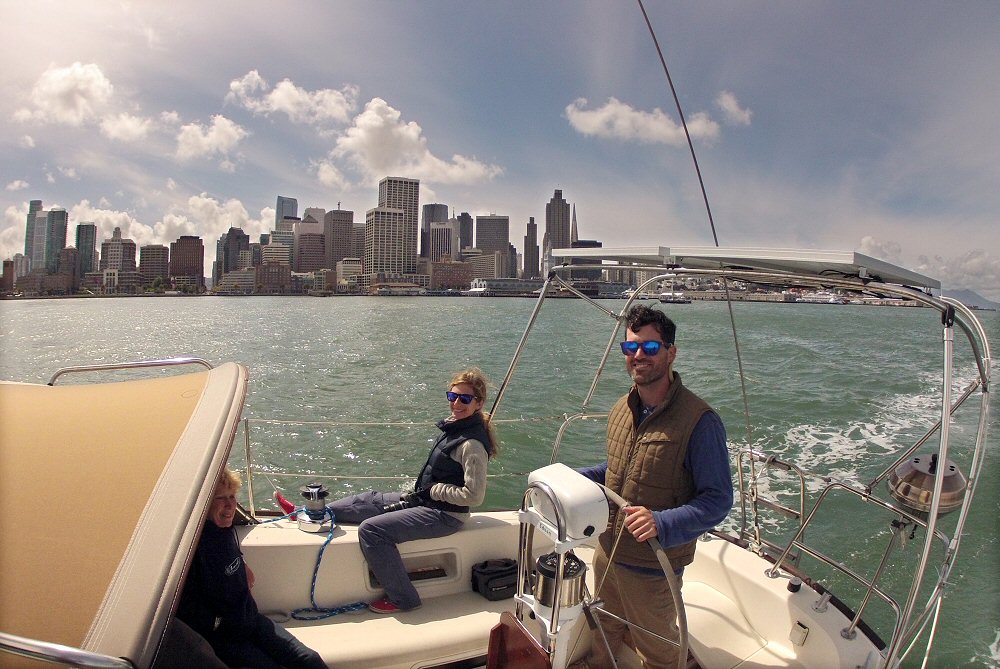
Just some shots from Sunday when we took the boat into the south bay with Mum, David, Mike and Rachel.

Travels, adventures and family …
Just some shots from Sunday when we took the boat into the south bay with Mum, David, Mike and Rachel.
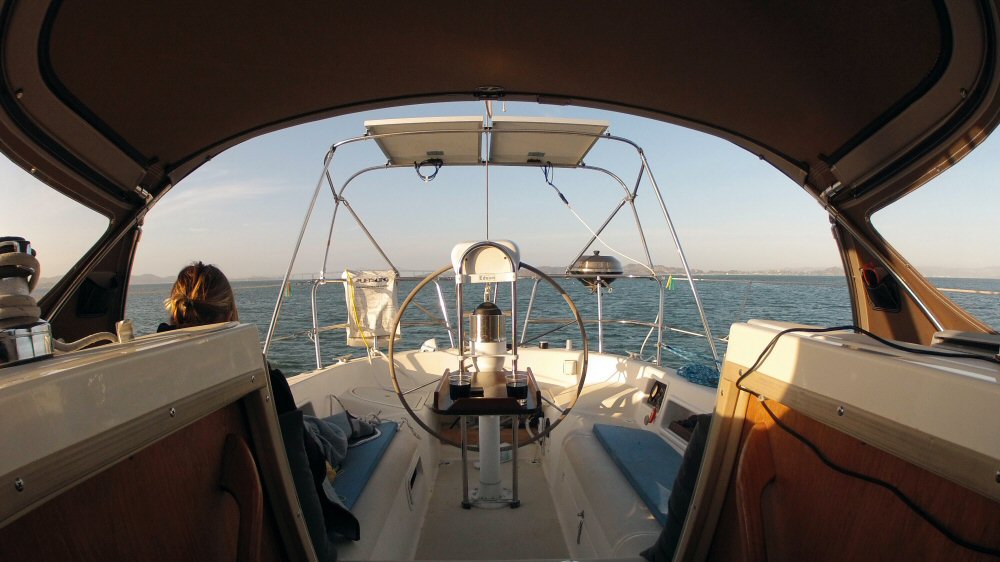
We’re sitting peacefully at anchor at Paradise Cove as the sun rises over San Pablo bay. We arrived last night and dropped the hook a few yards off the end of the pier.
The morning high speed ferry powers past, sending a wake to the shore. The waves roll under the boat, making it rock; the cupboards make the click-clunk noise so familiar when out at sea in a swell. The half finished bottle of rum from last night nearly slides off the galley onto the floor- it’s just rescued in time by falling into the sink. A minute later, the waves crash on the beach, and then all is calm again.
A man is taking his morning swim in front of the huge, luxurious beach homes. Rose and I try to decide which is the ugliest house. She tells me about her studio mate back in Sausalito, a lady in her forties who was born and grew up in this area. The two of them were out with our kayaks the other day, Maude saying how when she was a kid, there were no houses here, and how they found old arrow heads in the dirt, wondering whether it was an old Indian settlement. How much things have changed, in not very many years. There’s hardly a spot of spare land on this peninsula now.
The sun has decided that it wants to be the boss again today, and burns away the morning cloud by ten. I’ve only connected one of my solar panels up so far, and it’s starting to do its job, trickling some charge into the batteries. Rose is getting on with her knitting, and I’m just enjoying being out here.
We’re only half an hour away from our dock, but I feel we’re well and truly down the road towards self-sufficiency, a taste of future adventures a long way away from people and civilisation. Yesterday I finished installing the new alternator, which means that, when both solar panels are also connected, we’ll be covering all our electrical power needs without any help from the outside.
Last night’s wind has all but gone, with only a light zephyr blowing from the north. It brings with it the faint sound of trains and ships, making their busy way back and forth across on the other side of the bay in Richmond. Not a hundred yards away on land, the green hills are filled with bird song, and every now and then I catch a snip of conversation between the men fishing on the pier.
All is well.
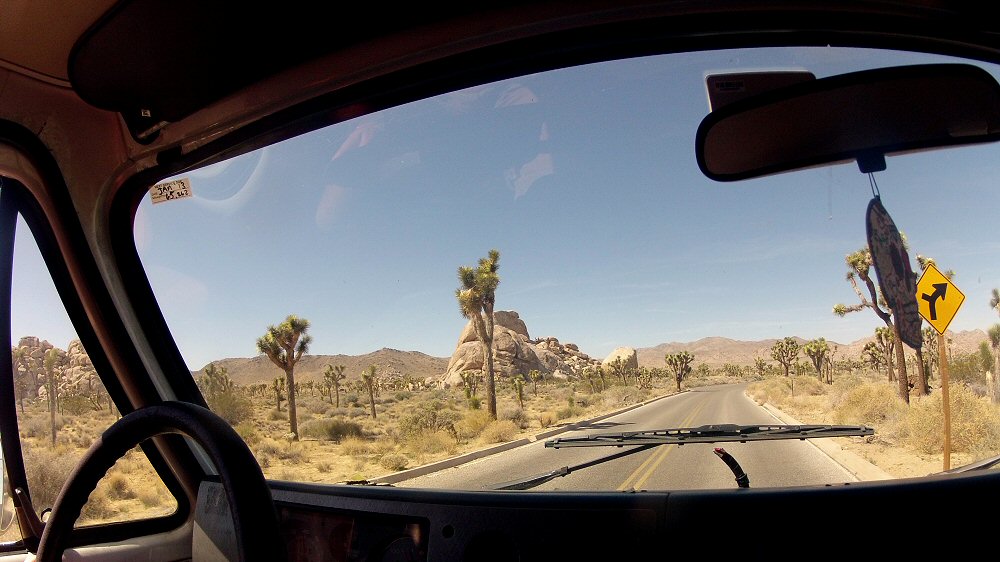
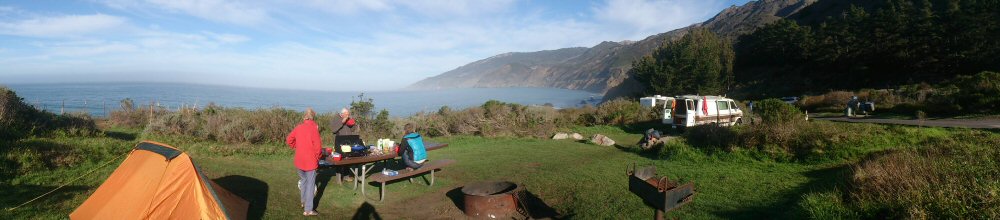
We left San Francisco late on Thursday afternoon, aiming to drive down the coast of Big Sur and find somewhere for the night before continuing on to Joshua tree the next day. Tight on time, it was dark not long after we left Monterey Bay, but we managed to get a fair way before losing the light. Rose found what looked like a nice camp site perched on the top of the cliffs overlooking the sea, and we figured that we could just turn up on a Thursday night and they’d have space. Turns out that this is a pretty popular spot, and all the pitches were officially booked – with paper tags attached to the posts, put there by the campground host. It was 10 pm and a few places were still empty so we took our chances and set up on one of them. Nobody disturbed us, and we woke to an amazing view over the sea. Our pitch was just metres from the edge of the cliff, and we could hear the waves crashing on the rocks below.
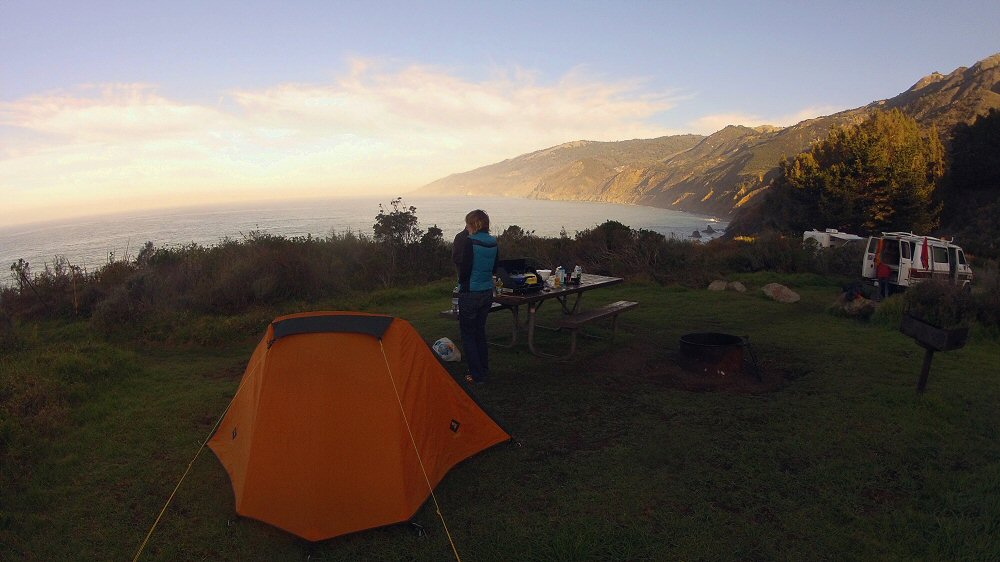
The sun started poking its head over the hills in the east as we prepared breakfast, and then once packed up we were off on the long drive across the hills to Joshua tree.
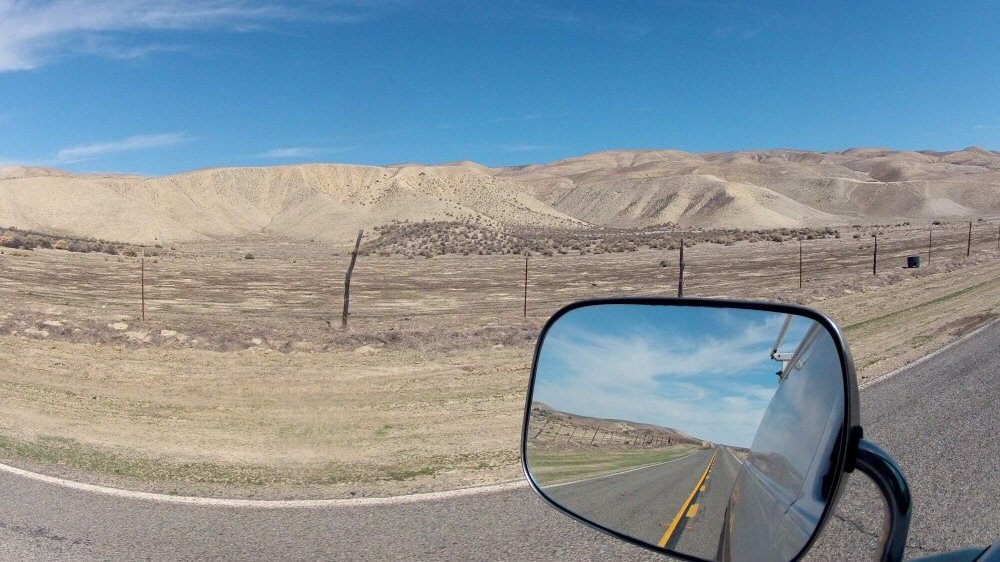
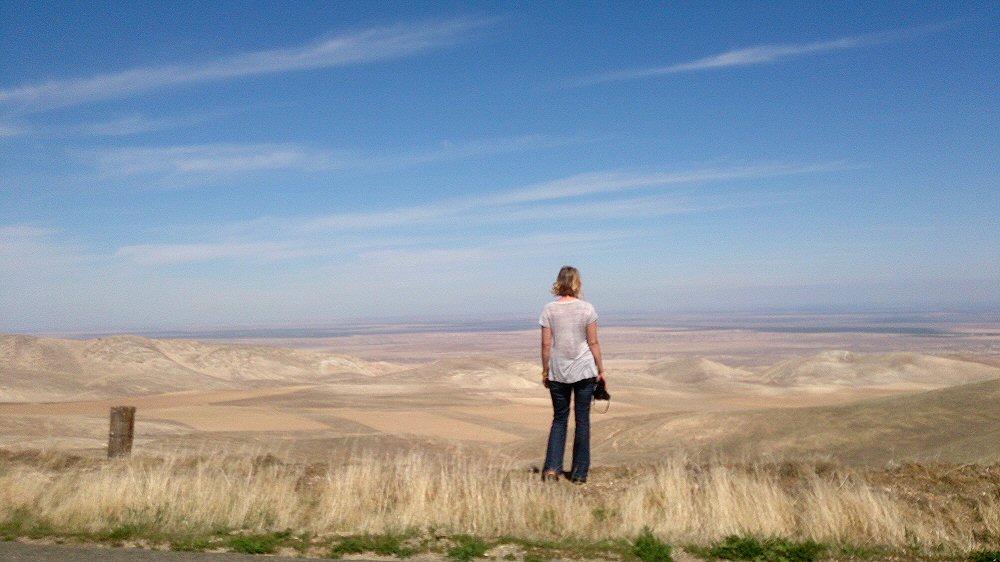
We turned off the coast and headed inland just south of Cambria, scooted down highway 101 for a short distance then continued eastwards on the 58 across miles and miles of hot, dusty, desert.
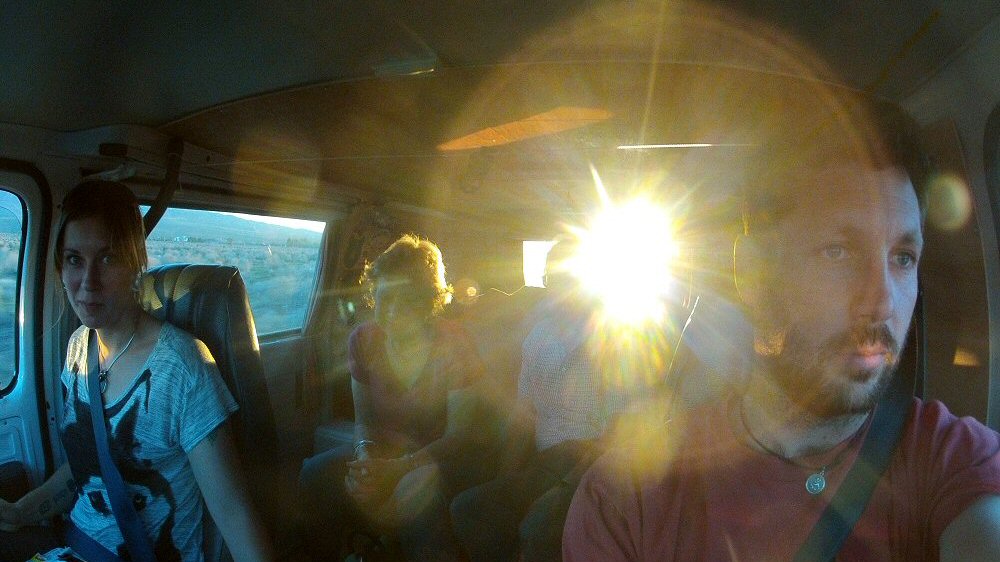
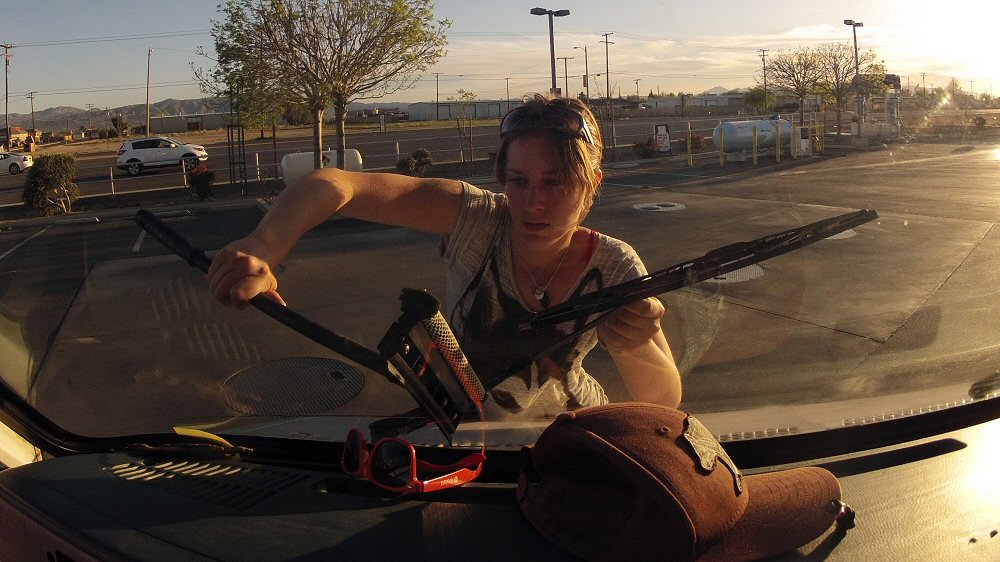
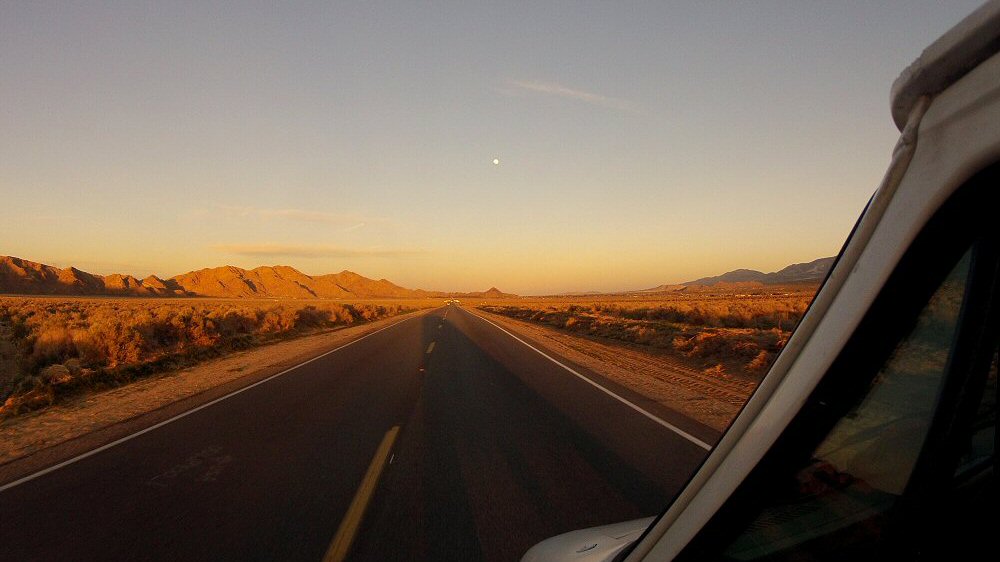
We were still a way off as we chased our shadow down the road, heading towards Yucca Valley, where a big American burger dinner was followed by a short hunt for a Motel and then some rest.
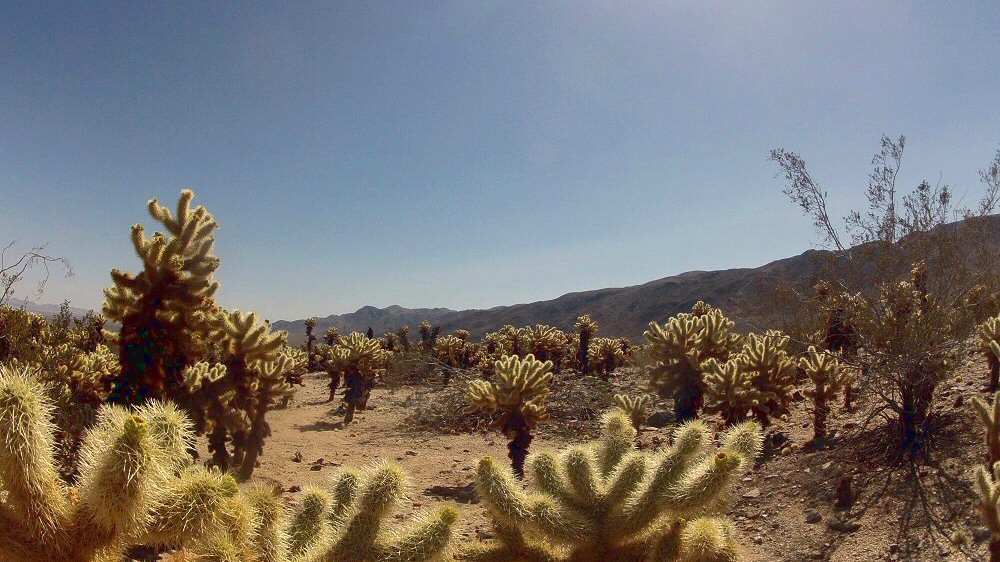
Next morning we were up early and straight into the park. The scenery changes so quickly as you gain altitude leaving the town of 29 palms, with the Joshua trees being pretty dominant amongst the scrub and smaller, similar looking yucca plants. The rangers at the gate said that all the campgrounds were full, but confident from our previous night’s stealth technique we thought it would be worth checking for ourselves. Yeah, it was pretty busy, but we did manage to find a spare spot, so we set up camp right away and then headed out exploring the park for the rest of the day.
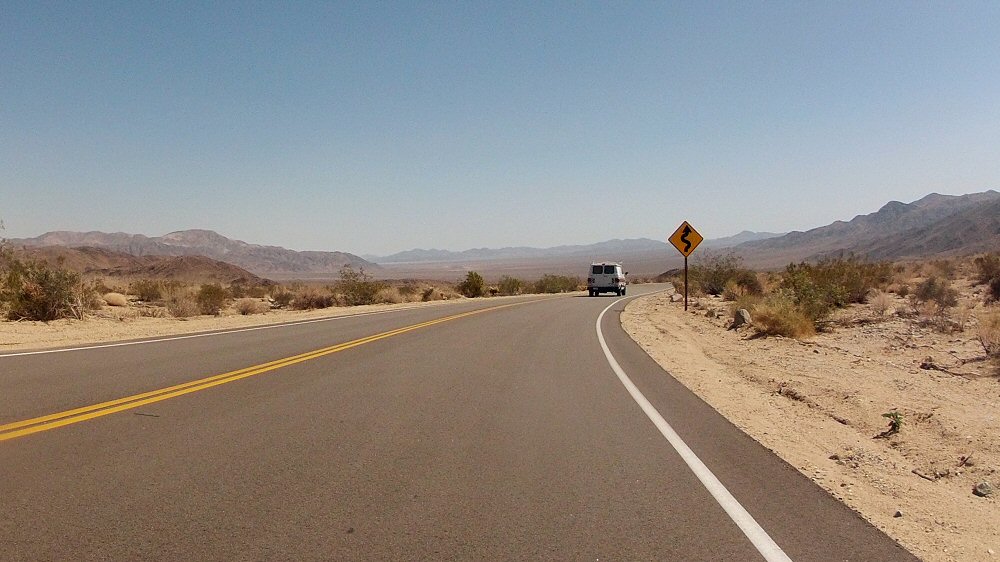
I keep my longboard in the van all the time, and over the past few months we’ve driven along so many awesome skating roads, but I’ve not yet managed to stop. This time I couldn’t resist. “See you at the bottom!” … endless miles of perfect asphalt, hot sunshine, pretty much no traffic – an epic skate.
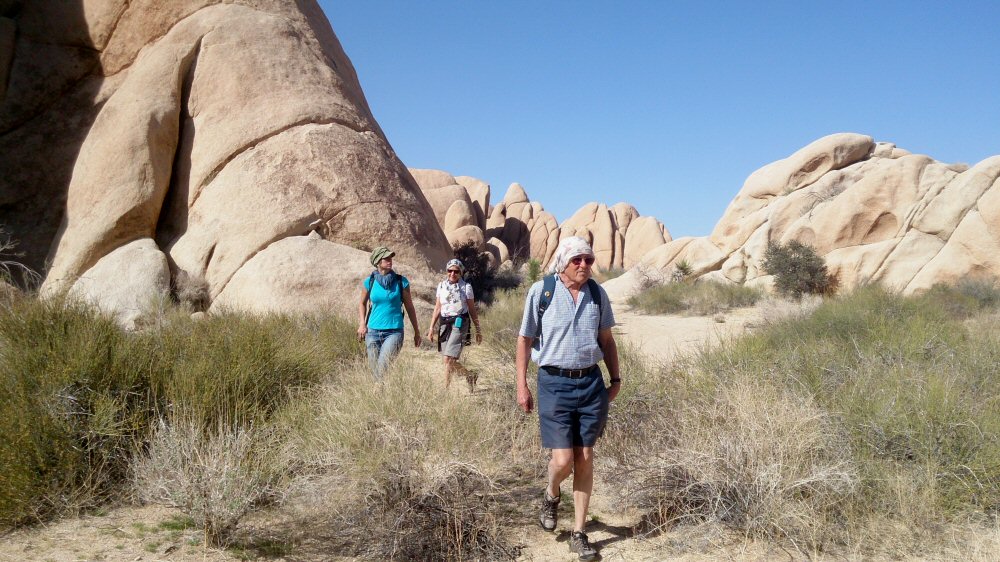
David had forgotten to bring a sun hat so we fashioned a head scarf that made him look like a real explorer.
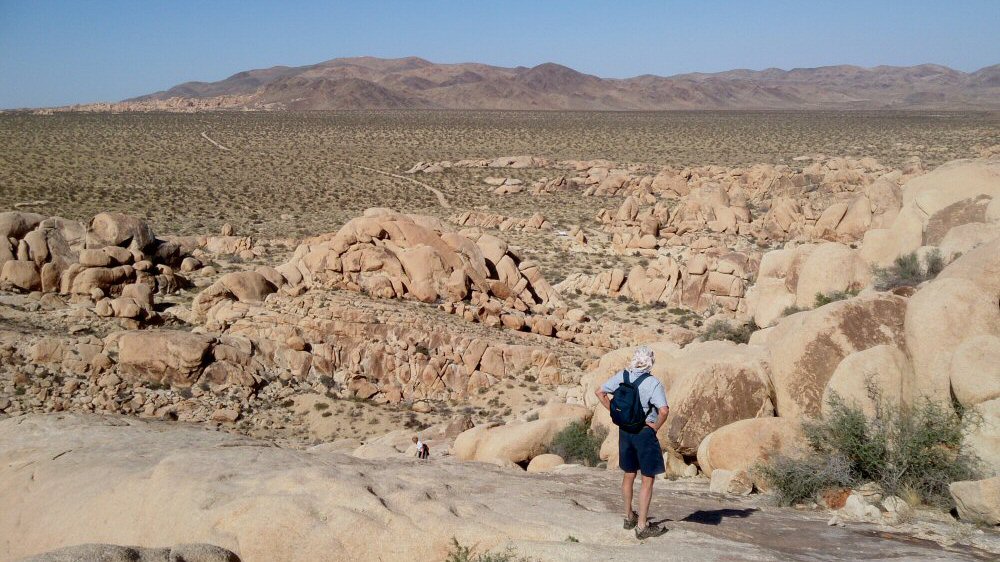
I love the big, open, arid spaces of the desert.
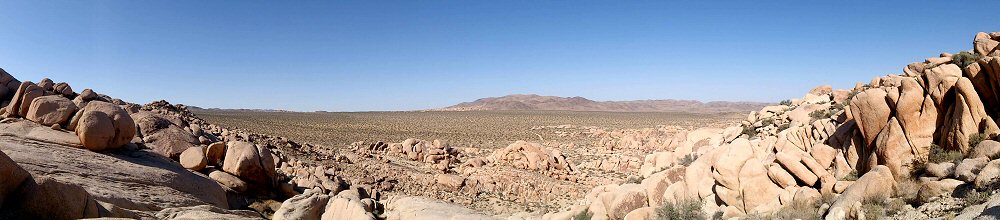
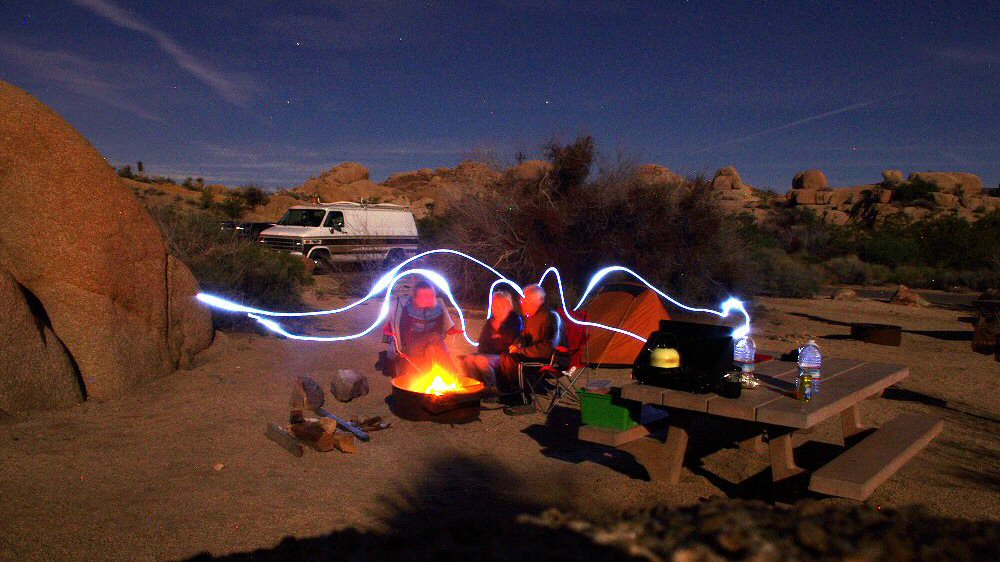
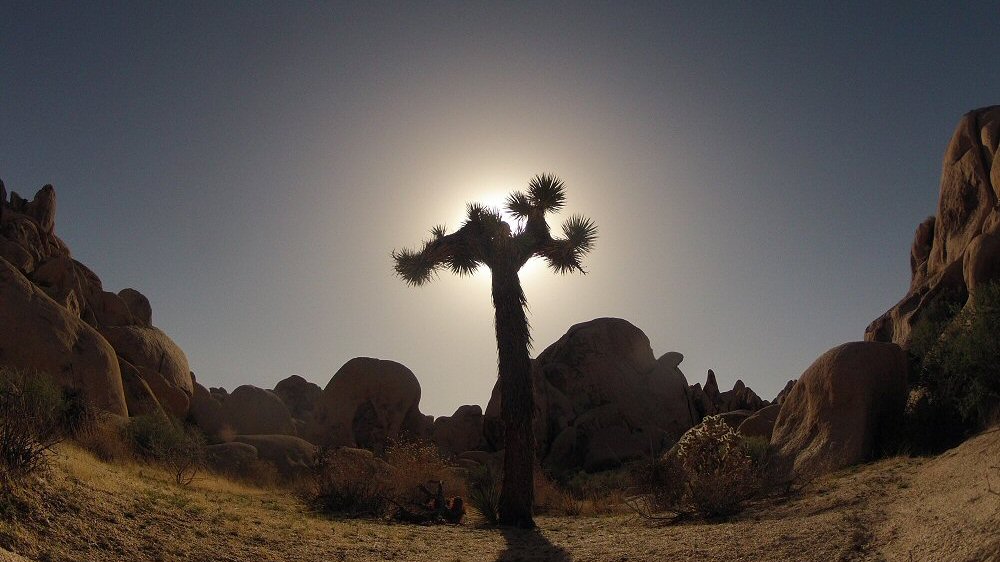
The obligatory long-exposure night time shots of the desert, with some loon running around with a torch. It was full moon while we were there, which meant that as the sun went down the moon was rising, which was pretty awesome. And in the morning, the moon was just setting over the west as the new day was starting with the sun rising in the east.

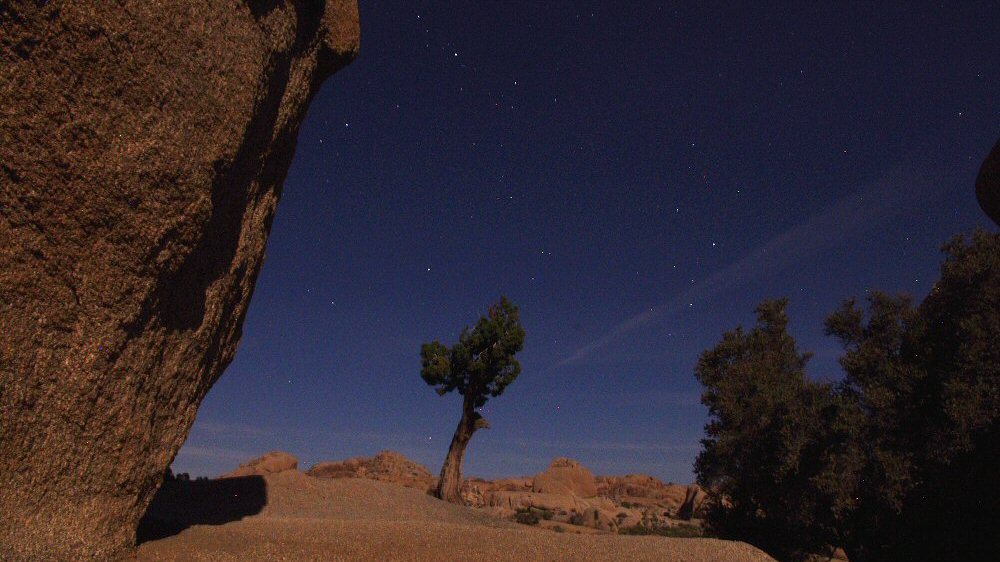
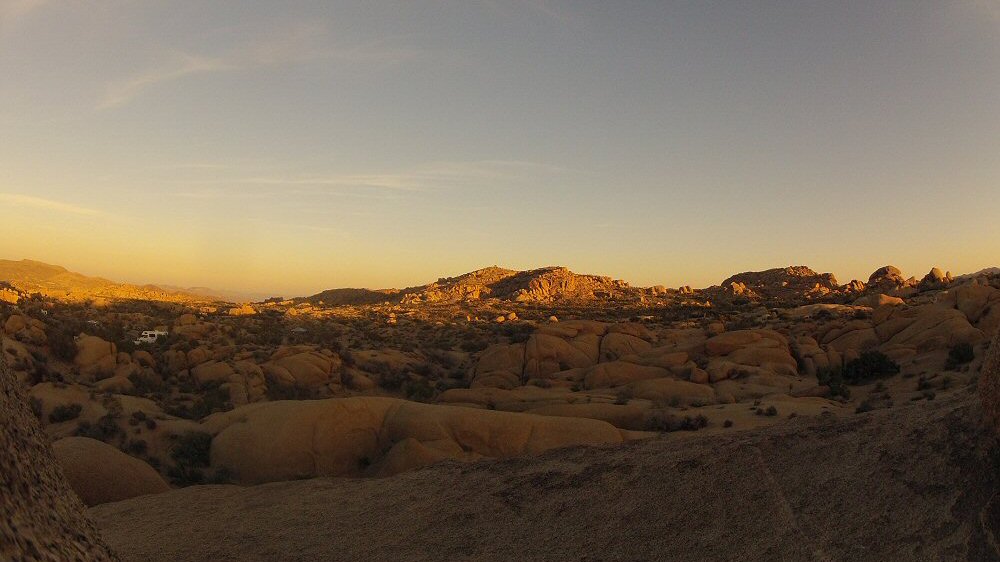

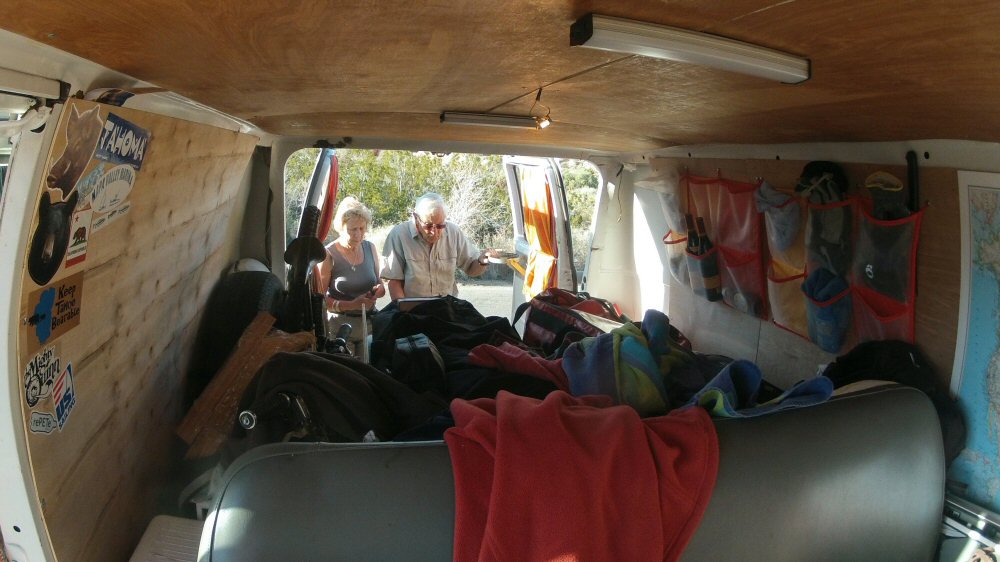
Mum and David planning where their travels will take them next. We left early on the Monday morning and dropped them off in Bakersfield to pick up a rental car while we bombed back to San Francisco.

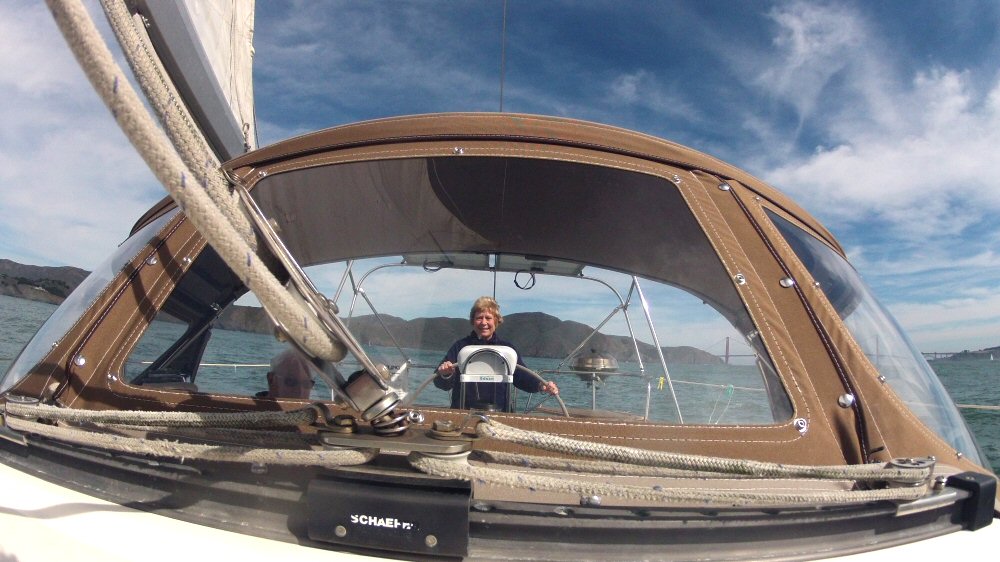
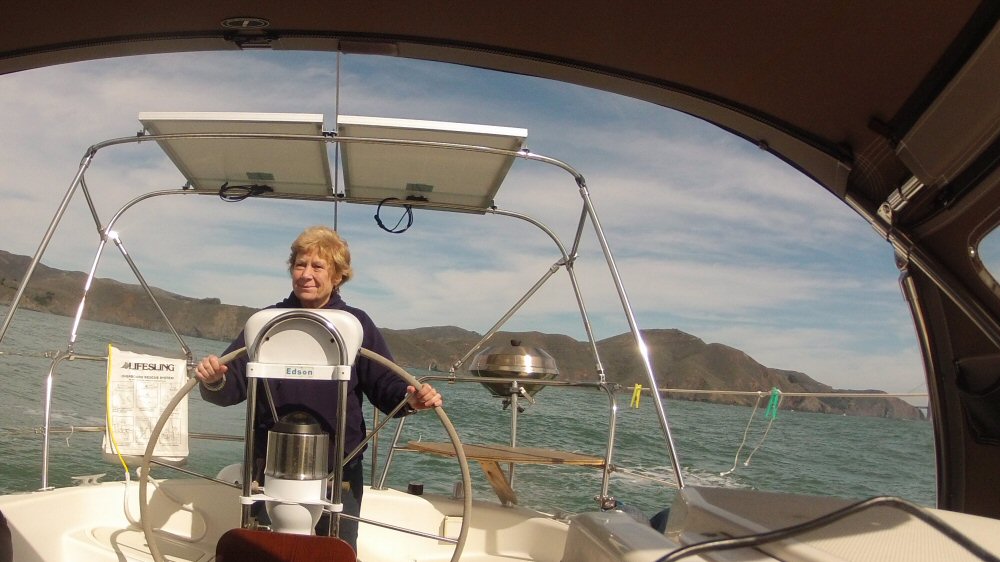
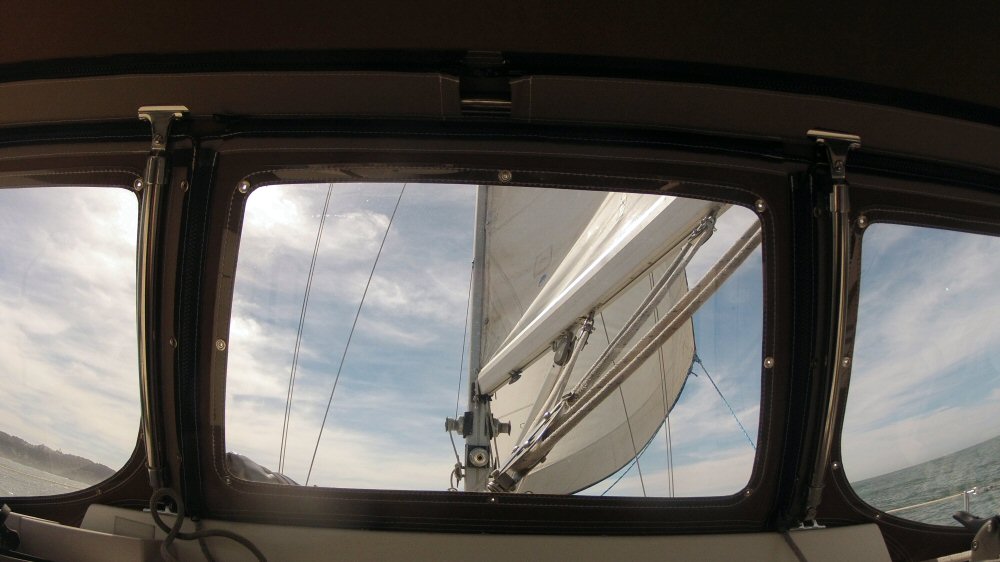
Mum arrived a couple of days ago with David, and one of the first things we had to do was get the boat out for a sail! We rode the ebb tide under the Golden Gate bridge and out to sea. I’ve stopped taking pictures of “the most photographed bridge in the world”, it feels too familiar now. Though it did make a nice backdrop to our lunch time anchorage, just inside point Bonita.
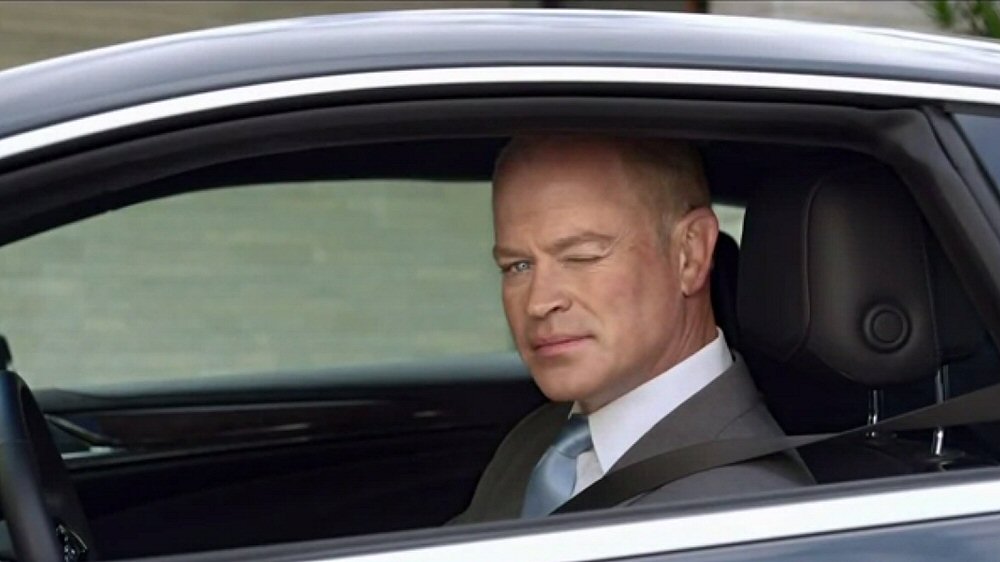
As the commercial came to an end, Rose and I looked at each other across the room, our eyes wide with incredulity.
Why do we work so hard?… for stuff? … in other countries they work, they stroll home, they stop by the café, they take August off. OFF. Why aren’t you like that? Why aren’t we like that? Because we’re crazy, driven, hard working believers, that’s why… [bla bla] … as for all “the stuff”? That’s the upside of only taking two weeks off in August.
This intense promotion of dark, greedy consumerism was lost on our hosts, who, being Americans with TVs, are bombarded by auto commercials all day every day. I, for one, sure ain’t going to go out and buy a new Cadillac off the back of this. It makes me sick to see the media pushing new stuff down peoples’ throats everywhere – stuff that they just don’t need. New phones, new gizmos and gadgets, new vitamin supplements, new cars, bigger homes … for what? To become “happier”?
We don’t own a TV. I’ve never owned a TV, and Rose hasn’t had one since we moved in together over seven years ago. Seeing this commercial reminded me why. Sure, there are lots of awesome programs on but you can get most of that on the internet now, which means you don’t have to sit in front of the goggle box, bombarded by messages telling you to do this, do that, buy this, buy that. We make our own choices.
I lost pretty much all of my meagre possessions when my camper van was broken into just after moving from Sheffield to Bristol in 2005, and since then I’ve consciously not been building up a load of stuff to hold me down like a ball and chain around my ankles. We now live on a boat that doesn’t have much room, and that’s just fine. We moved out here to the USA with just a few bags on the plane and now it’s a case of “one in, one out” when it comes to “stuff”.
When we moved out of our house, we figured we’d put a few things in storage. We were pleasantly surprised to discover that all we owned fitted into the six or so bags we were taking with us, plus half a crate in a storage warehouse for some books and paintings.
I came across this minimalist game the other day. See if you can make it through 30 days. I don’t think I’ve got enough stuff to!
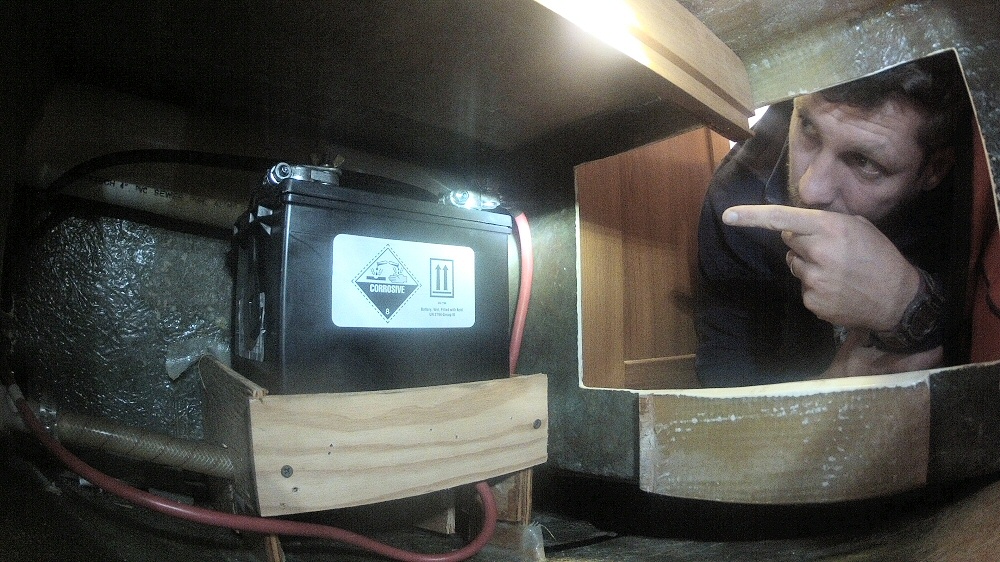
When I bought this boat, it was pretty much exactly as it came out of the factory nearly 30 years ago. Everything had been looked after, a few things had been replaced, but that’s about it. Because it was built as a “coastal cruiser”, designed for day trips and the odd weekend here and there, it came with a pretty basic 12v DC electrical system.
For extended periods away from shore power, the batteries weren’t going to last long. Perhaps 24 hours at most. And then when it came to charging them up again, the poxy 35 Amp alternator with no fancy regulation would have taken perhaps 7 hours to charge them up again. No es bueno. We’re planning to get a long way from shore power, for long periods of time. Over the past few weeks (months?!) I’ve been reading all I can get on 12v boat systems, and have come up with a new systems design; the two main components being a new, powerful alternator with smart regulator and a set of solar panels.
The new 125 Amp alternator will pack way more of a punch than the old one, the smart regulator pumps the charge into the batteries way faster, and then handles things nicely when the batteries get near full. Budget doesn’t yet stretch to solar AND wind power, so out of the two I decided that we’re going to get more benefit from 200 Watts of solar panels than a wind generator. I’ll mount the panels on the cage I’ve fashioned on the stern rail from the old dodger frame, which just happens to be a perfect fit. They’ll also give a load of shade above the helm for those hot, tropical passages and days sat at anchor…
The solar panels are sat by my desk at work waiting for an opportunity for me to swing into the city with the van and pick them up. The other stuff should arrive next week, but I’ve managed to get a few things ready ahead of time. I bought a small car battery to use as the starting battery, which means I can wire the two existing large deep-cycle batteries in parallel and double the useful capacity for everything else – the fridge, lights, autopilot, instruments … so we’ve about 230 Amp-hours there now. From my workings we’ll be using about 100 Ah per day whilst on passage with all the gubbins on and lights at night, so even with the panels giving full power for about 6 sunny hours we’ll still need to run the engine every day to keep the batteries healthy. At anchor when we’re not using navigation lights and autopilot, the solar panels should keep at least the fridge running.
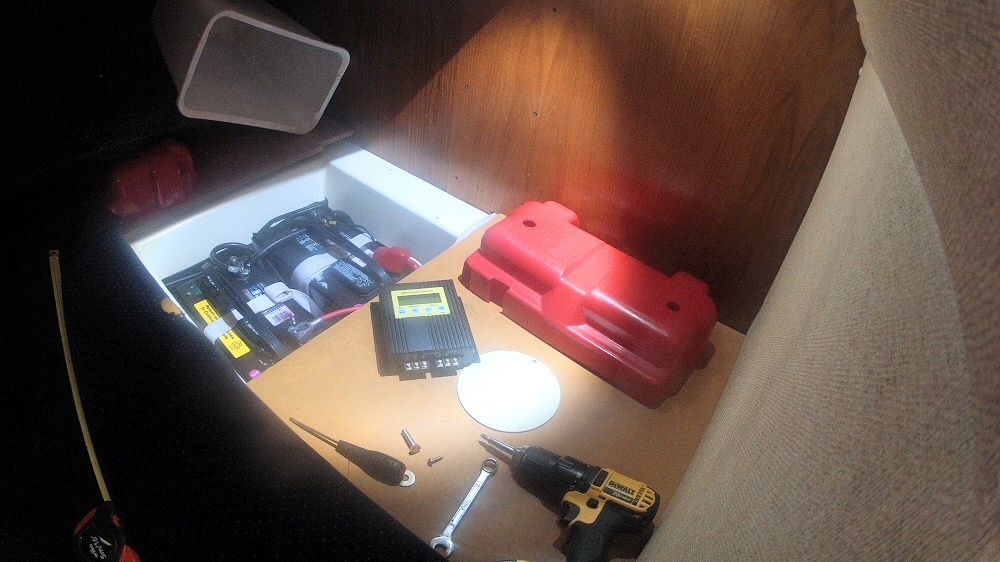
I found a space for the starting battery just next to the existing battery bank, nestled in between the side of a drawer and the fuel tank. I built a solid box for it and have wired it up. Now we’re all set for the solar panels and the new alternator. The panels are going to be run via an MPPT controller, which does some smart jiggery-pokery with the Amps and Volts from the panels to make sure that they are operating at their most efficient.
We’re still going to be on the dock here for a while yet … so why the need to get all this stuff? I want to have plenty of time living aboard self-sufficiently before we cast off the dock lines and set sail over the horizon. If something’s not quite right, I can get it sorted now whilst there’s plenty of stores and services around. And I also want to see if we can go “off-grid” completely, even while we’re here. We only use the mains power to top-up the batteries, and for a bit of heating. I’m hoping that with spring on the way, we’ll leave the heater off and run everything off solar power.
A month or so ago I installed a voltage / current meter in the dashboard so I can see exactly what load we’re using. The biggest drain is the fridge, which takes about 7 Amps for perhaps 20 minutes each hour. That’s 8 hours * 7 Amps each day … 56 Ah. The solar panels will output 10 Amps at max power, perhaps for 6 hours a day … the 60 Ah just covering our bases. We’ll see!

Rose and I made a last minute decision on Friday to head up to the mountains for the weekend. There were a bunch of folk going snowboarding, and the weather looked good. The original plan was to leave late on Friday night after Mark and Heather had left after dinner … but when it got to 10.30 the prospect of packing the van and driving for hours wasn’t so appealing.
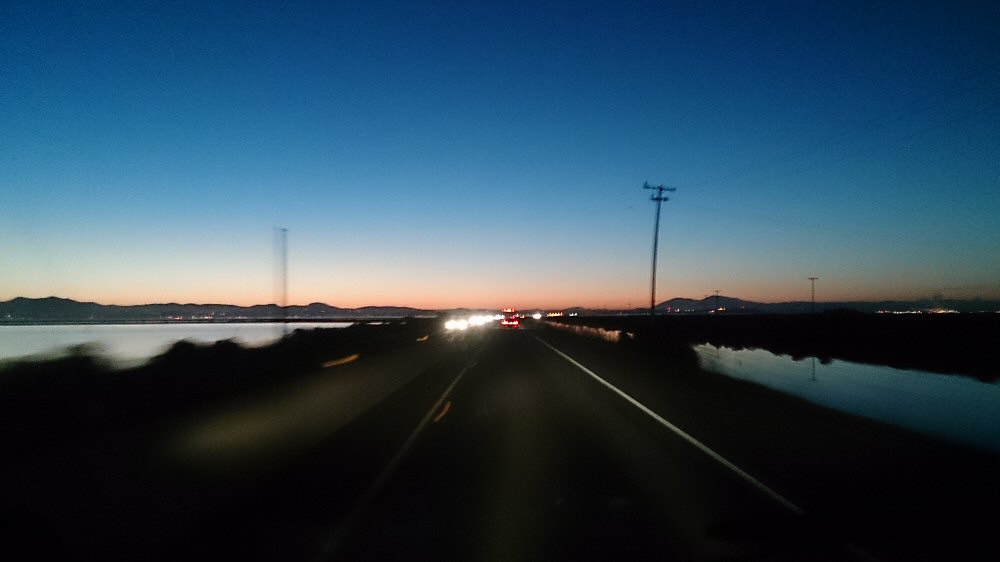
We set our alarms for 0430 on Saturday morning instead, and hauled ourselves out of our bunk into the van, well before the sun was even thinking about peeking its head over the hills in the east. We were well across the causeway to Vallejo by the time the first signs of dawn were showing.
Our early start paid off and we were up at Northstar by 9am to meet Mike, Rachel, Brent and Michelle. I spent the day snowboarding while Rose hung out around the village, soaking up the sunshine and reading the papers. At first, I wasn’t sure about getting back into the whole snowboarding thing. I’d not forgotten how to snowboard, but it seems I just didn’t get the buzz from it that I used to. I wasn’t as excited about the day on the mountain as I thought I should be. The stinger of a $119 lift pass probably went some way to needing justification! How much is fun worth? Tough question.
I managed to ride quite a bit while I was in my early- and mid-twenties, then didn’t get out to the mountains in winter for many years until a trip (to Tahoe) in January last year. Since then I’ve been to the Alps once, and then again to Tahoe over Christmas just gone. None of those trips were blessed with good conditions, which meant not much fast riding, and not riding with a gang of close buddies. Hmmn. I wonder if I’ll ride again this winter. The snow looks good for next week, but for some reason I’m just not that amped for it.
Anyway, I ended up having a great day; classic spring-time snowboarding – in February! It was hot enough to spend the afternoon riding in just a T-shirt (yes, and pants/trousers). As the sun settled down over the mountains the temperature fell rapidly, Rose and I bundled back in the van and headed around the lake to see Amanda (Shane was away for the weekend). She had a load of buddies around for a “pot-luck” meal – good times hanging out with some real American folk, being educated in the culture of The History of Rap with Justin Timberlake and Jimmy Fallon.
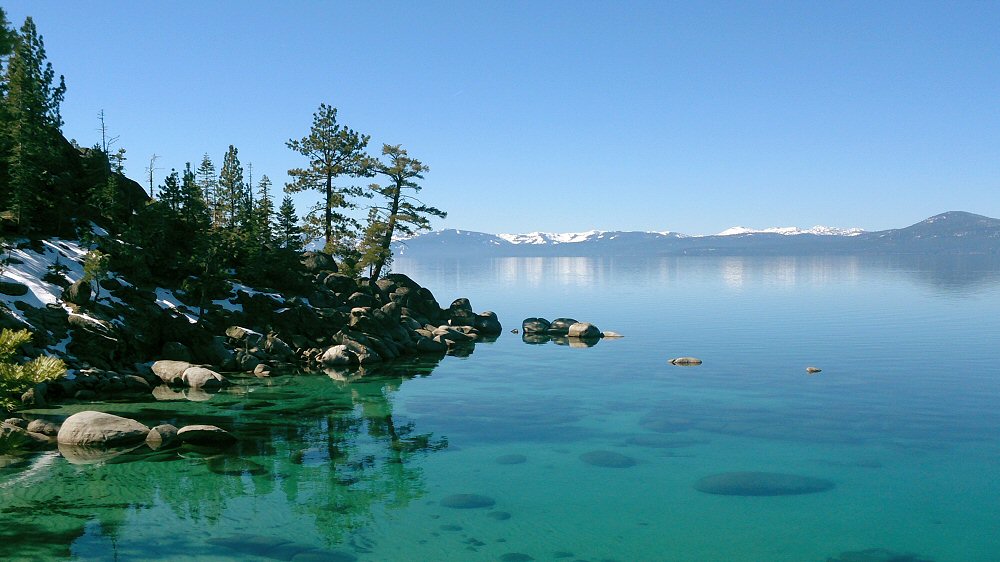
Sunday was a day off the hill, spent checking out the east shore, south shore and a short walk up to Fallen Leaf Lake where we had a wonderful, peaceful snooze in the sun. The only thing you could hear was the gentle lapping of the lake and the wind in the fir trees. It looked like this place would be pretty busy in the summer, with docks and boats and wealthy folk hanging out in their lake-side mansions … but the road was closed and all the houses were boarded up. The only person we saw was a lone kayaker way out on the lake, towing his fishing line.
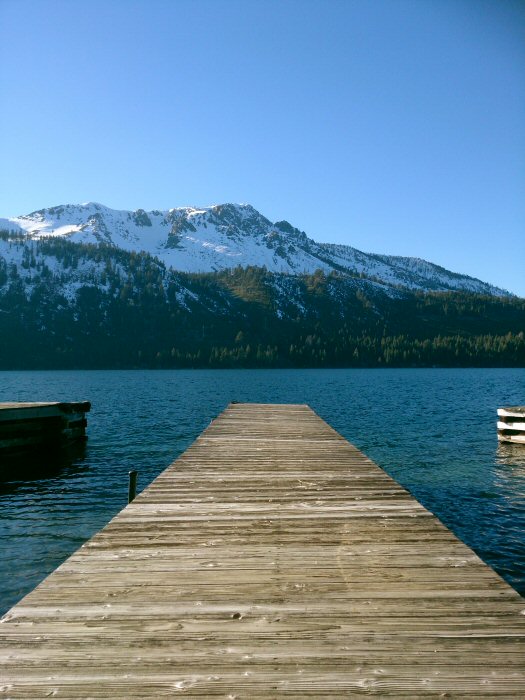
Striking colours in the winter vegetation. My phone camera and photo skills don’t really do it justice:

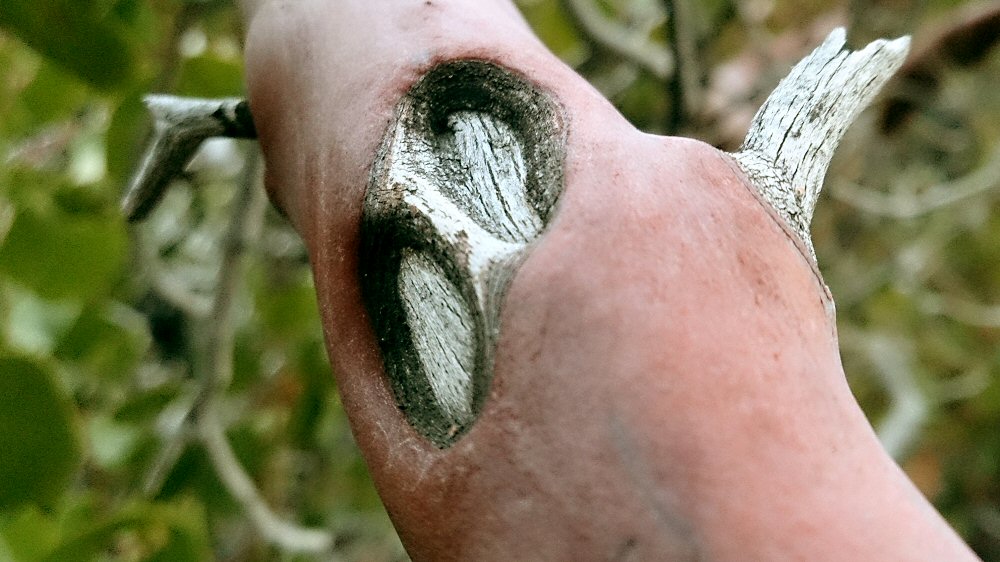
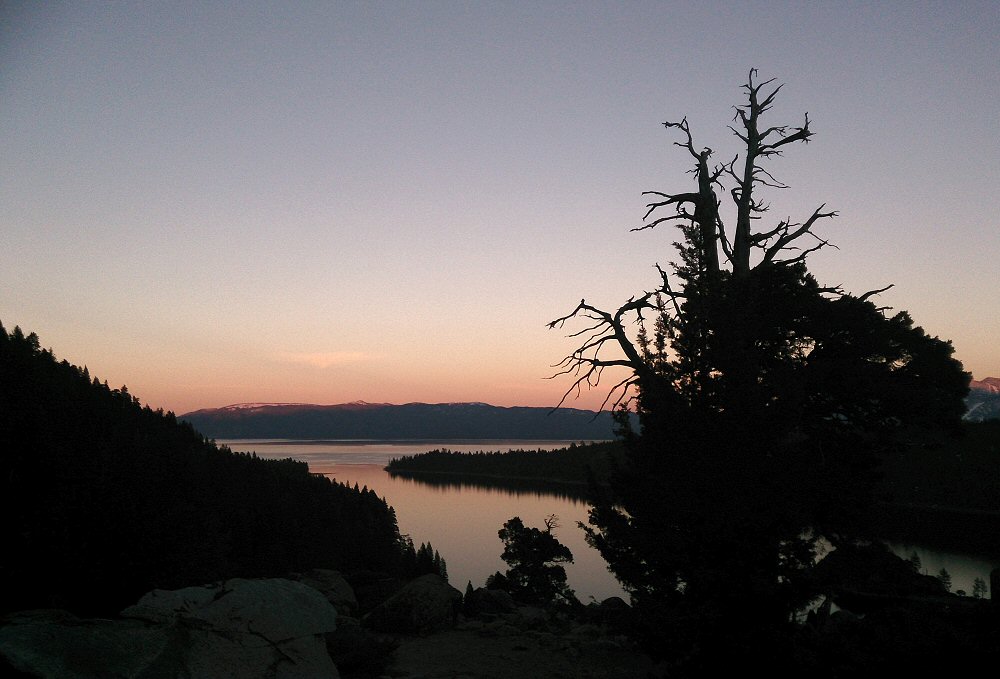
After exploring Emerald Bay as the sun went down, we grabbed some grub in Truckee then headed back to San Francisco after the traffic, getting back to the boat at about 11pm. Mission accomplished! It took just 3 hours each way, much faster than last time when we had 5 crew aboard and all their baggage. We only managed to get 13 miles per gallon out of the beast, even driving in super-eco mode. Ouch.
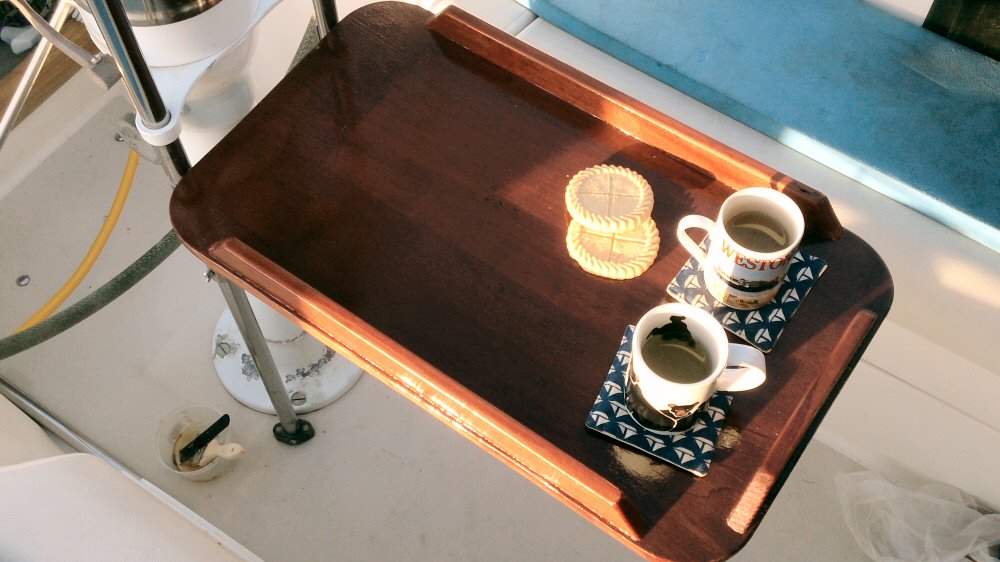
On President’s day (a bank holiday here) I went on a table making frenzy. Perhaps the most extravagant table making extravaganza ever. I produced a whole cockpit table AND a fold-up chopping table for the galley. Phew. I think I’m at my creative peak. Does it get any better?
It’s funny how much difference a cockpit table makes. It’s doubled our outdoor flat surfaces (the only other one is the cockpit floor) – which means we now have somewhere to put mugs and plates down without their contents going walkabout. I picked up an old piece of plank from near Rose’s studio in the shipyard nearby and spent a happy afternoon shaping it up. Rounding off the edges took me right back to the days at Lush when I was building longboards by hand. Haven’t lost an ounce of technique in ten years, me.
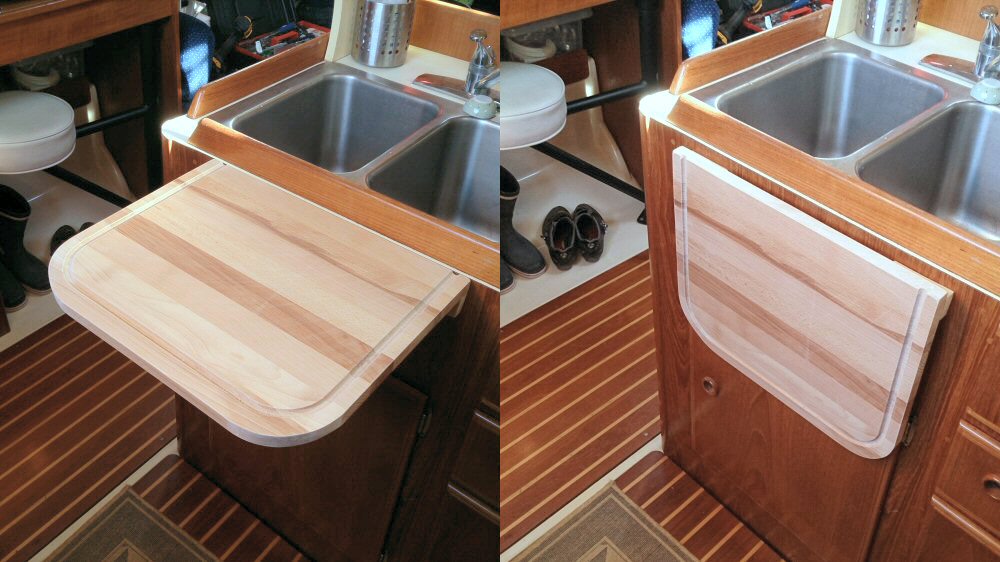
The galley extension folds away neatly and again, doubles the flat surfaces. It’s made from a $10 IKEA chopping board. We’ve not used it as much as I would have thought, even though we’ve been complaining about having to move everything off the surfaces just to get something out of the fridge. I think it’s real value will come when using the galley at sea. It needs toughening up a bit so that you can use it to brace yourself when the boat’s on port tack (leaning away from the cooker), and some deep fiddles.
Now, where did I put that jigsaw?
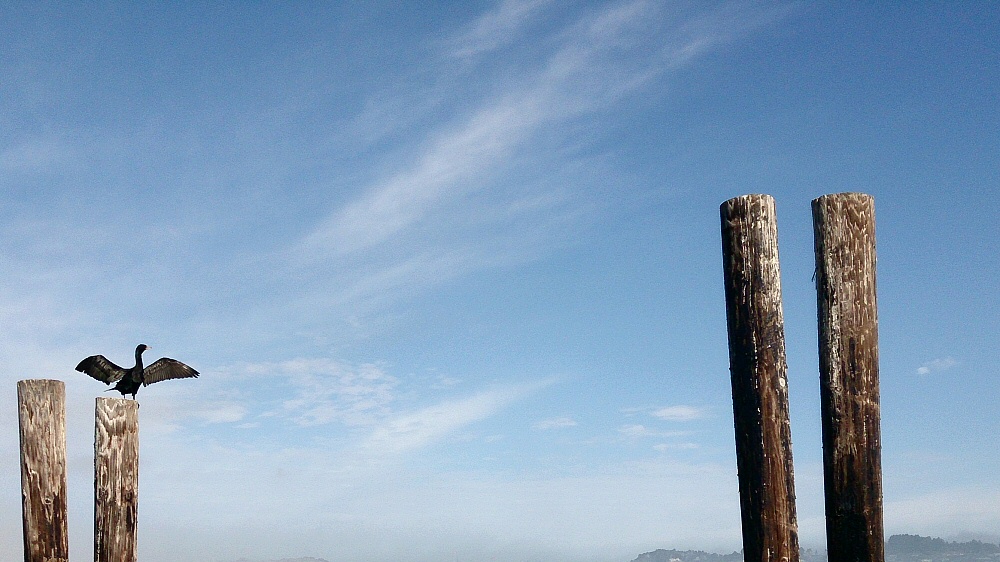
The sun is back! The last few days have been pretty wet and windy – though nowhere near as bad as they are getting it back home in the UK. Every day I’m checking in to various news sites to hear more stories of flooding and chaos. Poor folks.
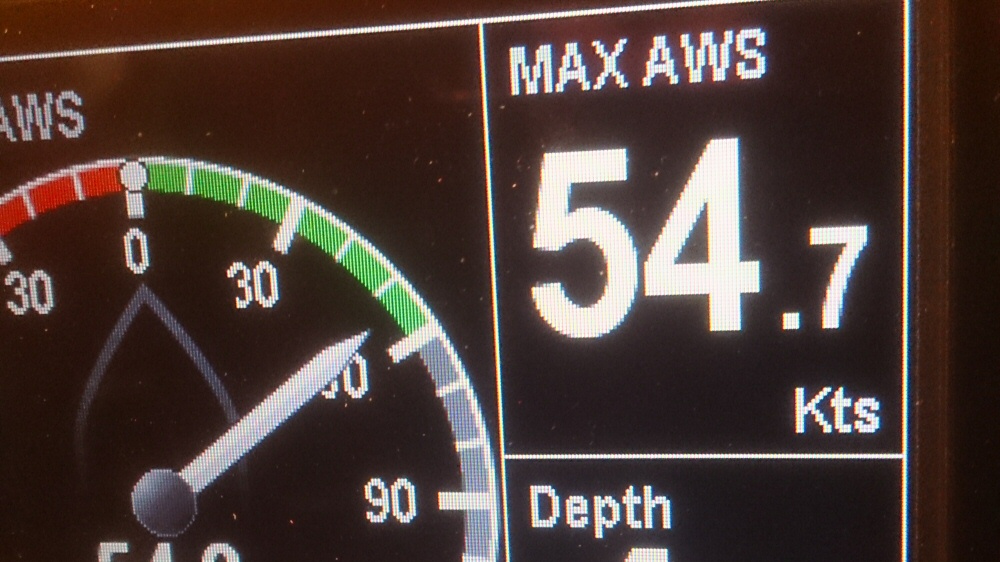
The docks here are busy with people coming to check on their boats after the weekend storm. We had 4 days of solid rain, with winds at the masthead well over 50 knots one night. Down here at deck level it was a whole lot less frisky – but that’s still some mean wind. Unsurprisingly, we found a few more leaks – the incessant water being lashed against all windward facing portholes found it’s way inside in a number of places. Rose’s wardrobe got in the way of one of the drip lines and a load of her dresses are more than a bit damp, so everything is hanging up around, drying out. We’ll need to pull those portholes out and re-seal them. More jobs for the job list! The one I re-sealed a couple of weeks ago didn’t let a drop in. Woohoo! All things considered, it’s pretty dry in here. The new spray hood was finished just in the nick of time! Having that really makes a difference to our exposure to the elements – even when down below. When the wind coming from the bow, we can have the hatch open in the pouring rain. Joe lives on his boat on the other side of the fairway, stern to this particular storm, and got a fair bit more water inside than we did.
To celebrate the arrival of the sunshine this morning I went for a short paddle in the kayak. There’s still a fine haze of mist hanging around which dampens the sound of the distant highway and gives the place a diffused light which is pretty cool. I can just hear the sound of the fog horn on the Golden Gate bridge when the wind brings it this way.
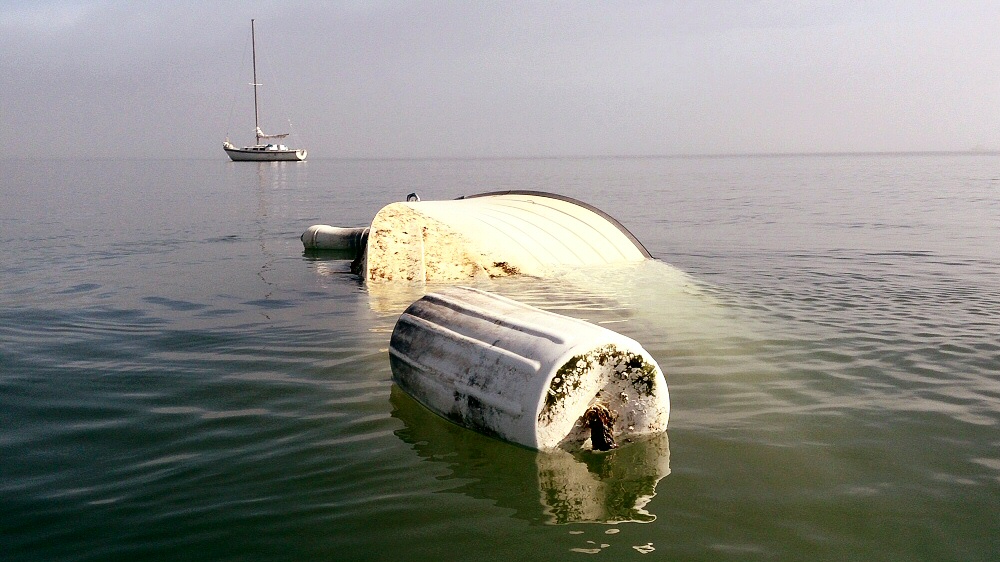
Found a sunken boat that clearly didn’t weather the storm too well. As the gentle swell rose and fell, the water level inside the boat pushed air in and out – the poor ship’s last dying wheezes. I wonder what’s going to happen with it next. It’s fairly big. Judging from the bit I could see, perhaps a 25 footer. I hope it wasn’t someone’s home.

We also discovered that we have a nasty leak in the van. The whole mattress was waterlogged. That’s something we’re going to need to fix soon – not least because I’m storing a whole load of spare plywood in there to keep it dry! So, off I go to the auto shop to pick up some filler.
Putting money into old boats is perhaps one of the most foolish things a man can do with his hard-earned greens. Often it’s a case of justifying each extra gizmo or fix with the thinking that “hey, I’m saving money by fitting it myself”, or “this could save our life one day”, or “life will be so much more comfortable afterwards”. But usually every dollar sunk into a boat is gone, spent, never to be seen again. Not many boat projects increase the value of the boat by the same amount as they cost.
There are two types of project. Reactive, and preemptive. Reactive projects are the ones that should come first – fixing things that have either broken, or are not working as well as they should be, but are already in place in some shape or form. Apart from the benefit of truly understanding what’s going on around the boat, these are less exciting, and sometimes a fair bit harder as you have to deal with rusted bolts, over-enthusiastic epoxy resin use in the past, or a previous owner’s bodged job. Fortunately on this boat, I’ve (touch wood) not had to do much of this at all.
Preemptive projects are “fitting out” projects. Stuff you think you’re going to need in the future. Or as I’ve often seen (and often been tempted by), things that people say you’re going to need. Here’s where the line between “need” and “want” needs to be fully understood! I’ve always split my to-do list into needs and wants, and so far I’ve been pretty good at sticking to the “need” list. Sure, everyone’s perception of need is different, usually defined by how much money you’ve got to throw at the whole thing and your level of personal comfort.
We’re running a pretty tight budget at the moment, but not on a complete shoestring – my needs done so far have included new instruments, autohelm, new spray hood, new anchor chain, new VHF radio, re-bedding some deck hardware and various jobs around inside the boat like a new oven and a timber grid under the front berth to prevent condensation in the mattresses. All reactive, or fixes, apart from the significant cost of the spray hood and autohelm. Classed as needs for me, with a vision to voyaging further, but really not essential for sailing around here.
On the wants list completed are things like new stereo, LED lights to save power, extra storage for the galley – that’s about it.
So far, I think I’m breaking even. The boat was cheap enough for the extra cost I’ve put in to bring the value up to a point where I’d claw it all back if we sold it. The Pearson 36 was designed as a “coastal cruiser”, and that’s exactly what it is at the moment – in great condition, with a bunch of new kit.
The next set of jobs however are where this all changes. At some point we’d love to leave the San Francisco bay area, and head much further afield. That’s going to need a level of financial and time commitment I won’t get back. I’d be turning a coastal cruiser into an offshore voyaging vessel. I’ve been thinking long and hard about whether it’s worth it with this boat. It’s an awesome liveaboard boat for being sat in a marina, but that’s not what this is all about. From our limited trips so far, this here boat is great to sail in both calm and strong conditions – she gets up to speed quickly in little more than 5 knots of wind, and we don’t need to reef until we get near 20 knots. She’s really well balanced on the helm, and rides waves nicely. And while it’s not as tough as a classic “blue water boat”, it is strong and well put together, it’s fast, it’s in great shape, and it’s got potential.
As soon as we know for sure we’re going to be headed over the horizon, the new list of preemptive “needs” will be straight up on the wall. Off-the-grid power (solar, extra batteries, new alternator & charging systems), life raft, dinghy + outboard, more storage, new anchor and windlass, more chain, more sails … I love getting stuck into this kind of stuff, but I am going to hold fire just a little longer.
He says, getting up to measure the cockpit for a solar panel mounting frame…
 Road and Ocean