I’d best get something jotted down about Palmerston atoll before we make our next landfall, where new experiences will push old ones away. Traveling by boat, spending contemplative time at sea in between busier times ashore, is good for letting memories settle. Traveling by road, new sights and experiences come thick and fast, all day every day – which even though it is half the objective of traveling, means that the mind doesn’t have space to re-live things and cement them into the memory banks.
So, after a few days at sea, we made the final approach to Palmerston at dawn on the 28th – Thursday. The swell was huge. Monstrous hills of ocean, generated somewhere deep underneath the planet in some vicious southern ocean storm. By the time they get to our latitude they are mellow, but massive. At sea, that’s fine. But when they hit land, boom! Huge thundering waves crashing onto the reef. I could see the house sized white breakers miles away, and then when we got closer, a roar like a plane was going overhead. I’d had mixed reports about the accuracy of our charts for this island, which lies waaay out in the middle of nowhere, a single atoll poking up from the ocean floor many kilometres below – so I left plenty of sea room around the breakers as we maneuvered our way towards the moorings. There’s no pass into the lagoon big enough for a yacht, so the islanders have a number of moorings anchored just off the reef (three when we were there). And they really are “just” off the reef. Taking the boat within metres of yacht-killing coral always makes me nervous, and today there was a fair swell, and current, and wind. Our first attempt at picking up a mooring ended up with the boat hook being lost over the side, which of course started drifting towards the breakers… a few minutes of cautious driving allowed us to recover it, ready for a second, successful pickup, disturbing a sea turtle from his breakfast of mooring-line algae. Reminds me of the hours we spent in Weymouth harbour on Rancote, practising picking up a mooring under sail (without the turtle). Over and over and over… eventually we used the engine. Now I know various other techniques (like lassoing the mooring ball) which would make it much easier!
We radioed Palmerston Island, and got a friendly response from a guy called Bob who was going to summon Customs and Immigration, and send them out to us. Palmerston is part of the Cook Islands – a new country – so we have to formally clear in. A few hours passed and I thought hey, maybe they are being considerate and, understanding we’d had a long journey getting here, they were letting us rest a bit. Mid afternoon, still nobody. I didn’t want to be pushy, but by late afternoon we were wondering what was going on. I tried the radio every half hour for the rest of the day. No response.
When we first turned up I had a strong feeling of arriving in a new, far off, exotic land. One I’d not yet had, apart from perhaps as we arrived in Nuku Hiva at dusk, after the long passage from Mexico. For some reason, none of the islands so far have given me a feeling of something completely new. The tropical climate, flora and fauna is mostly familiar. The places we’ve visited have been fairly well developed, and I’ve been able to communicate with the locals – whereas an unknown foreign language always makes things seem new and exotic. And everywhere we’ve been so far has had an airport, with tourists … or else at least some other yachts around.
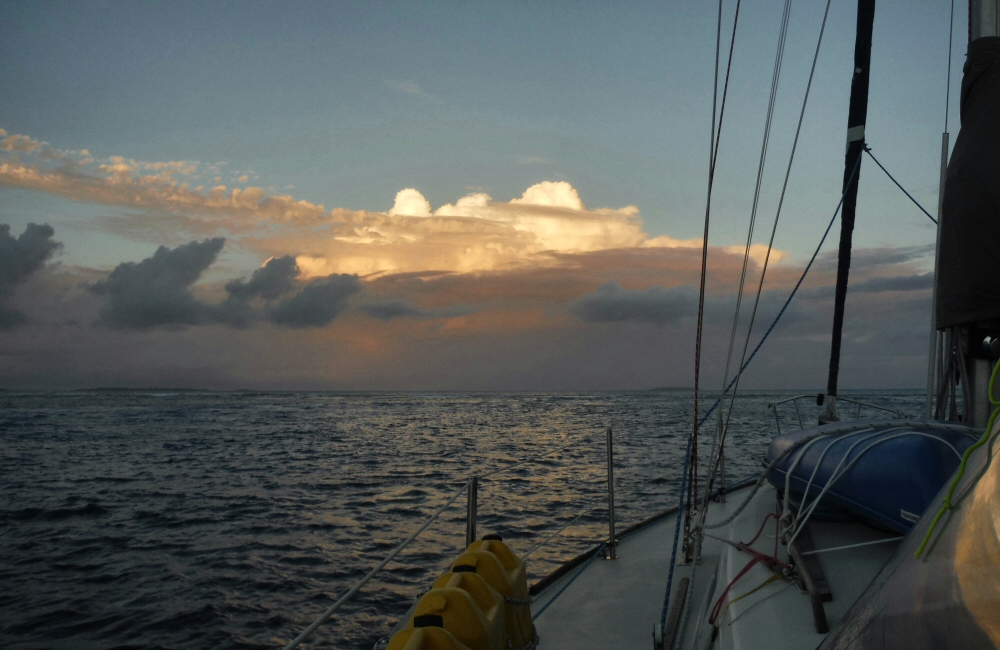
But here, the only way to arrive is by yacht or on the 3-monthly supply ship from Rarotonga. No tourists, no airstrip. It really is the middle of nowhere. We’re the second yacht to visit this year; the last was two months ago. Only 60 inhabitants on the island, all from the same family … but enough has been written about this strange place elsewhere so I’ll skip the history. Still no word back from anyone on land, and no sign of a boat coming to see us. My initial feelings of excitement were soon replaced by a distinct sense of being let down… I was expecting, from other sailors’ accounts, “boats rushing out to meet us and offer to host our crew … the last true Polynesian welcome”. Nope. Nada, not a peep. So we went to bed disappointed – admittedly under a stunning sunset, and I got to sleep outside most of the night without rain.
Next morning we eventually got through on the radio, and a small tin motorboat was soon on its way out to meet us. On board; a couple of smart chaps in lifejackets, the driver, and his son. The boat tied up alongside and the life-jacketed officials clambered on board; “smart” being a relative term; floral shirt, shorts and no shoes evidently being standard office wear here. While the boat was fumigated, we filled out some paperwork in the cockpit, handed over a few dollars, and all was done. Easy. Since the small-boat passages in the reef are dangerous, and the culture is that the local families host visitors, we don’t use our own dinghy. So we piled all our gear into the motor boat and charged towards the reef. The driver threw the small boat around the marker posts, over the waves in only inches of water, along a twisty channel surging with current – and then we were in the lagoon. He took us ashore to his compound, where his family will “host” us for the time we are here.
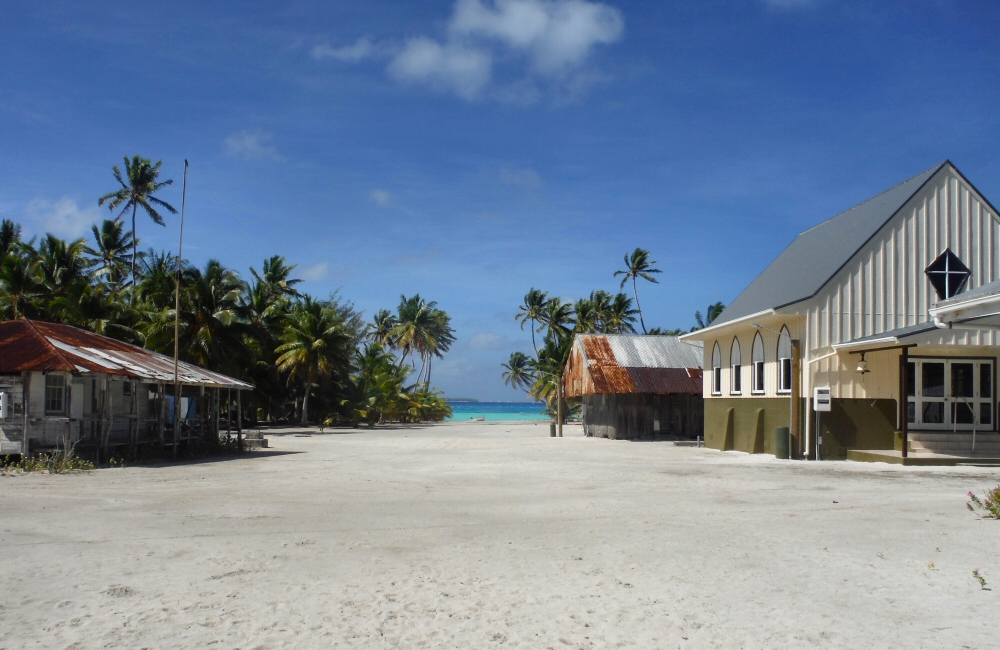
Walking ashore past the destroyed hulk of the yacht “Riri” that broke its mooring here a couple of years ago is a reminder that consequences of mistakes can be serious. I’d triple-looped the mooring line, and for extra safety left the anchor dangling a few metres above the sea floor; if the mooring went completely there was a chance that the hook would grab the coral before the yacht hit the reef. Pushing those thoughts to the back of my mind, I was introduced to the family. Everyone on the island speaks English – some with more pronounced accents than others. We spent a few hours with Danny and his family, chatting, having a short tour of the island, and him asking me how best to fibreglass one of his broken fishing boats.
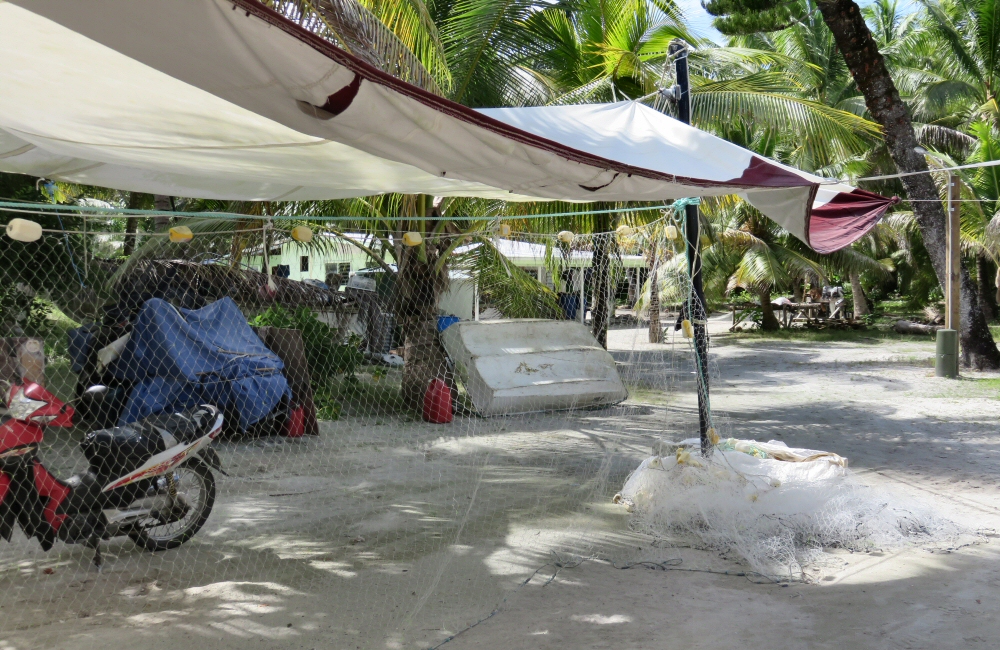
The three families here seem to live in perfect comfort- even though it’s so remote. A solar plant was installed a few months ago which gives everyone 24/7 power, and means they don’t have to run their diesel generators unless they want to fire up heavy loads like welding gear. They have telephones and an internet connection. Plenty of fresh water in large cisterns that fill with rain, which seems to be pretty regular. Lots of fish and coconuts. A clinic with trained nurses. A school with enthusiastic teachers. Anything they might be lacking would be from a materialistic western perspective – which of course influences the atoll in the form of TV, radio, internet and via the regular trips that some residents make to the other Cook Islands and New Zealand.
Ever since the early days of researching this voyage, I’ve been well aware that most of the South Pacific has been irreversibly changed by outside influences – the days of Thor Heyrdahl’s “Fatu Hiva” are long gone. Supply ships come to even the most remote islands; lunch was canned meat, mayonnaise and white bread from the freezer. Modern life is here to stay. Especially along the route we’re taking, the shortest line from Mexico to Australia.
Still, as one of the more remote places we’re stopping at, it would have been interesting to stay longer, and spend more time chatting with various people. The island administrator (in the floral shirt) was keen to see more craft activity, and culture preserved. But without a local economy, no cash on the island, a limited market, and not much incentive he’s finding it a challenge.
In some ways I felt that the hospitality was a little forced; it’s supposedly “part of the culture” for islanders to host visiting yachties, and in return accept “gifts” of spares, fuel, old sails, ropes. Maybe I’m being a bit cynical, but it didn’t seem that we were welcomed with open arms and wide smiles – and also 24 hours without acknowledgement. Something about that smelt a bit strange.
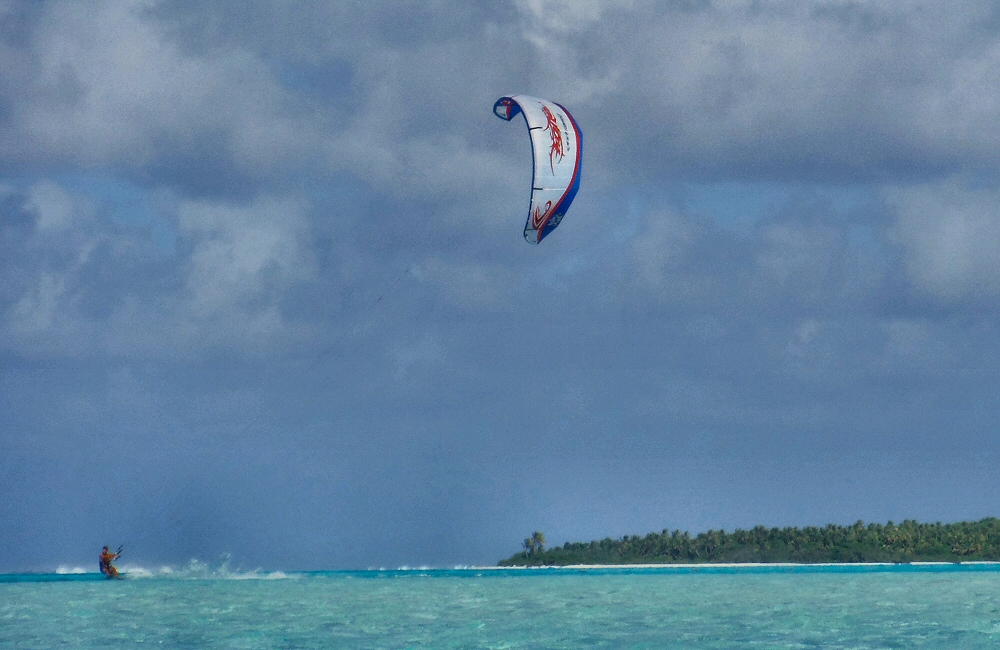
Anyway. It was blowing like stink so I’d taken my kite gear ashore and had an awesome session in the afternoon, navigating carefully around the shallow, sharp coral heads, and timing my jumps very precisely to make sure that take-off and landing zones were not going to leave me shredded and skinless if things went pear-shaped. An amazing place to kite – white sand beach, every shade of vibrant blue in the sea, warm wind, clear sky… would have been best with a buddy to kite with though. Next time!
That night on the boat wasn’t so pleasant. About 7pm the rain started, and the wind swung around to the north, nearly putting the reef dead downwind of us. As long as the wind didn’t shift round further, I was OK staying on the mooring. Had it backed more and put us up against a lee shore, on a mooring that may or may not have been checked in the last year, I would have definitely left, sharpish. As it was I was awake most of the night, keeping an eye on instruments – it was too dark, windy and rainy to tell exactly what was going on any other way. We had a few hours of gale force winds in the early hours and the swell from the north was wrapping around the island making the boat heave and roll horribly. Ugh. As dawn approached things calmed down a bit, the rain stopped and I dozed off in the cockpit. Eva woke me at about 8 with a hot cup of strong coffee – top lass.

We decided not to go ashore again; wind was still from the north and we felt we were ready to move on. Like all these places, you either skim through quickly and just get a taste of what they are like, or you stay for ages and really get into the community. We don’t have time for the latter, and the needs of the former are met usually within a day’s visit. It feels superficial – it is – but that’s the way we’re travelling this time. Danny and his gang brought back empty the diesel can I’d given him full the night before, my flip flops that I’d left under his porch, and a hard drive of movies I’d lent his son to copy. Then we were off! Westwards again – next stop either Niue or Beveridge reef, depending on how benevolent the wind and sea gods are feeling this week…


 Road and Ocean