Another day of driving – though not as much as we were doing when it was just the two of us, where we were regularly doing well over a hundred miles a day. Today, it’s about 90 miles from our camp to Bryce Canyon National Park, through the Grand Staircase Escalante National Monument.
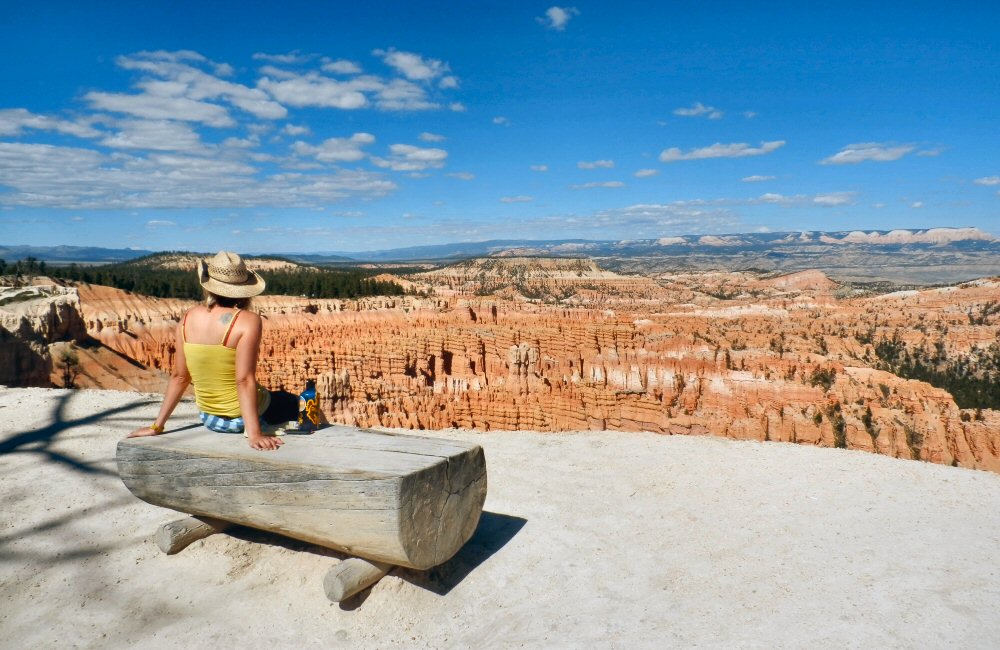
Arrived at Bryce in time to get a spot in one of the park first-come first-served campsites, and then walked the Rim Trail along the edge of the canyon. Bryce Canyon isn’t technically a canyon – it’s the edge of a plateau, where the underlying sandstone and mudstone is eroding away to leave an impressive vista of gullies, hoodoos and towers. As expected, even a couple of days before the weekend, it’s pretty busy. And so many Germans! It seems like 9 out of 10 parties are German, maybe their school holidays haven’t finished yet? Since we’ve not really been around much humanity, we find ourselves watching the people more than taking in the scenery.
For some reason I’m a little underwhelmed by Bryce Canyon. Maybe it’s because we’ve been immersed in such endless mind-blowing landscapes for so many days that I’ve reached saturation point. I remember driving past some pretty small hoodoos in Canada and being impressed. Now I wouldn’t give them a second glance – that’s the danger of new experiences and broadening horizons – it has the potential to reduce the impact of everything else…

Bryce is one of the “Dark Sky Parks” – far from any light or air pollution, so you can see more than you would be able to in other parts of the USA. I’m no stranger to dark skies – growing up in Africa and spending nights at sea – but I still gaze up into the huge, starry night filled with awe. I’m trying to learn more about the constellations, but, like other learning, unless you do it frequently, it’s easy to forget things. But this trip we’ve had clear, dark skies for many nights in a row, so I think some of it is sticking. Of course what you can see changes on the time of the year and time of the night, too. I learnt that Orion was a cocky old chap, boasting to the goddess Artemis that he could kill every beast on the earth. Artemis was a guardian of all creatures and took offence to this, so she sent a scorpion to kill Orion. You can never see them both in the sky at the same time – every winter Orion hunts in the sky, but he flees under the horizon each summer when Scorpio comes along. At the moment Scorpio is up, and the new moon is just setting with the sun, so the sky is dark and it’s full of stars.
The park runs an astronomy evening a couple of times a week and fortunately one was running this evening – starting with a talk given by a very enthusiastic ranger about how the night sky was interpreted by the Native Indians. The Great Bear (Big Dipper) is still a bear to the Mik-Mak Indians of north eastern Canada, but instead of the trailing stars being the bear’s tail, the bear is much smaller and the following stars are hunters; Robin, Chickadee and some other tag-alongs. The story goes on to say how the birds chase the bear around and around the sky as the night and seasons progress, and then when the bear finally drops below the horizon, Robin has wrestled it to the ground and is all covered in blood – hence the Robin’s red breast. I think the bloody murder happens in autumn, and it explains why the maple tree goes red at that time of year. That’s the quick version anyway.
After the presentation we all trooped out to a set of telescopes lined up in a dark parking lot behind the visitor centre, where we got a quick peek at Saturn, a globular cluster, a gas cloud and an exploding supernova. I’m looking forward to nights on the boat where the sky really is huge – a whole hemisphere where you can see stars rise and set without anything in the way.

 Road and Ocean